
Living by Making | Issue 16
At the Workbench
There is a moment in a live performance, in the space between the final note and the first sound of applause, when everything the orchestra played is still in the room. The musicians hold still. The conductor’s hands haven’t moved yet. The audience takes a breath. That interval, a second or two at most, is one of the strangest and most complete feelings I know. Everything that happened is finished and present at the same time.
I have been thinking about that interval a lot lately.
A life season has that quality when it ends well. The track season I just finished, my last as a coach and teacher after fourteen years, had everything a good season is supposed to have. It had its fortissimo passages, weeks where everything was loud and fast and the stakes felt enormous. It had its pianissimo ones, quiet practices in early spring, a few athletes and a starting block and nobody watching. There were weeks where the full ensemble sound was almost overwhelming, the gym, the infield at the state meet, the faces of kids I have watched grow up inside the sport. And there were single notes that separated themselves from all of that, clear and distinct, moments that lifted out of the rest and rang on their own. A quiet word after a hard race. A rival coach I have respected for a decade shaking my hand at the end of the meet. A kid crossing the finish line and looking immediately for me in the crowd.
Then it ended. And like the orchestra’s last note, the season was finished and present at the same time. There is the word I keep coming back to. Poignant. Not sad exactly. Not just bittersweet. Something more specific than either. Poignancy is what happens when something is beautiful and finished at the same moment, and you are present enough to feel both at once. It is the emotional register of a full season, fully inhabited, now complete.
That’s what I want to explore this week. What it actually means to be inside a season rather than documenting it. What gets pressed in and retained when you’re truly there for the ending.
Under the Surface
There is a tradition in art that takes impermanence as its premise rather than its problem. Ephemeral art is work made with the full knowledge that it will not last, and often with the intention that its disappearance is part of what it means.
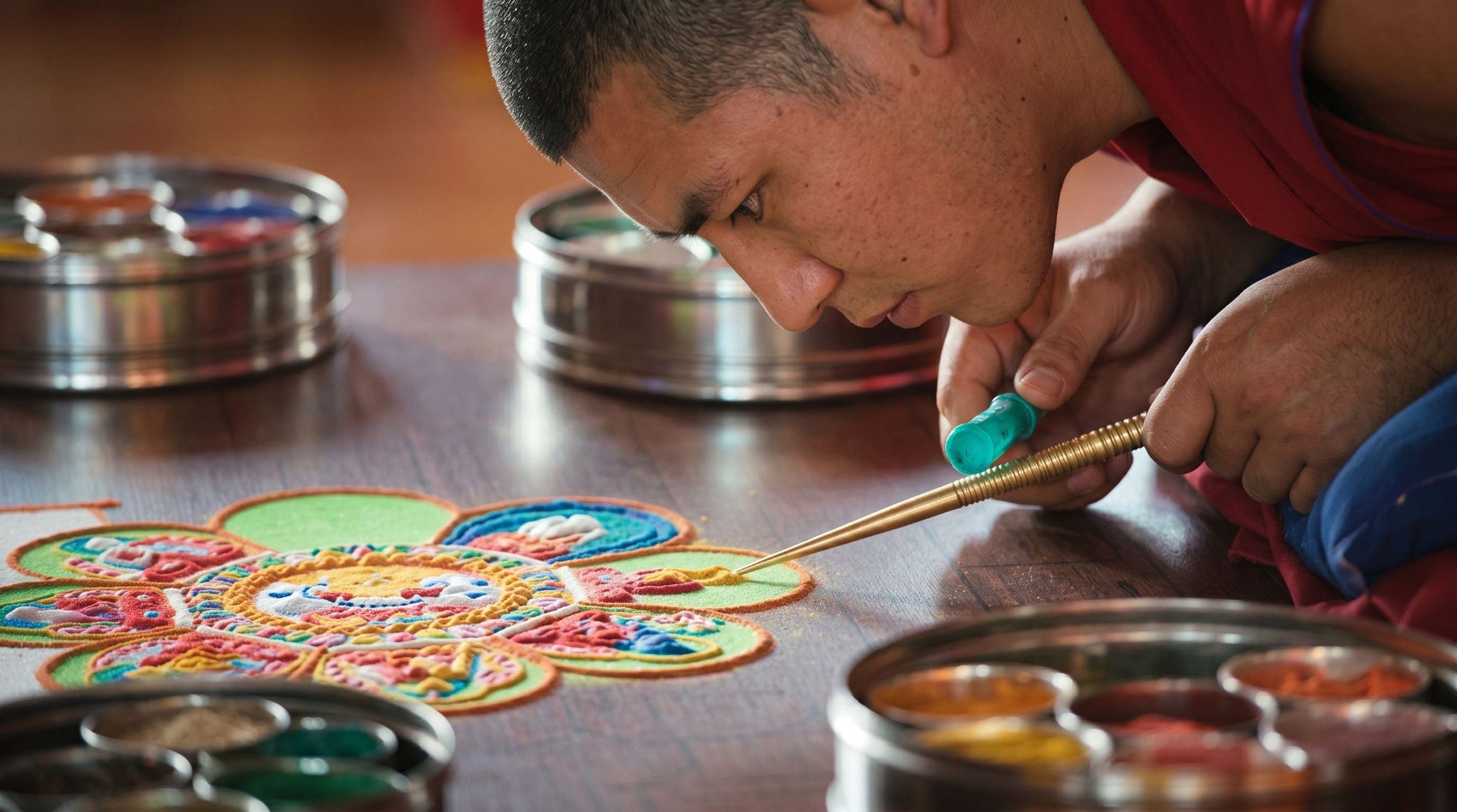
Tibetan Buddhist monks create sand mandalas over days, sometimes weeks, placing colored sand grain by grain in intricate geometric patterns that radiate outward from a center with the precision of sacred geometry. The name in Tibetan is dul-tson-kyil-khor, mandala of colored powders. The process itself is understood as a form of meditation, each grain placed in a state of focused devotion, the making inseparable from the spiritual work it is doing. When the mandala is complete, it is ceremonially destroyed. The sand is swept inward, the colors mixing together, then carried to flowing water and released into the current. The destruction is not a tragedy appended to the work. It is the completion of it. The impermanence was always the point.
Banksy built a shredder into the frame of Girl with Balloon before it ever went to auction. The moment the gavel came down, a remote trigger activated and the canvas ran itself through the mechanism hidden in the lower frame. Half-destroyed, half-intact, it was retitled Love is in the Bin and became something more resonant than it had been whole. The ending was planned before the beginning. The piece already knew how it would finish.
There are artists working in cities right now using superhydrophobic coatings on sidewalks and walls, images invisible in dry weather and fully revealed only when it rains. The work exists in potential until the conditions are right, and then it appears, clear and specific and briefly bright, and then the surface dries and it disappears again. Peregrine Church has been doing this in Seattle since around 2014, calling the project Rainworks. The activation event is rain. The art requires an event to become itself.
Andy Goldsworthy builds from whatever the landscape offers, ice, leaves, stacked stone, thorns. He works alone in remote places. The structures collapse, melt, dissolve back into what was there before, and he photographs them as they go. The quality of attention he brings to watching his own work fall apart is not grief. It is something closer to completion.
The Japanese have a name for this feeling. Mono no aware, sometimes translated as the pathos of things, is the bittersweet awareness that beauty is inseparable from impermanence. The scholar Motoori Norinaga articulated it in the eighteenth century, but it runs through Japanese aesthetics far older than that. The cherry blossom is the most familiar image. It is most beautiful, most fully itself, in the few days before it falls. The falling is not the end of the beauty. It is the fullness of it. Mono no aware is not sadness about impermanence. It is the recognition that impermanence is precisely what makes something beautiful enough to feel.
I think about all of this when I think about seasons. A season of life is its own kind of ephemeral art. It has a score and it plays all the way through, highs and lows and tempo changes, the full ensemble sound and the occasional single note that lifts free of everything else. And then it ends. The question is whether you were present enough to hear the whole thing, or whether you were backstage taking photographs of the musicians.
There is a principle in psychology called the peak-end rule, developed by Daniel Kahneman through research on how we actually remember experience. We do not remember experiences as averages. We remember by the emotional peak and by how the experience ended. The ending is where memory consolidates. What this means for any maker is that the ending of a significant season is not a footnote. It is the experience, looked back on. How fully you inhabit the ending determines how deep the groove goes.
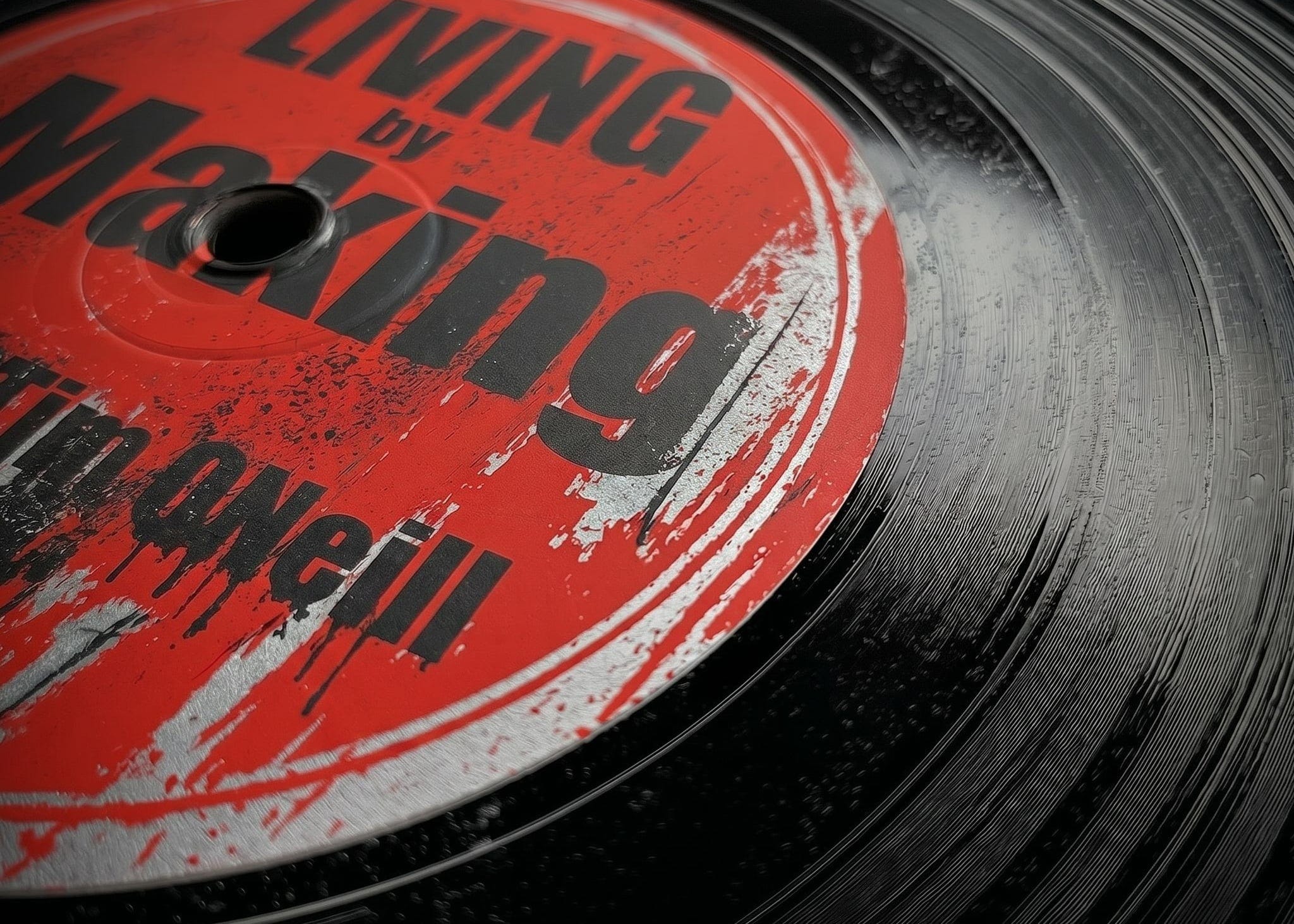
I have been thinking of seasons as LP records. The grooves pressed into the vinyl are what make it playable. A season fully inhabited presses its grooves, the music is in there now, permanent, retrievable. You can put the needle down years from now and hear the whole thing again. A season you documented but didn’t fully inhabit is something different. Present on a screen but not quite yours in the body.
Studio Notes
The resonance and the dissonance are not competing feelings. They are the same talisman, front and back. The joy of the meet and the ache of it being the last one do not cancel each other out. They are one experience with two surfaces, and you only get to feel both if you were present enough to be touched by it.
I did not take a single photograph at state track. Not one frame in two days. This is strange for me in a way that’s hard to overstate. I photograph gravel. I photograph the way afternoon light cuts across a concrete step. On any trip I take, the phone is out inside the first hour. But at the meet the camera bag stayed in the van and the phone stayed in my pocket and I did not miss it once. I understood on the drive home that I had been too fully inside the season to step outside of it. The instinct to frame and document simply did not fire.
I suspect to the athletes and parents around me it may have looked like I was somewhere else entirely, quiet, inward, not my usual self. And maybe that’s right. There is a cost to full presence inside a significant ending, and one of them is that you become briefly unavailable in the ordinary social sense. The monks building the mandala are not available for conversation either. I have made my peace with that. The question of whether I was there for the people I love is answered differently than the question of whether I was available to them. I was there. I was just inside the music.
I wonder how many of us move through the endings of our creative seasons in document-and-move-on mode. A project finished, a class taught, a series closed, a medium set down for reasons we can’t fully name yet. The instinct is to photograph it and post it, which is not wrong, but there is a cost. Documentation creates distance at the precise moment when closeness is what makes the groove. You step outside the season to preserve it and in doing so you can miss the pressing.
The sand mandala monks do not photograph the mandala while they’re making it. They make it. The photograph comes at the end, and then the sand goes into the river. They know the difference between what is for keeping and what is for showing. That distinction is worth carrying into your own studio.
On the Table
This week’s practice: name a season that is ending, or has recently ended. Not a finished project. A real season, a period of making that had a shape to it, a distinct before and after. Write down, not for anyone else, what the groove contains. What the needle would find if you put it down in ten years. Not what the photographs show. What was actually happening inside you while it was happening.
If you can’t name a season that has ended recently, that is worth paying attention to. Some of us are practiced at beginnings and not practiced at endings. Some of us move so quickly from one season to the next that nothing gets time to press into the grooves of the LP. The grooves require a moment of full weight, the surface softened just enough by presence to receive the music. That is not a passive thing. It is a choice, made in the middle of everything, to stay inside what is happening rather than stepping back to frame it.
If a specific season came to mind while you read this, I would genuinely like to hear what it was. Hit reply or click Message button below.
In Good Company
Rivers and Tides (2001), Thomas Riedelsheimer’s documentary about Andy Goldsworthy, is one of the most honest films I know about making things that don’t last. Goldsworthy builds in remote landscapes from whatever is present, ice, leaves, stone, thorns, and he talks about the work with a kind of practical reverence that is very hard to fake. The structures collapse. He photographs them. Then he starts another. It is a quiet two hours that will do something to your relationship with impermanence if you let it.
Unhurried Letters is a physical subscription built around the idea that some things are worth slowing down for. Handwritten travel stories, a fine art print, a recipe card, postcards that arrive when you’re not expecting them. Each issue is its own temporal object, made with care, sent once, received once, kept or passed on. You can learn more at unhurriedletters.com.
A Quiet Note
Not much to add this week beyond the letter itself. If a season came to mind that you moved past too quickly, or one you are right now inside of, I would be glad to know about it. Just hit reply. I read everything.
Leave the Light On
The bittersweet feeling at the end of a real season is not a problem to manage around. It is a signal that something was real. You cannot feel that particular resonance, the ache-and-warmth together, both surfaces of the coin at the same moment, if you were not truly there. The temporal art does not last. The sand goes into the river. The sidewalk dries and the image disappears. The canvas shreds. None of that undoes what it was while it was happening. None of that pulls the needle out of the groove.
Some seasons are for keeping. Not for showing.
One-Click Check-In
If you want to read this later or find other issues, you can find them here or hit subscribe.
Reference
Kahneman, Peak-End Rule: The original paper is Kahneman, D., Fredrickson, B. L., Schreiber, C. A., & Redelmeier, D. A. (1993). “When More Pain Is Preferred to Less: Adding a Better End.” Psychological Science, 4(6), 401–405. https://journals.sagepub.com/doi/10.1111/j.1467-9280.1993.tb00590.x
If you’d prefer something more accessible than a journal article, his TED talk “The Riddle of Experience vs. Memory” covers the same ground in plain language: https://www.ted.com/talks/daniel_kahneman_the_riddle_of_experience_vs_memory
The TED talk is the better read unless you love the style and format of white papers from an educator or science point of view.
Sand Mandalas: Minneapolis Institute of Art: https://new.artsmia.org/hub/programming-events/tibetan-sand-mandala-history
World History Encyclopedia: https://www.worldhistory.org/article/1052/tibetan-sand-mandalas/
PBS, Collective Healing Sands: https://www.pbs.org/video/klru-collective-healing-sands-sand-mandala-project/