
Living by Making | Issue 17
At the Workbench
Jim was filling his 95 Ford at the pump in Bird City, Kansas when I pulled in for fuel. Two different people walked up to him mid-sentence and started talking, the easy way people do in small towns where everyone already knows the story. Did Jerry get the bearings repacked? How is Amy doing this afternoon? He asked where I was headed. I told him Limon, Colorado. He gave me directions without hesitation, the kind that come from knowing every road by memory rather than a screen. I told him I needed a paper map rather than a gps on my phone. He chuckled knowingly and replied something about us growing up with paper. Turn west at Wheeler, unincorporated ghost town, takes you straight to Goodland, hop on I-70, you’re in.
I asked about food. He didn’t quite roll his eyes but there was a glint there, something amused. He thumbed over his shoulder. Best Mexican restaurant in the state, he said, right there. He was not wrong. Chicken burrito at Los Jarochos, Bird City, Kansas, middle of nowhere, genuinely one of the better meals I’ve had in recent memory. I sat eating slowly taking in the pace, the place and the moment before getting back in the truck. The sky to the west had gone a particular shade of gray that I’ve learned to pay attention to. The day had already been more than I planned for, and it wasn’t close to finished.
Under the Surface
I’d left home that morning chasing a Tarpon 105 kayak in excellent condition at a good price, four hours south and west. The kind of find that makes you rearrange a Monday. I had seven missed calls by the time I cleared Nebraska. My youngest son is neurodivergent and lives in a supported situation in a city four hours from me. He had escalated during the morning, something about his living arrangement, and by the time I was deep into Kansas backroads with a dying phone and no charger, the calls were stacking up. His caseworker. A police officer who had eyes on him but couldn’t file a missing persons report because technically he wasn’t missing. His mother, upset, calling from her end of the situation. Noah himself, not picking up for me. The thing about a crisis at distance is that you are doing something with your hands, in this case driving through a patchwork of section roads across the Kansas high plains, while your mind is somewhere else entirely. You stay functional. You keep moving. There isn’t much else available to you.
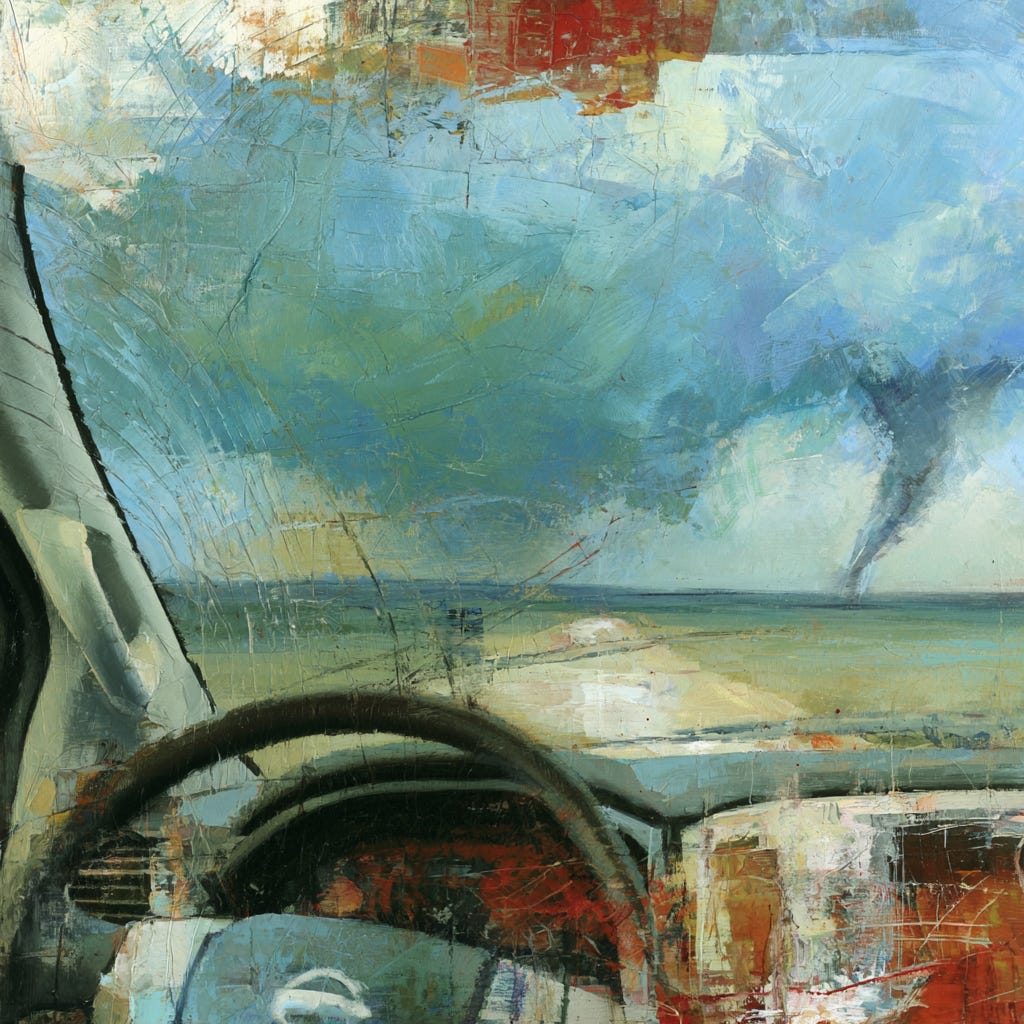
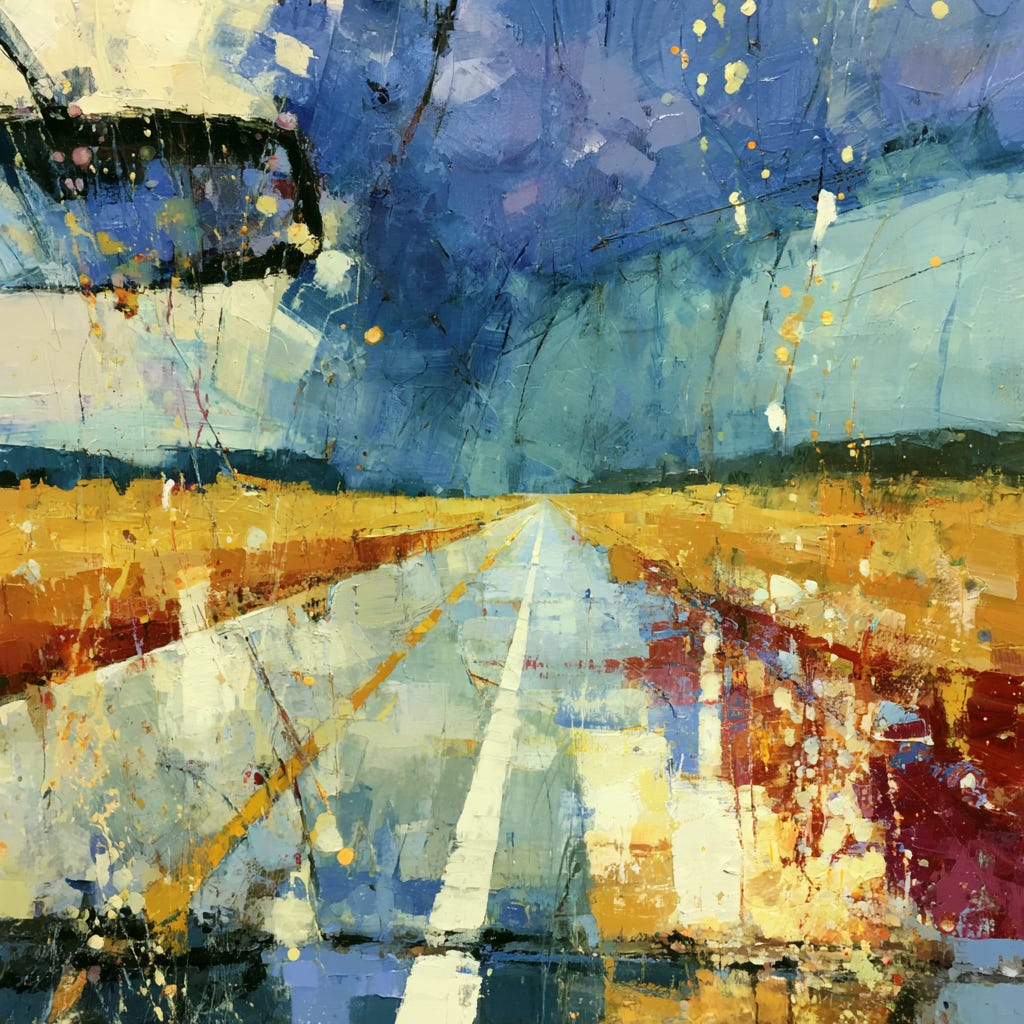
I picked up the kayak in Limon in under fifteen minutes, loaded it, strapped it down, and pointed the truck east toward home. The sky had gone green by then, the particular green that means business. Small hail started coming down and building up on the road. My phone, down to almost nothing, showed me on the doppler that I was skirting the edge of something serious if I stayed straight. Staying straight seemed like the right call.
I noticed the section roads when I got past Last Chance, which is an actual town and whose name felt fitting given the afternoon I’d had. A half dozen cars on the road to the left. More on the right. Not regular cars. Storm chasers, geared and waiting. A two-ton truck with a full doppler array on top came up fast behind me and flew past, followed by several more. By the time a tornado touched down in the field to my left I had chasers in front, chasers behind, and chasers running parallel on both sides.
Another one touched down to my right, maybe a quarter mile ahead.
I slowed. Thought about it. The chasers in front of me turned east at the next section road, which meant they were moving toward it, which meant if I kept going straight, I was moving away from it. I kept going straight. The hail stopped somewhere past Woodrow, Colorado. By Brush it was just rain. By the interstate it was clearing. I drove home elevated, exhausted, and holding a low-grade sadness about my son that wouldn’t resolve itself until late that night when the hospital finally got involved and he was somewhere safe.
A typical day. All is good.
Studio Notes
I have been trying to figure out what to call the thing that makes a person drive four hours into an uncertain sky to pick up a kayak on a day when everything else is already complicated. It is not recklessness exactly. It’s not even optimism, though there’s some of that. It’s more like an orientation. A persistent leaning toward rather than away.
I built a digital painting magazine years ago and made a living from it before I walked away to teach. Now I’m building again, writing every week, making things, putting them into the world. The list is small. The growth is slow. Some weeks the echo comes back and some weeks it doesn’t. I’ve had people ask me, in various ways, why I keep going at it. The honest answer is that I don’t know how not to. The same pull that sent me south on a Monday morning toward a kayak I didn’t strictly need is the same pull that has me at this desk every week writing something I hope finds the people who need it.
You probably have a version of this. Some direction you keep moving in regardless of what the day throws at you. Not because the logistics are cooperating. Not because the evidence is overwhelming. Just because the thing is there and you are the kind of person who moves toward things. That’s worth something, I think. More than the subscriber count, more than the sales numbers, more than whether the sky is green or clear when you pull out of the driveway.
The Tarpon 105 is in the garage. I’m going to build a trailer for it the next few weeks. I already have a guy in McCook who sold me a boat trailer and a pile of unistrut for a hundred and twenty-five dollars, which also gave me the justification I needed for the welder I’ve been stalking for over a year. One thing leads to the next. It usually does, when you let it.
On the Table
What is the thing you keep moving toward, even when the day is fully on fire?
Not the goal exactly. The orientation. The direction you’re pointed when everything else falls away. If you know what it is, I’d genuinely like to hear. Hit reply.
A Quiet Note
Unhurried Letters goes out once a month. Handwritten stories, a fine art print, a recipe card, a postcard, all in an actual envelope. No algorithm deciding who sees it. Just the thing itself, made with some care, sent to the people who wanted it.
If that sounds like your kind of thing, you can learn more at unhurriedletters.com.
Leave the Light On
My son is okay. Not resolved, not easy, but okay. That’s usually the best available outcome on the hard days and I’ve learned to take it. The storm moved east. The kayak is home. The new welder is at the top of the order sheet.
Whatever you’re moving toward this week, I hope you find a Jim at the pump in Bird City who points you in the right direction. And I hope the Mexican food is as good as advertised.
Keep making.
Tio
Daily life is an awesome adventure!
One-Click Check-In
If you want to read this later or find other issues, you can find them here or hit subscribe.
Reference
Kahneman, Peak-End Rule: The original paper is Kahneman, D., Fredrickson, B. L., Schreiber, C. A., & Redelmeier, D. A. (1993). “When More Pain Is Preferred to Less: Adding a Better End.” Psychological Science, 4(6), 401–405. https://journals.sagepub.com/doi/10.1111/j.1467-9280.1993.tb00590.x
If you’d prefer something more accessible than a journal article, his TED talk “The Riddle of Experience vs. Memory” covers the same ground in plain language: https://www.ted.com/talks/daniel_kahneman_the_riddle_of_experience_vs_memory
The TED talk is the better read unless you love the style and format of white papers from an educator or science point of view.
Sand Mandalas: Minneapolis Institute of Art: https://new.artsmia.org/hub/programming-events/tibetan-sand-mandala-history
World History Encyclopedia: https://www.worldhistory.org/article/1052/tibetan-sand-mandalas/
PBS, Collective Healing Sands: https://www.pbs.org/video/klru-collective-healing-sands-sand-mandala-project/