
Living by Making | Issue 26
This week was a struggle in terms of writing. My journal this week is full of fun stuff. Sensory, some emotion as well. I was having difficulty weaving all of that into a cohesive piece that was not, well…boring. Not sure that I overcame boring but I have come to realize that writing, like art, may not always please me. There are some pieces of my art that get sanded and painted over. Some get cut up and used for other things and yet some others just end up in the bin. So with that I did have some fun visualizing the words from the page marching off to the garbage disposal. Easy for someone dyslexic to see, not far from a normal day of marching, dancing words. Anyway, the whole process of writing this week was instructional for me, so there is that. Not my favorite but created in the slow way of making that I love. For me, as always, it is about process way more that product.
At the Workbench
A man named Mack Ross found me on the sidewalk in Sheridan, Wyoming, not long after I mailed a stack of Unhurried Letters at the post office before the shops even opened. He was in his seventies, born and raised there, forty years and something like four million miles behind the wheel of a truck before the neuropathy in his hands and feet caught up with him. He did not shake my hand when we met. He pointed me toward King’s Saddlery instead and sped off in his electric wheelchair, and that is how I ended up standing just inside the door of a museum that Don King spent most of his life filling.
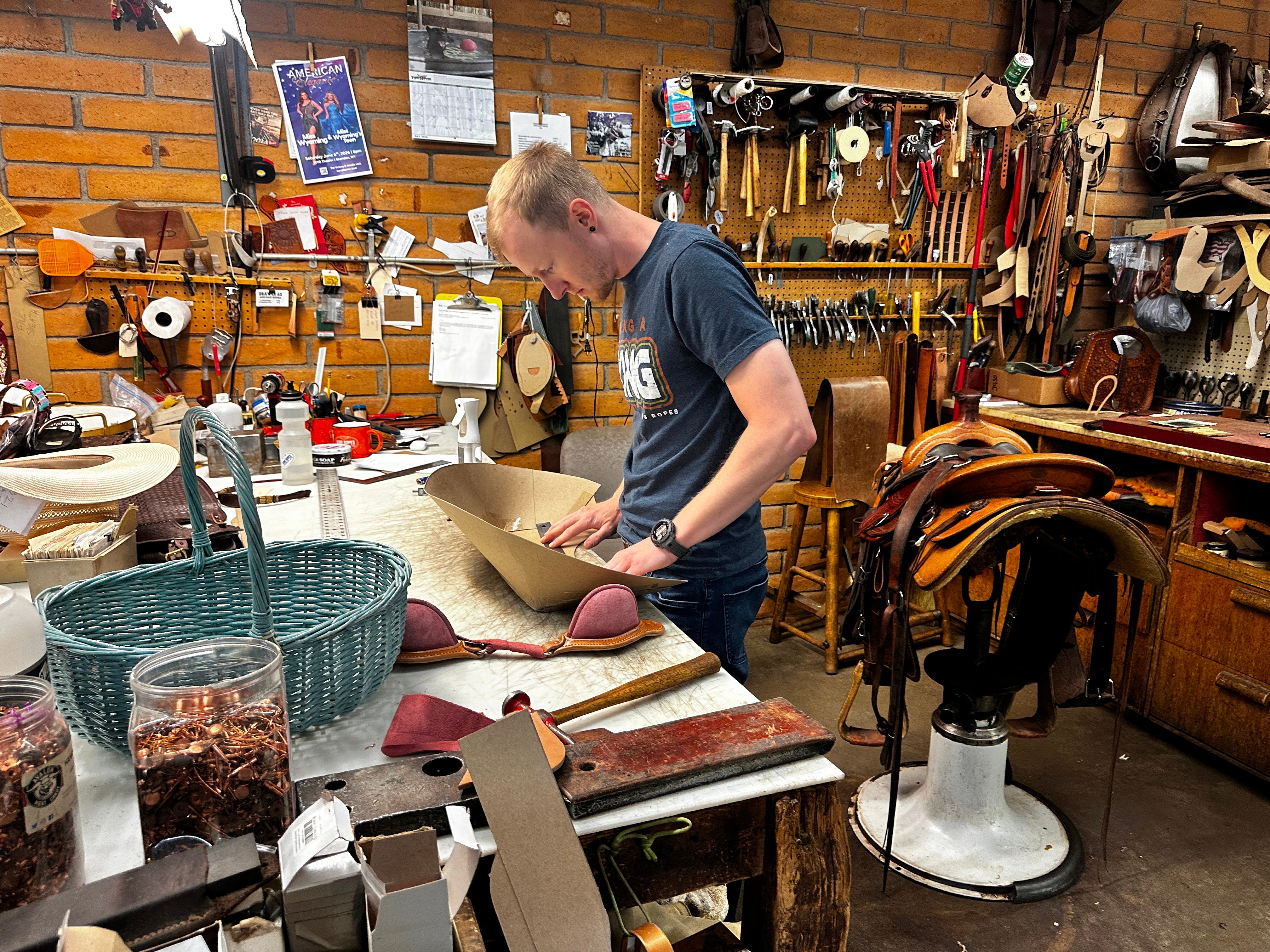
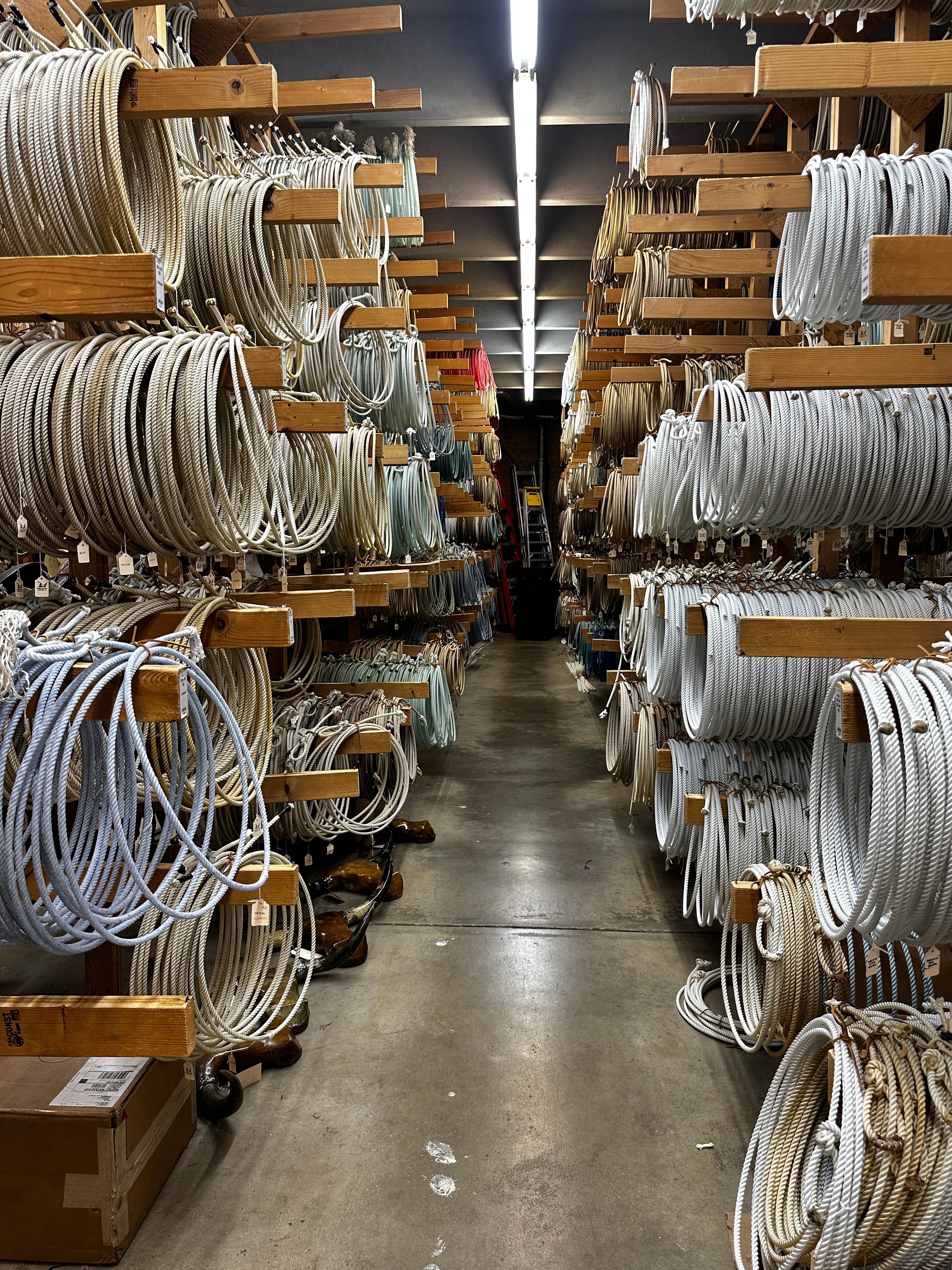
Leather. Saddle soap. Something earthy and musky underneath both that I could not place, the good kind of underground smell, not a basement, not a cave. Past the saddles and the rope racks was a workroom, ten or so craftsmen and women at long tables, hands moving over rope stock and half finished saddles. Nobody asked me to leave. They let me hang back and watch. I had nothing on me but my phone, no real camera, no proper lens. I stood there taking pictures with it anyway, of hands that had put more years into that one bench than most of what I have ever made.
Under the Surface
An older woman two tables over was coiling rope with a rhythm that never broke stride, feeding slack through her palm without once looking down at her hands. Across from her a younger guy worked an awl through a saddle skirt, the leather squeaking faintly with each pass, a transistor radio somewhere behind him playing low enough that I only caught it between the other sounds. Nobody looked up when I raised my phone. I noticed the regret almost right away, the feeling every photographer knows, standing in exactly the right light with the wrong tool in your hand.
But underneath that regret was something else I did not expect. I was not there to make anything. Nobody was waiting on a finished piece. There was no deadline, no client, no version of the day where I walked out with a photograph worth framing. Presence has been a goal of mine for a while now, a more intense, fully present mindset I have been trying to cultivate, and for a few minutes in that workroom I managed it. The phone in my pocket was not a limitation. It was the only tool the moment actually called for.
That is rarer for me than I would like to admit. Most of what I take in gets turned into something before I have even finished looking at it. A texture becomes a reference. A face becomes a study. I have built an entire working life on that reflex, and it has served me well. But watching that woman feed rope through her hand without looking, watching that awl catch the light on every third pass, I was not translating anything. I was just present for it.
Studio Notes
Watching those ten hands work, I felt something closer to respect than temptation. I do not have what it takes to give forty years to one craft the way Don King did, the patience, the willingness to let a single skill get slowly and completely mastered while everything else waits its turn. That is its own kind of discipline, one I have never had, and standing in that room I did not think less of myself for lacking it. I just make differently. My own bench is crowded on purpose, encaustic next to a half-finished manuscript next to a jar of something fermenting I probably forgot about, and watching those ten craftspeople did not make me wish for their path. It made me admire it, the way you admire a language you were never going to learn.
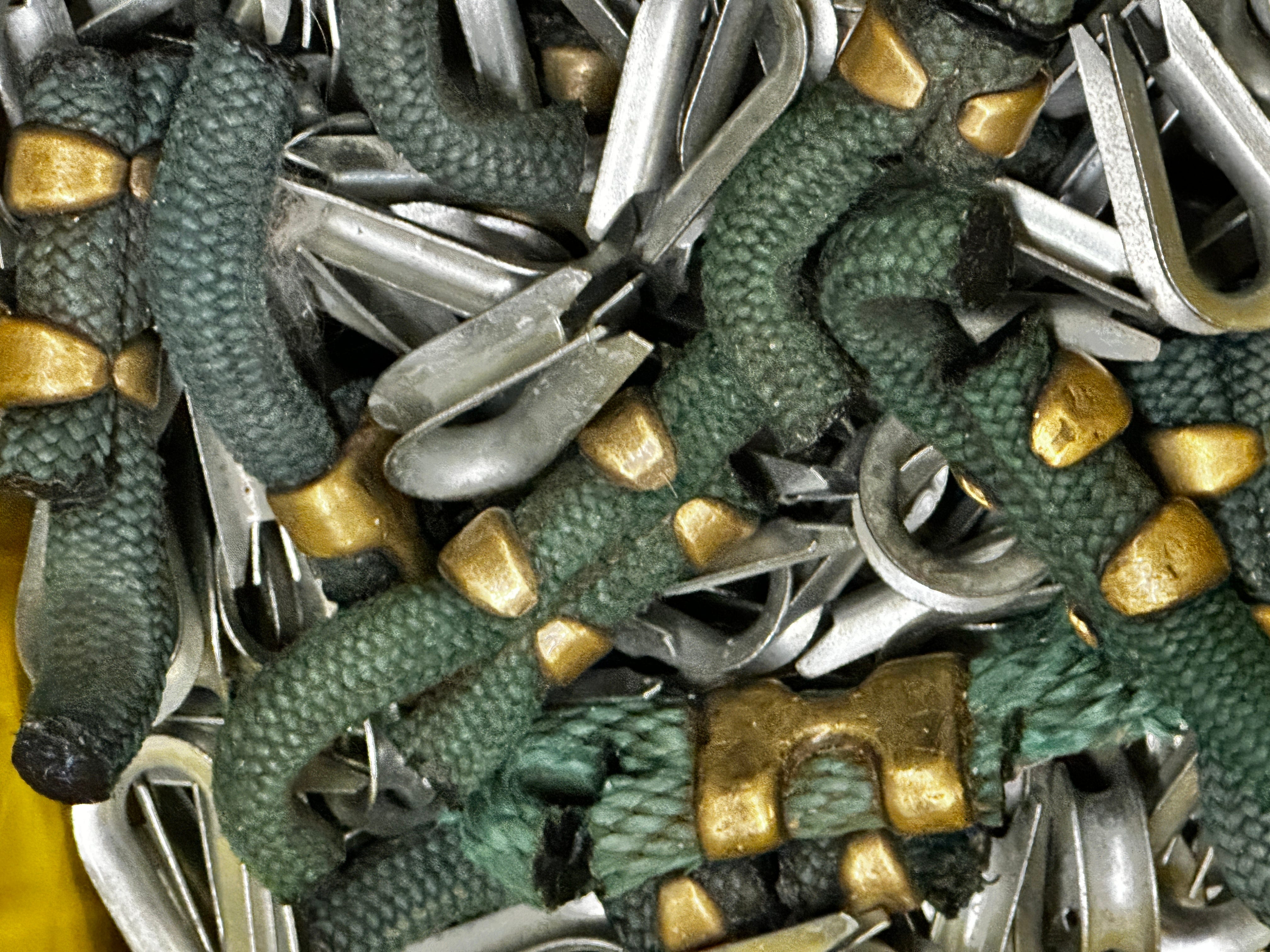
I came home with a phone full of ropes and worn wood floors and a million texture and pattern shots like normal, and a list of ideas that has only gotten longer since. Tiles glazed with alcohol ink. A whitewashed paper bag, stamped and reused. A whole run of Eco printed scarves. A splatter piece made with a pickleball instead of a brush, because a magazine at the gallery had an article about a man who paints with a fly rod, and my brain took off after it in about four seconds flat. None of that came from the workroom itself. It came from the part of me that never quite stops gathering, even when it is standing still.
On the Table
One fact from the museum has stayed with me. In 1991 the National Endowment for the Arts recognized Don King as an artist, the same year it recognized B.B. King, a saddle maker and a blues guitarist named in the same breath by the same institution. Two very different kinds of a life’s work, both called art by the same people, and I do not think that is a coincidence worth smoothing over. We need people willing to go all the way to the bottom of one thing until they hit something the rest of us can only borrow from a distance. We also need people who keep moving, gathering unlikely connections a specialist would have no reason to go looking for. Neither one is the fallback position for people who could not manage the other. They are just different instruments, and a civilization needs both kinds of hands in it.
In Good Company
Watch: The Saddle Maker, a full episode of PBS’s A Craftsman’s Legacy. Host Eric Gorges visits saddle makers Charon and Tom Caldwell at their ranch and learns how a saddle actually comes together, tree, ground seat, tooling, and all. Twenty some minutes, free on YouTube, and about as close as you can get to standing in that workroom again without the drive back to Sheridan.
Read: King of the Western Saddle: The Sheridan Saddle and the Art of Don King by Timothy H. Evans. A folklorist’s look at how King’s Sheridan style, the wild rose motif stamped into leather across half the trophy saddles in the country, turned a working tool into a collected art form. Mostly out of print these days, so a used bookstore is probably a better bet than Amazon on this one.
Listen: The Smell of Memory, an episode of Simon Sinek’s A Bit of Optimism with scent designer Dawn Goldworm, about how smell ties into memory harder than any other sense we have. I thought about it the moment I stepped through King’s front door and the leather registered before anything else did.
The Boy Who Rode Away-I wrote the lyrics from my journal notes and substack story. Suno produced the song.
A Quiet Note
Those letters I mailed before the shops opened that morning are built on the same instinct as everything in that museum, something made slower than it needs to be, sent out anyway because slow is the whole point. A travel story, a fine art print, a recipe card, a postcard, arriving by mail instead of a notification. If that is the kind of pace you are after, you can find it at unhurriedletters.com.
Leave the Light On
You do not have to make something out of everything you witness. Some rooms just want your attention, not your reflex to turn them into work. The next time you find yourself standing close to somebody else’s craft, watching hands that know exactly what they are doing, let yourself just watch. You will probably reach for your phone anyway. That is fine. The tool was never really the point. Being there was.
Keep making, keep growing, be you.
Tio
“For the entire earth is but a point, and the place of your own habitation but a minute corner in it.” -Marcus Aurelius
References
The Saddle Maker, A Craftsman’s Legacy, full episode:
This May, Leathercraft Takes Center Stage in Wyoming, American Craft Council: https://craftcouncil.org/articles/this-may-leathercraft-takes-center-stage-in-wyoming/
King of the Western Saddle: The Sheridan Saddle and the Art of Don King by Timothy H. Evans: https://www.walmart.com/ip/5350558463
A Bit of Optimism, “The Smell of Memory with scent designer Dawn Goldworm”:
King’s Saddlery and the Don King Museum, background: https://www.sheridanwyoming.org/explore-kings-ropes-and-saddlery/ and https://kingropes.com/about-us/museum/
One-Click Check-In
If you want to read this later or find other issues, you can find them here or hit subscribe.