
Living by Making | Issue 24
At the Workbench
I have been hanging out in my daughter’s old room this week, I do not think I am the only parent who does it. You walk in with no real reason to be there and let the room just work on you, and something about standing still in it triggers this rush of memory that feels almost chemical, like your brain rewards you just for showing up. Her room is decorated in soft neutrals, cozy, exactly the way she likes things. On the corner of her desk there is a box with a stuffed pyredoodle in it that looks uncannily like our family dog, its head sticking up over the cardboard edge like it is waiting on an answer to some question nobody asked out loud.
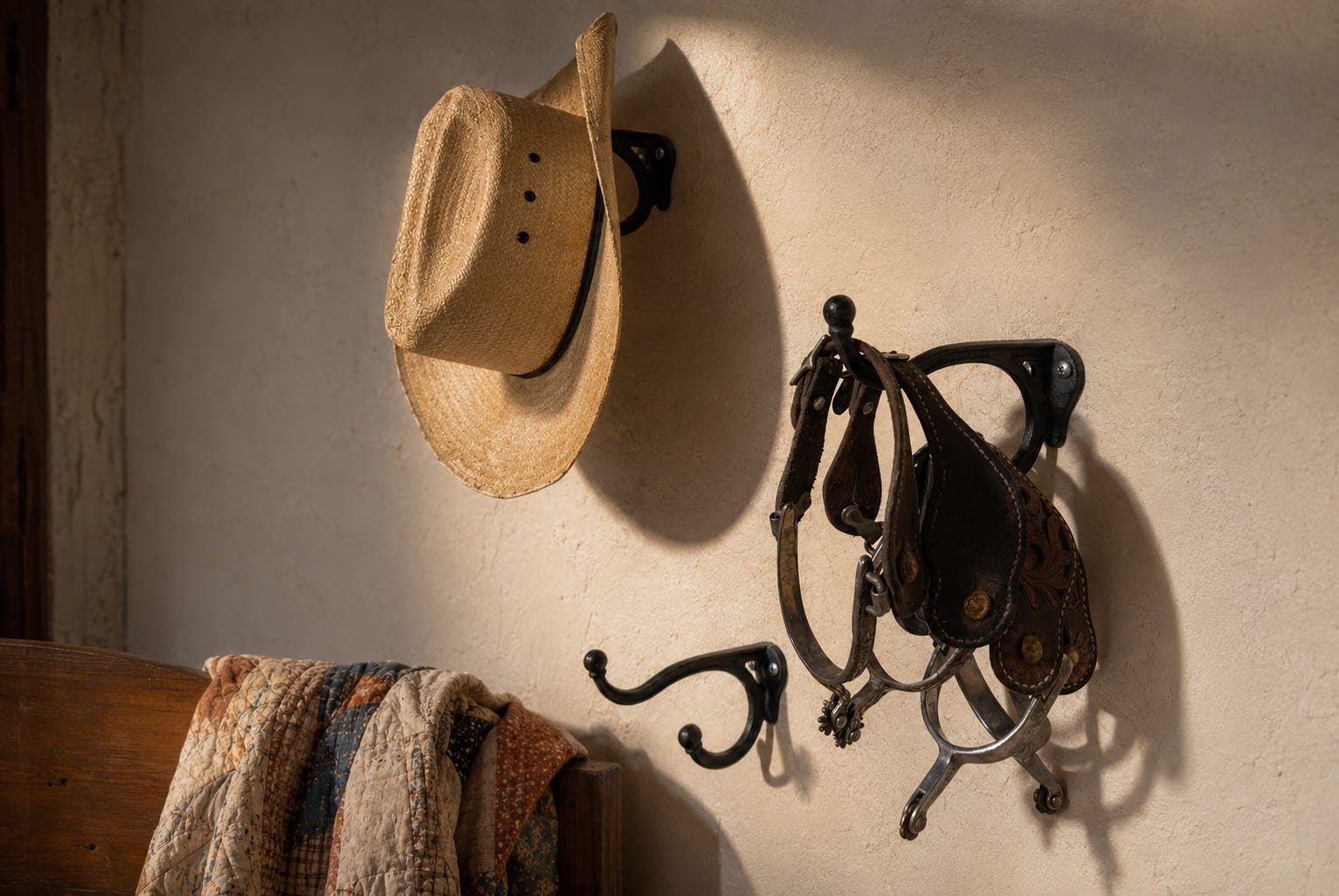
On her bed is a quilt her grandmother stitched by hand, one of several she owns, one her mom collaborated on, one from a different grandmother, one from my own grandmother, four generations of women’s hands under one roof. The walls are covered in things I made for her or she picked up somewhere over the years: a mixed-media piece with her boots painted and a verse from Second Corinthians about walking by faith and not by sight, a ceramic piece shaped like four horses seen from behind, a poster from her national dance team’s fire-themed competition season, an abstract portrait I painted of her a few years back. Below a hook holding two pairs of spurs, one worn plain and utilitarian, one fancier for competition, and a straw cowboy hat gone the particular dirty gold of real sun and real sweat.
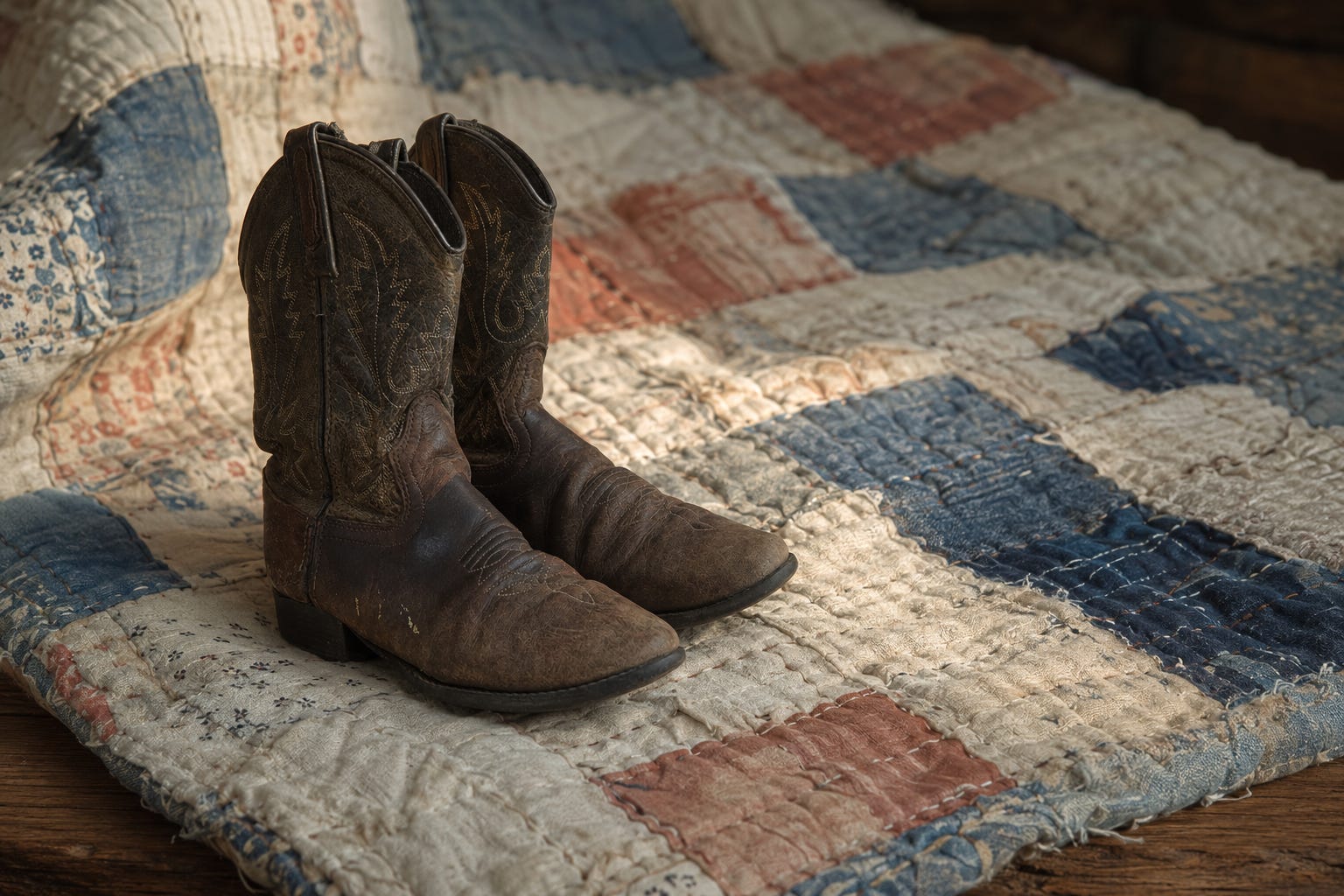
There is a stand she built herself, at home in my woodshop, out of the same salvaged lumber I have written about that I used for the base of the table I built her as a wedding gift. On that stand sit the boots she wore at nine, her first real pair, tiny spurs still attached. Everything else in that room is a museum of what she became. That pair of boots is the only thing in it that remembers how she started.
Under the Surface
Those boots are older than the barter I struck at a trail-riding outfit up the road, older than the nine years of stable work that came after it, and looking at them this week I finally understood something about our house I had never quite named before. Quilts are a thing in our family. Not decoration, an actual practice, generation after generation of women sewing scraps of used fabric into something whole enough to keep a person warm for decades. I am surprised that I have not learned to quilt.
Her own room has one from her mother, from her grandmothers, from my grandmother, each one carrying the literal cloth of an earlier life stitched into the one being lived now. I do not think I understood, until I stood in that room this week, that my wife and I had been doing the same thing without a needle or thread, one stable shift at a time, one dance recital at a time, one small decision after another, none of them looking like much on their own, sewn together into something that turned out to be just as load-bearing as any quilt on that bed.
She went from mucking stalls for lessons to a trail boss, to a barrel racer, to someone who could drive a whole team. She went from dance lessons a few nights a week at four years old to a scholarship, to a national qualifying dance team, to a teaching degree, to a classroom of her own where she is starting a dance team out of her own kids now. None of it looked connected while it was happening. You do not get to see the pattern from inside the loom, you only feel the individual threads, and it is only now, looking at a boot not much longer than my hand, that the whole quilt is visible at once.
Studio Notes
I keep trying to name what I actually feel this week and none of the easy words fit. It is not really sadness. We have reached for that word plenty the last few issues and I am tired of grabbing it out of habit when it is not even the true one. It is closer to a strange, over-the-moon excitement for her, tempered by something smaller and quieter underneath it, a thread of melancholy that mostly shows up when I am standing still in an empty bedroom. On the surface I am calm about all of it. Underneath, it is more like a duck paddling, still and composed up top, feet going in every direction down where nobody can see them working.
My oldest son came home this week to see her off, which meant a rare night with two of my kids at the table again. He and I think alike, which is not always a compliment to hand a kid. He chases a question down every rabbit hole it opens, curious to a fault, restless in the same neurodivergent way I am, and I have come to see that as a gift, though it took years and a fair amount of difficulty to get there, more on the dyslexia side than the ADD.
He already helps me with more of my own systems than I probably admit out loud, and he has offered to take over the rest more than once. I should let him. He does not have the hours though, not with a training schedule eating forty-plus a week on the road to the next Paralympic cycle, so the offer just sits there, held onto, unused. Her table is done now too, cut from the same salvaged lumber as the little stand in her old room, built out of bleacher wood from the gym she grew up watching games in. It will end up in a house in Montana I have so far only seen in photographs, holding up a life none of us built for her, just the tools she used to go build it herself.
On the Table
I went looking this week for whatever explains why none of this made sense at the time and all of it makes sense now, and found a term psychologists use called narrative identity. The short version: we do not live according to a plan and narrate it afterward, we just act, mostly without a plan, one decision at a time, a stable shift here, a dance recital there, a quilt square sewn on some ordinary Tuesday, and only much later does a person look back and stitch the decisions into something that resembles intention. Dan McAdams has built a career on this idea, how people turn the raw material of a life into a story that feels like it made sense the whole time. I do not think it did, not while it was happening. I think it just piled up, one square at a time, until one day you stand in a bedroom and there is finally enough of it finished to see.
In Good Company
Watch: The Quilting Women of Gee’s Bend (PBS, 2025), about a community of women in rural Alabama whose quilting tradition passed mother to daughter for generations, each quilt built from whatever scraps were on hand at the time into something whole only in hindsight. Hit closer to home than usual this week, watching my own daughter’s bed covered in the same kind of stitching. Streaming free on pbs.org and the PBS app.
Read: The Redemptive Self by Dan P. McAdams. A psychologist’s look at how people make sense of their own lives by turning them into stories, usually stories where the struggle resolves into something worth having gone through. Closest thing I’ve found to a manual for what I was doing to my own week without realizing it. Note: The link for the book is a pesky Amazon affiliate link. I would encourage you to use your local mom and pop bookstore. If you are going to order online then by all means support any other mom and pop business by using their affiliate links.
Listen: “One Small Square at a Time,” the original song lyrics written from my journal notes this week and produced through Suno, a slow, fingerpicked Americana ballad built around the same walk through the same bedroom, the same quilt, the same boots. It exists because writing the piece made me want to hear it sung back instead of just read. If paragraphs aren’t doing it for you this week, the chorus might.
A Quiet Note
The quilts on that bed took decades to become heirlooms, one ordinary square sewn at a time by someone who was not thinking about heirlooms. Unhurried Letters runs on the same slow math: a travel story, a fine art print, a recipe card, a postcard, made now, mailed now, worth more later than it costs today. If there’s someone far away you’d like to be quietly building that kind of thing with, one mailing at a time, that’s what it’s built for: unhurriedletters.com.
Leave the Light On
Depending on your particular season will determine how this reads specifically for you. You might be sewing squares into a quilt you will not see finished for years, maybe decades. A drive to practice. A recital that seems like nothing. Show up for it anyway, even without proof that any single square matters on its own. Maybe you are further along, at the age where you get to watch something you started years ago take a shape you did not fully choose and could not have planned. Somebody, someday, maybe even you, will stand in a doorway and see the whole thing finished, warm, and a little astonishing, and feel excited and a little melancholy about it in the very same breath, and both of those will be true at once.
Tio
That pair of boots is the only thing in it that remembers how she started
References
References: McAdams & McLean (2013), "Narrative Identity," Current Directions in Psychological Science. The actual peer-reviewed source behind the "On the Table" concept, with the SAGE link plus a free plain-language Northwestern writeup as a companion since the journal itself is paywalled.
One-Click Check-In
If you want to read this later or find other issues, you can find them here or hit subscribe.