
Living by Making
At the Workbench
The podcast was already queued up. I almost hit play.
This is what I do. What most of us do. Any silence that lasts longer than thirty seconds starts to feel like waste, like something that should be filled. A drive, a flight, a waiting room. We treat these as dead time to be survived, and we have a device in our pocket perfectly designed to help us do exactly that.
I didn’t hit play. I’m not entirely sure why. And somewhere in the next hour, riding passenger with nowhere to be and nothing to do, the answer to a problem I’d been stuck on for weeks quietly arrived.
I’m building a dining table for my daughter Elise as a wedding gift. The top is a 46-inch maple cookie, a full cross-section of a tree, about two inches thick and very heavy. The voids are filled with resin and copper mica powder. The radial cracks at the center will get a burst of bright orange, like something still burning at the core. Two bowtie inlays. Live edges retained. The kind of piece that takes the long way around to beautiful.
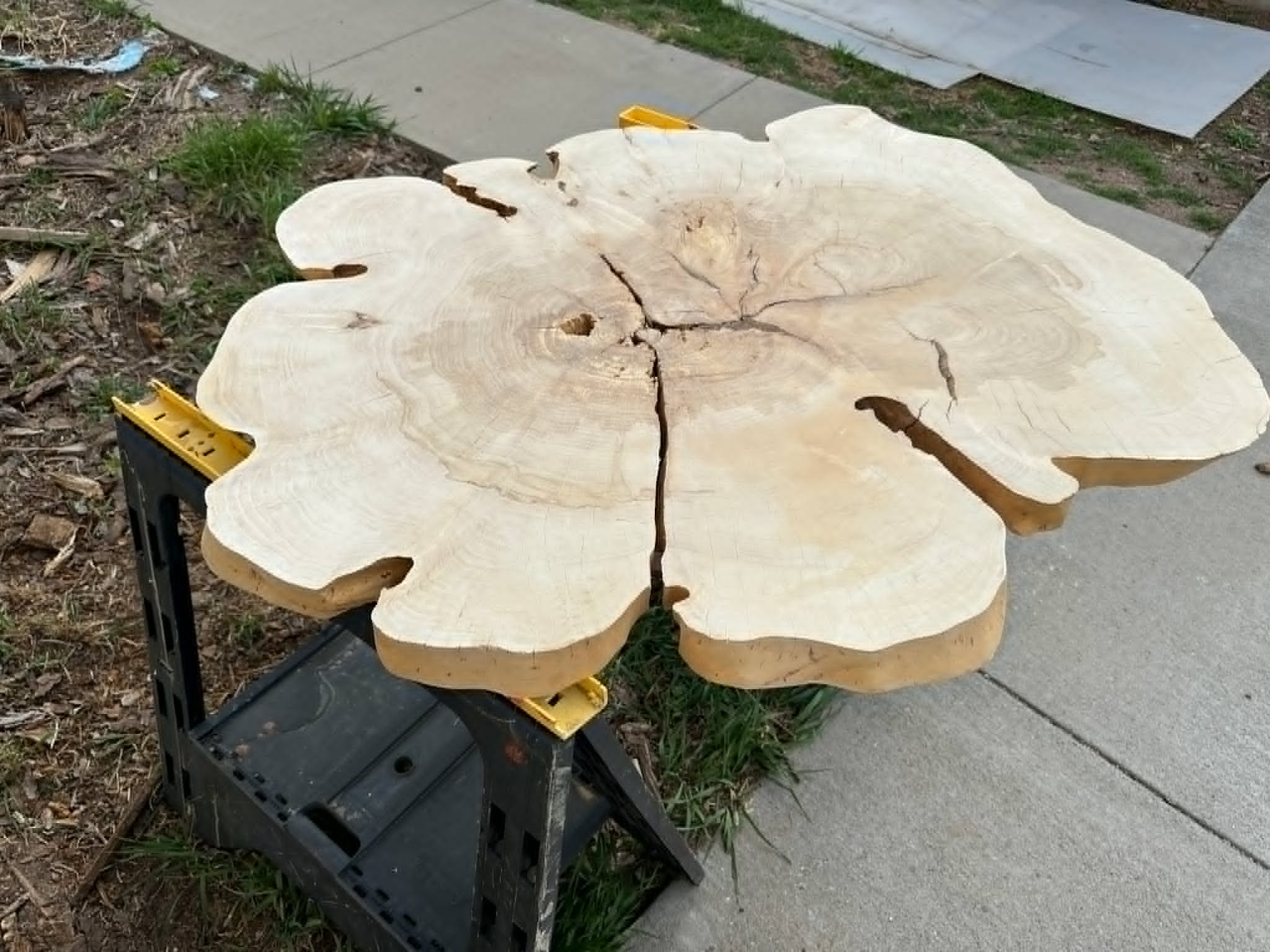
The base is an antique oak pedestal from the early-to-mid 1900s, the kind with four heavy curved feet that sweep out from a central column like something that belonged in a farmhouse dining room for fifty years. It has presence. It has history. What it didn’t have was any obvious way to accept a 46-inch live-edge cookie on top of it. I should say here that I’m an artist who woodworks. Not a professional, not an accomplished furniture maker. This project has been taxing my abilities in ways I didn’t fully anticipate, and I mean that as a compliment to the challenge. The growth alone has been worth it.
But I was stuck. Weeks of standing at the bench turning it over. The problem was wood movement. You can’t make a rigid connection between a top that size and a base that age without the whole thing fighting itself over time. And there were no natural attachment points. I’d worked through it in the studio, in conversation, on paper. Nothing seemed right. The more I pushed at it directly, the more it stayed exactly where it was.
Then I was riding. I’d just re-read a long back-and-forth I’d had while working through the engineering, put the phone down, and let the miles go by. And the answer came. Not as a flash. More like a slow arrival, the way fog lifts and you realize you can see something that was there all along.
Two pieces of C-channel steel in a cross pattern to stabilize the cookie against radial movement. A custom plate set into the base top. Inserts, bolts, two plates. A system that holds without fighting the wood’s nature. The connection that lets both things be what they are.
I had been forcing that answer for weeks in the one place it was never going to come.
Under the Surface
Here’s what I think is actually happening when we fill every quiet moment with content.
We’re not managing our attention. We’re destroying our most cognitively free moments of the day, and we’ve gotten so good at it we don’t notice anymore.
There’s a network of brain regions researchers call the Default Mode Network. It activates not when you’re focused on a task, but when your mind is gently occupied. Just enough stimulus to keep boredom away, not enough to demand full attention.
Driving a familiar highway activates it. So does the ambient hum of a plane. The rhythm of miles.
What it does in those states is the interesting part: it makes connections. It pulls together memories, half-formed ideas, unresolved problems and begins quietly weaving them into something. The work happens underneath. You often don’t notice it until a thought arrives that you have to catch before it disappears.
This is why the shower is famous for breakthroughs. Why long walks unlock things. Why the drive home from a hard day sometimes delivers the answer you spent all afternoon forcing.
Your brain doesn’t stop working when you stop working. It just switches modes. And sometimes that second mode is the one that actually solves things.
Studio Notes
I’ve been tracking this in myself long enough to notice two different flavors worth separating.
The first is physical containment. You’re on a plane. You’re in the passenger seat. Your body is committed to going somewhere and there is genuinely nothing else to do. The choice has been made for you. No errands can be run, no emails justified, no studio calling. I can enter flow on a plane in a way that almost never happens at my desk or easel. The absence of options is the gift.
The second is environmental displacement. You’re away from your regular surroundings. Your daily tools aren’t there. Your usual patterns don’t apply. The visual noise of your regular space, the unfinished projects, the things waiting, none of it follows you. Your brain, unmoored from its usual anchors, gets curious in a different way.
Both are useful. Both produce thinking I wouldn’t have arrived at otherwise. But they work differently, and knowing the difference has helped me use them more intentionally.
I keep a voice memo app open on long drives now. Not to record anything polished, just to catch what surfaces. Most of it is half-formed. Some of it is unusable. But a surprising amount of what has moved my work forward, including a wedding gift I was stuck on for weeks, came out of a car, or a waiting room, or a passenger seat far from home. Its like the muse is just hanging out begging for a small moment of “non committed” thinking to grab me.
The studio is where I make things. I’m not always sure it’s where I figure out what to make.


On the Table
One small practice this week.
The next time you have a contained stretch, a drive, a flight, a waiting room, a passenger seat, resist the reflex to fill it immediately. Hold off on the podcast for ten minutes. Leave the phone alone. Let it just be the road, the hum, the miles.
Bring one question with you. Not a to-do item. Something genuinely unresolved, a problem at the table or easel, a direction you haven’t been able to decide, something you’ve been considering but not yet committed to. Hold it loosely. Don’t push. Just let it ride along.
Then when something surfaces, catch it. Voice memo, a note at a red light, a sentence typed the moment the plane lands. Don’t evaluate it yet. Just catch it.
→ I’d genuinely like to know what comes up for you. Message me.
A Quiet Note
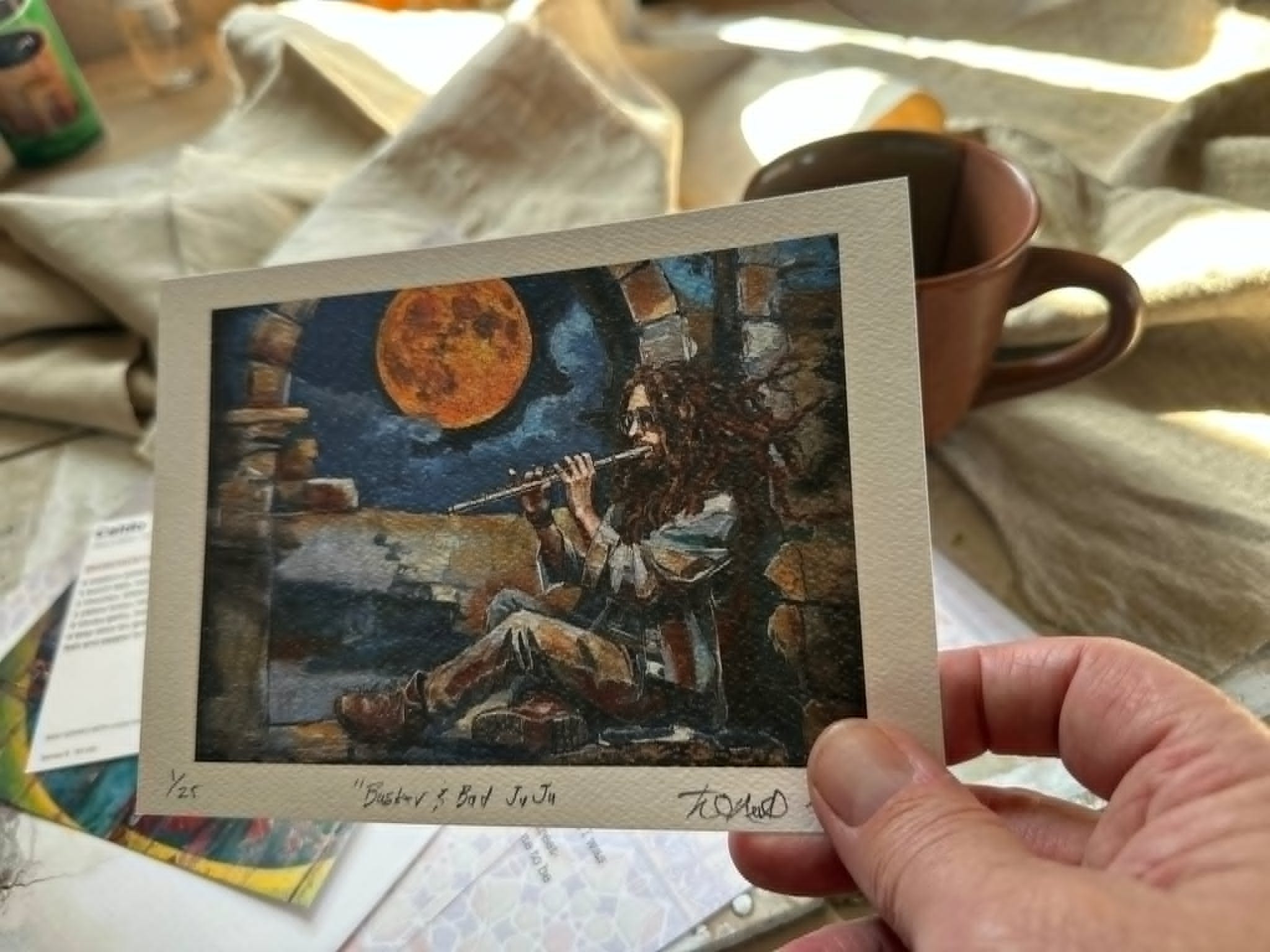
Unhurried Letters started, in part, from exactly this kind of contained thinking. Stories and images that arrived on long drives and long flights, things that don’t fit a newsletter but want to exist somewhere. If you’re curious about receiving a little of that in your actual mailbox, you can find it at unhurriedletters.com.
Leave the Light On
You don’t have to manufacture stillness. Life is already putting you in the tin can regularly. Long drives, waiting rooms, airport terminals, passenger seats on someone else’s errand.
The question is just whether you let those spaces be what they want to be. Not dead time. Not time to survive. Something else. The place where the thinking happens that can’t happen anywhere else.
The next time you’re contained, you’re not stuck. You’re working.
One-Click Check-In
If you want to read this later or find other issues, you can find them here or hit subscribe.
What a great read and I agree that we need these spaces to let our minds do their thing. I call this process "Moodling" and its my philosophy of attention.
I know so many people who fill every second with podcasts and courses and I can see it doesn't help them.