
Living by Making | Issue 19
At the Workbench
I was at the kitchen table Tuesday morning with an espresso, which I want to say upfront is not my everyday ritual. Some mornings I just need to shift into something sharper, a little ceremony of attention before the day gets loud, and that is what the espresso is for. I don’t really drink coffee but a tasty espresso, an occasional ritual that I picked up in Italy, seems to sharpen my focus overriding some neurodivergence. I had been moving slowly all week, energy lower than I like, and I was scrolling in that loose way you do when you are not quite ready to begin anything real. That kind of unhurried noticing has gotten easier the longer I have done this, not because I have more time, but because I have stopped needing every morning to produce something.
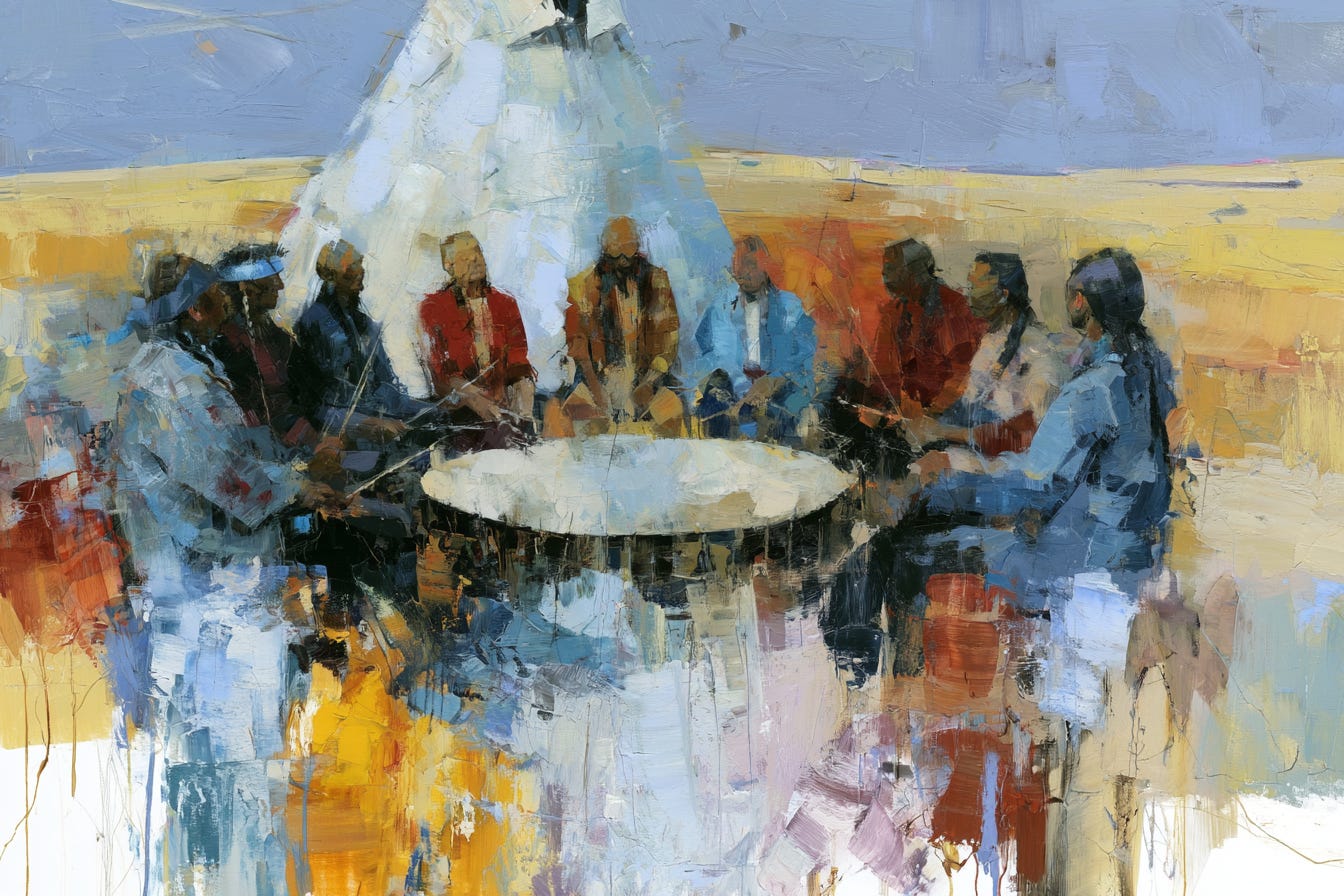
A video stopped me. A few seconds of Native Lakota men raising a teepee together, hands on the poles, the frame going up against open sky. I do not know exactly why I stopped. Something about the movement. The unhurried coordination of it, the way the work required all of them, nobody doing it alone, nobody performing it either. I put my headphones on, turned the sound up, and found myself watching a Playing for Change feature on the Doors’ Riders on the Storm, with John Densmore in conversation and Lakota drummers woven through the original track.
The drumming came in and I felt that familiar thump in my chest. Not a grand moment. Not tears. Just a quiet internal movement, the kind you barely notice unless you are paying attention and the espresso has not pulled you fully into the day yet. Densmore was talking about the storm, about being carried rather than driving, and the drums underneath him were doing something to the song I had heard a hundred times. Making it older somehow. Making it feel like it had always been there.
I listened for longer than I intended. The espresso went cold and I did not notice until it was over. (continued beneath the image)
Under the Surface
Here is what I think was actually happening, and I mean this less as an explanation and more as something I am still working out.
The brain does not receive things in a neutral way. Every piece of music, every image, every made thing arrives into a landscape that already exists inside of us, a landscape built from everywhere we have been and everything we have lived. Neuroscientists call this predictive processing. Our brain is not passively taking in experience. It is constantly making predictions based on what it already knows, and what arrives either confirms those predictions or surprises them. The moments that stop us are usually the ones that arrive unexpectedly, finding something in us we did not know was there to be found. They find a door we did not know was there.
My connection to the Lakota is not abstract. Pine Ridge is not far from where I live, and a few years back I spent time with a crew of high school students building an earth bag structure, work that had nothing to do with ceremony, just hands and bags and sun. But partway through the week we were invited to something that did. First to watch the fire ceremony, a long and exact process, certain rocks the Lakota called “grandfathers” chosen and set into the sacred fire to heat before the firekeeper carried them over to the lodge itself. Then, separately, invited again, to go through the sweat. What a blessing. I remember the dark most. Not the kind you get used to, the kind that stays total the whole time. Bodies pressed in close around the heated rocks, shoulder against shoulder, and somehow that closeness felt less like crowding and more like being held up. Then the singing started, and the drum under it, and I could not tell you anymore where the sound was coming from or where I ended and it began. It was an out of body experience in the most literal sense I know, the kind people spend a lot of effort chasing by other means, and here it had just arrived, on its own, in the dark, with that drum going.
Sitting there, I was not thinking about myself at all. So when those drums came through my headphones years later and met Densmore’s voice, something in me recognized something I could not have recognized any other way. Not the music itself, I know the Doors well enough. It was the drumming finding a register in me that had already been opened once, in a different dark, by different hands. This is not the same experience someone else would have had watching the same video. Two people can encounter the same piece of work and receive entirely different things, not because one is more perceptive or more educated, but because they are bringing a different landscape of experiences to it. Our life is the instrument through which art is received, as much as the work itself.
Studio Notes
I have been thinking about this in relation to making, not just receiving.
If the landscape of lived experience shapes what we receive, it also shapes what we make. The places we have been, the grief we have carried, the joy that surprised us, the specific quality of light on a particular morning years ago that you have never quite named, all of it is in there somewhere, showing up in decisions we make when creating that we cannot fully explain even to ourself. That is not mysticism. It is just how human making works. We cannot make from nowhere. We make from the accumulated weight of where we have been.
This is part of why I think the multipotentialite path, the wide-ranging, never-quite-specializing, always-accumulating path, produces something that a narrower path cannot. Every practice we have picked up, every place we have been willing to go as a learner, every experience we have let matter, it all goes into the landscape. It all becomes part of what we bring to what we hear, see, feel, and what we bring to what we make. Maybe I am just justifying my complete lack of capability, or interest for that matter, to specialize. Probably. But I do not think the landscape argument is wrong on that account. Here is the part I actually believe past the joke. A maker does not get less relevant with age. The landscape just keeps getting deeper, and there is more of it to draw from every year, not less.
On the Table
Playing for Change is worth knowing if you do not already. They record musicians around the world in their own environments and layer the tracks together. The results are not always polished. They are almost always moving. This one is worth the headphones and a slow cup of something.
Behind the Song: Riders on the Storm | John Densmore | Playing for Change:
If the multipotentialite thread resonates, Emilie Wapnick gave a TED talk in 2015 called Why Some of Us Don’t Have One True Calling that is still one of the clearest things I have found on the subject. Short, direct, and it will make a few things click into place if they have not already. Maybe my second favorite TED talk after the Sir Kenneth Robinson’s one on educating creativity out of kids.
Emilie Wapnick | TED Talk | Why Some of Us Don’t Have One True Calling
The broader question I keep coming back to: what is in your landscape that shapes what you make without you fully knowing it? What place, what person, what unlikely experience is in there somewhere, waiting to surface in the work?
A Quiet Note
Unhurried Letters is a physical mail subscription, handwritten travel stories, a fine art print, a recipe card, and a postcard, arriving by mail in the middle of a world that mostly communicates at speed. If that sounds like the right kind of slow, you can find it at unhurriedletters.com. This month’s letter is really fun and outlines a flight from Portugal to Ireland. I am sure that many peeps can relate to what happened. Anyway, Unhurried Letters is a fifteen minute break from the digital world. Slow down and read a real letter, check out a 5x7 handsigned, limited edition print from the story, make the meal from the recipe card and then send out the included postcard to a friend. Cool.
If you have been thinking about it: unhurriedletters.com.
Leave the Light On
You cannot always know what is going to stop you on a Tuesday morning. You cannot engineer the collision. But you can keep putting yourself in the path of things, keep accumulating the experiences that deepen the landscape, keep being willing to go somewhere new and let it matter. The work you make ten years from now will carry things you have not lived yet. That is a reason to keep living them. That is not a countdown. It is more landscape arriving, on schedule, whether you go looking for it or not.
Go find something that surprises you this week. Put your headphones on.
Keep making. Keep growing. Be you.
Tio
"Our life is the instrument through which art is received, as much as the work itself."
One-Click Check-In
If you want to read this later or find other issues, you can find them here or hit subscribe.