
Living by Making | Issue 35
This has been a glorous week in the Ancient East of Ireland. The locals tell me they don’t refer to this area as that, only a marketing phrase drummed up by someone somewhere. I like it though and really from my short 5 week observation and field study, it seems to fit. Anyway, many adventures and experiences this week, here is one of my favorite.
At the Workbench
The geese found me before anyone else did. Three of them, two white and one grey, came down to the fence of their pen the moment I turned into the drive and announced me to the whole property the way geese announce everything, as though it were an emergency and also somehow my fault. Beyond them a little banty rooster was working the edge of the gravel with a neat small flock, scratching and pecking at whatever the morning had turned up, and along the right side of the drive ran a garden of trees and shrubs I could not have named if you paid me, every shade of green the year had left. I wasn’t sure where to park, so I stopped in the middle of the drive and got out, and a border collie trotted across the yard to inspect me, decided I would do, and pushed her head into my hand until I scratched behind her ears.
Getting there had taken the usual scenic route. The address I had sent me first to a large house behind a gated drive that was clearly nobody’s pottery or basket weaving studio, so I tried the Eircode instead, a code people here seem to trust far more than a street name, and found that the address and the Eircode disagreed by better than twenty miles. The Eircode won. I am learning. I’m still not entirely sure what an Eircode is, I had never seen one before this trip, but in fairness I rarely need GPS to get anywhere back in the States either.
Heike Kahle came out of the studio to meet me, her silver-blond hair pinned up out of the way, a lovely woman with a quick, easy welcome, and walked me toward the door. Under a covered patio to the left stood a fig tree, a big one, with a handful of figs still hanging on. It had been a strange dry year, she told me, and the tree had given them far less than usual. I reached up and touched one of the leaves without really meaning to, the way you touch something in a garden that reminds you of your own. Heike and her partner, the potter Klaus, are both German, and they have been on this piece of land for thirty-five years, long enough for a fig tree to become an old friend.
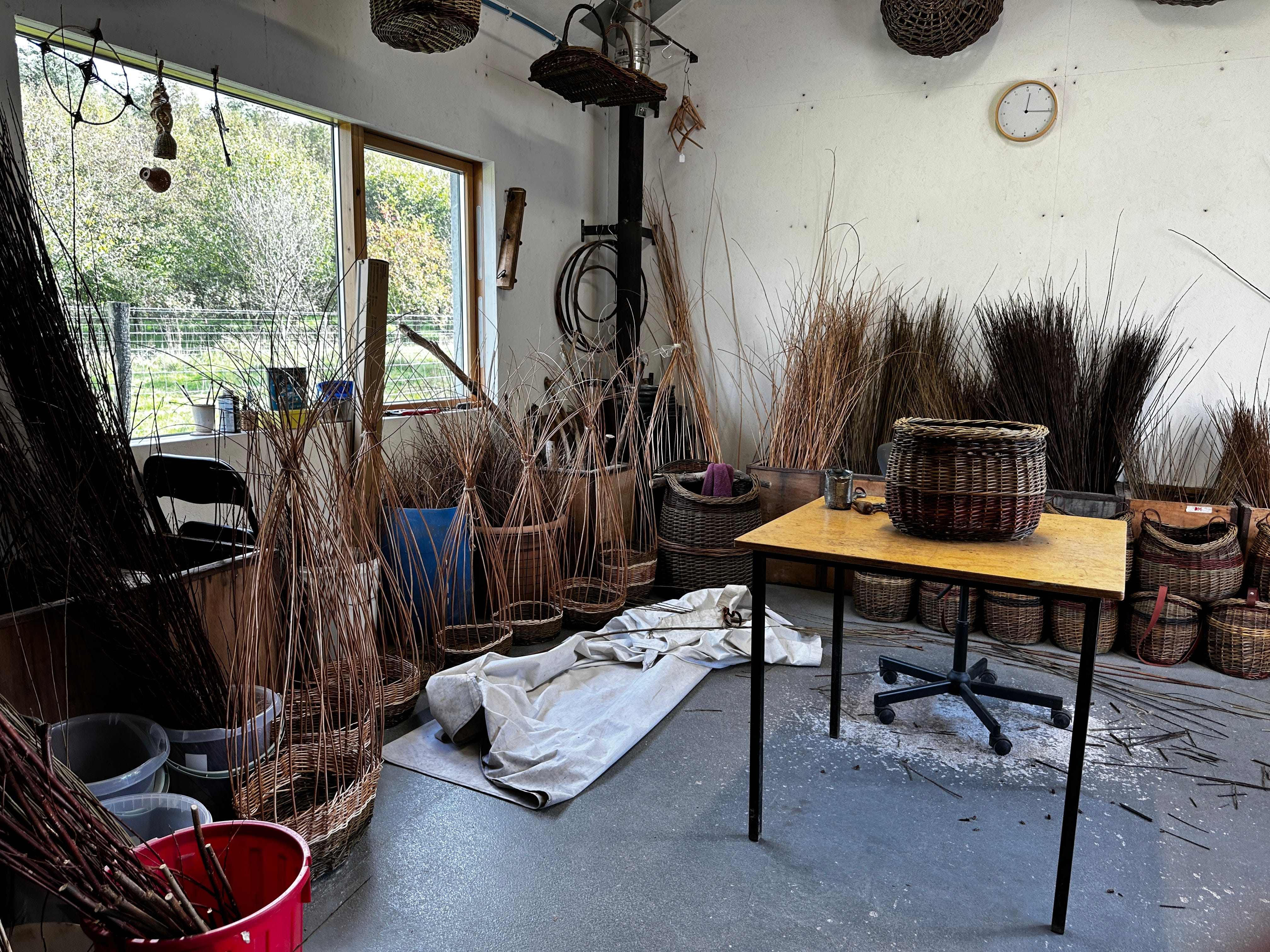
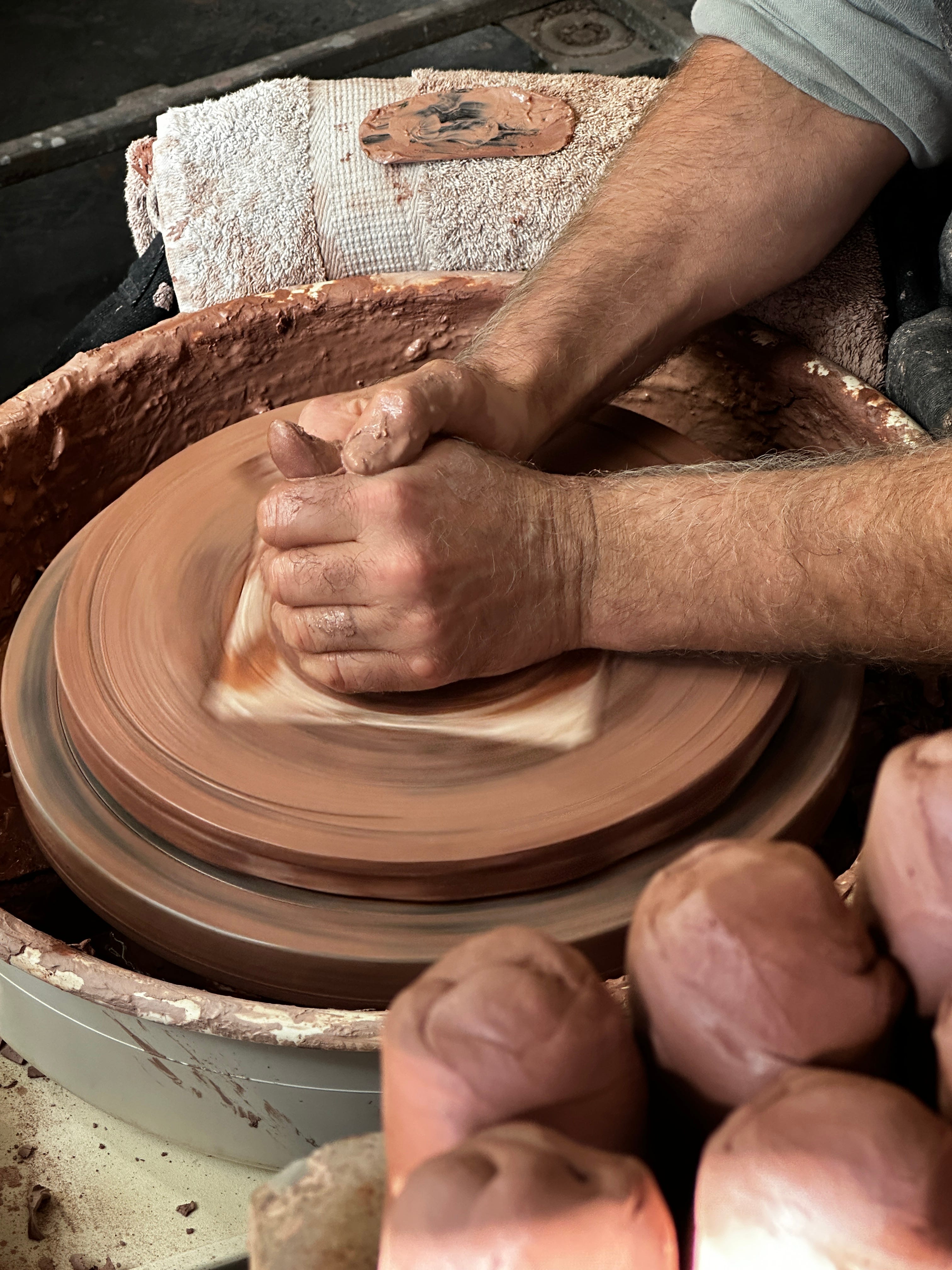
Inside, to the left, Klaus sat at the wheel in a clay-spattered apron, his long grey hair tied back, glasses on, a towel folded across his lap, easing a small bowl no bigger than his two cupped hands off the wheel head. On the bench in front of him a dozen balls of red clay stood in two neat rows, already wedged and waiting their turn like loaves on a baker’s board. Above and behind him rose shelves of unfired work, bowls and cups in that same warm red-brown, the throwing rings still spiraling up their insides, some dark with water, some gone pale and matte and nearly ready, and somewhere back there a small wood stove he fires to pull the moisture out of the room. To the right, a wide sliding door stood open, and through it was another country entirely. Willow stood on end in old wooden crates along the walls, sorted by color, honey gold and olive green, rust and a brown so deep it was nearly black. Finished baskets sat stacked along the floor, round-bellied and striped in bands of those same colors, some with leather straps for handles, some with driftwood handles, and more hung from the ceiling. Unfinished ones from a class she teaches stood about the floor, their upright stakes gathered and tied together at the top so they looked like tall willow lanterns, and the light from the big window laid their shadows across the grey concrete in long dark stripes.
It took me a few minutes to understand what I was looking at. Two crafts in one building, and each one wants the opposite weather. Klaus needs his side warm and dry so the pots give up their water evenly and don’t crack. Heike needs her side cool and damp so the willow stays supple enough to bend without snapping. There is a wood stove on her side too, she told me, and she has never once lit it. For thirty-five years they have kept two climates going under one roof with nothing but a sliding door between them, and they make it look like the most ordinary arrangement in the world.
Under the Surface
The day before, I had spent an hour in the wrong climate. Geraldine Walsh paints in Kilkenny, and I had been seeing her work all over town since I arrived, in windows and on walls, loose and confident and full of light. Beautiful landscapes in oil. Her regular workshop was full, but she kindly said I could drop in for a couple of hours on a Tuesday, so I did. My assignment was simple enough. Block in five to seven values in black and white, something like a notan, the light and dark map underneath a painting before any color goes on. I loaded a brush, put it to the canvas, and spent the next thirty minutes fighting it.
It was not the idea that beat me. I know values. I have taught values to teenagers for most of my adult life. It was everything about the doing. How much paint it takes just to cover the canvas, how blocky every stroke came out, how foreign it felt to sit at an easel pushing paint around with a stick when my hands are used to scraping wax, pressing paper into resin, working a surface with my fingers until it gives something back. I retreated to a plain seven-step value scale just to have something I could finish, and when I stepped back, what I had made looked like something a five-year-old might bring home from school. I don’t say that to be hard on myself. I know I could have done better finger painting at my own table in my own way. I had learned this lesson once already, in an online course with Milan Art Institute years ago. I am glad I know how traditional oil painting is done, and I do not enjoy doing it, and both of those things can be true. If anything, it gives me an even larger appreciation for those who create beautiful work in oil in the traditional manner.
So after an hour I begged off. The women in the class could not have been kinder, and we talked a little about America while they worked, but I felt like I was taking up room in a class that was going somewhere without me. Geraldine wouldn’t charge me for the materials I had wasted, which made me want to do something, so I bought two of her prints to take home. If I could have afforded an original, one would be riding home in my rucksack. She is a wonderful painter and a generous teacher, and none of what happened that morning had anything to do with her.
Standing in Heike’s willow shop the next day, I understood that hour a little better. The psychologists Edward Deci and Richard Ryan spent decades making the case that people flourish when they feel competent, when they have some say in how they work, and when they feel connected to the people around them. I had the connection in that room, plenty of it. What I didn’t have was the other two, and no amount of good will was going to manufacture them in an hour. Some of us need the room warm and dry. Some of us need it cool and damp. The work isn’t to become the other kind of maker. It is to know which side of the sliding door you belong on, and to stop feeling guilty about the stove you never light.
Studio Notes
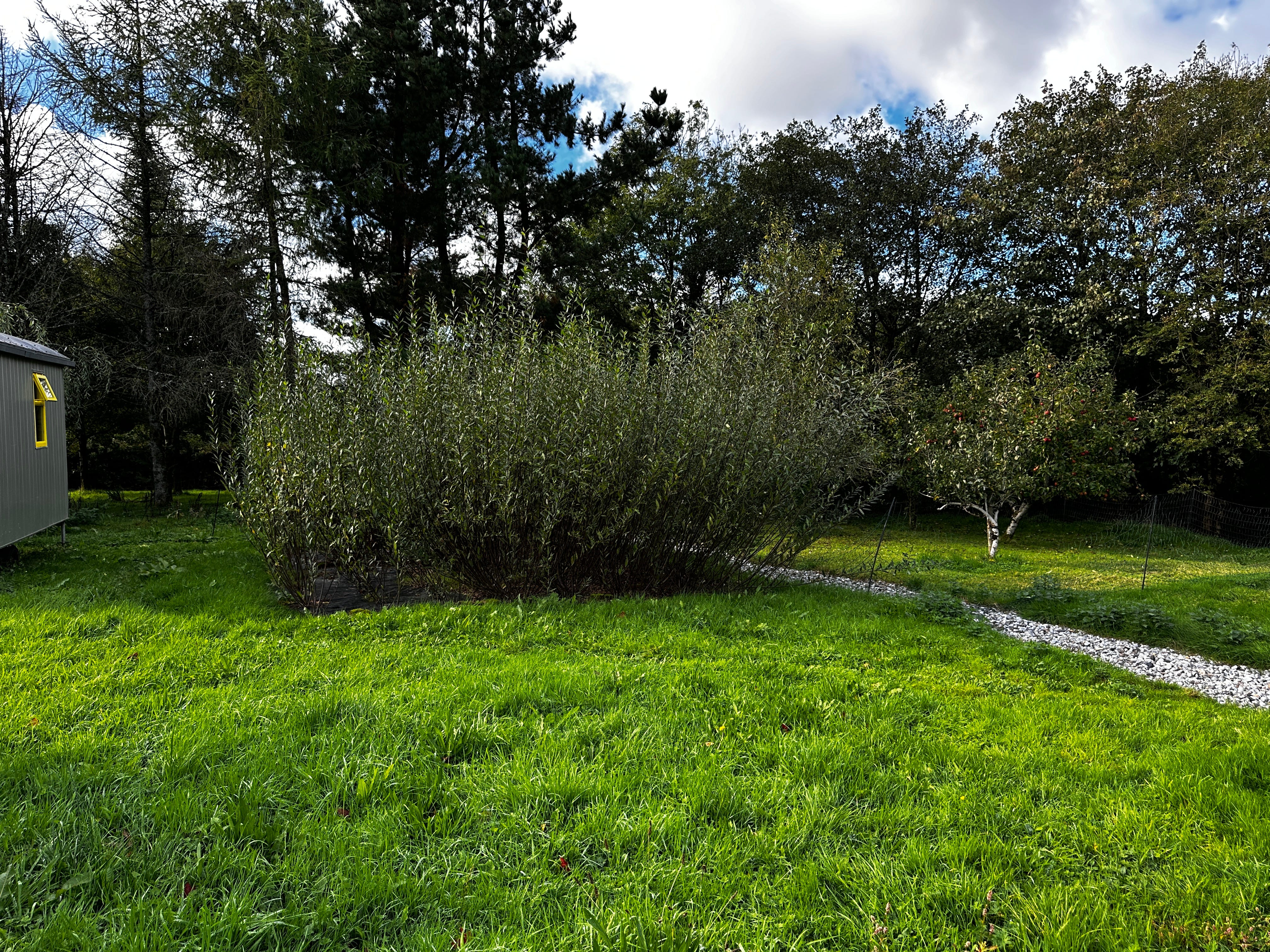
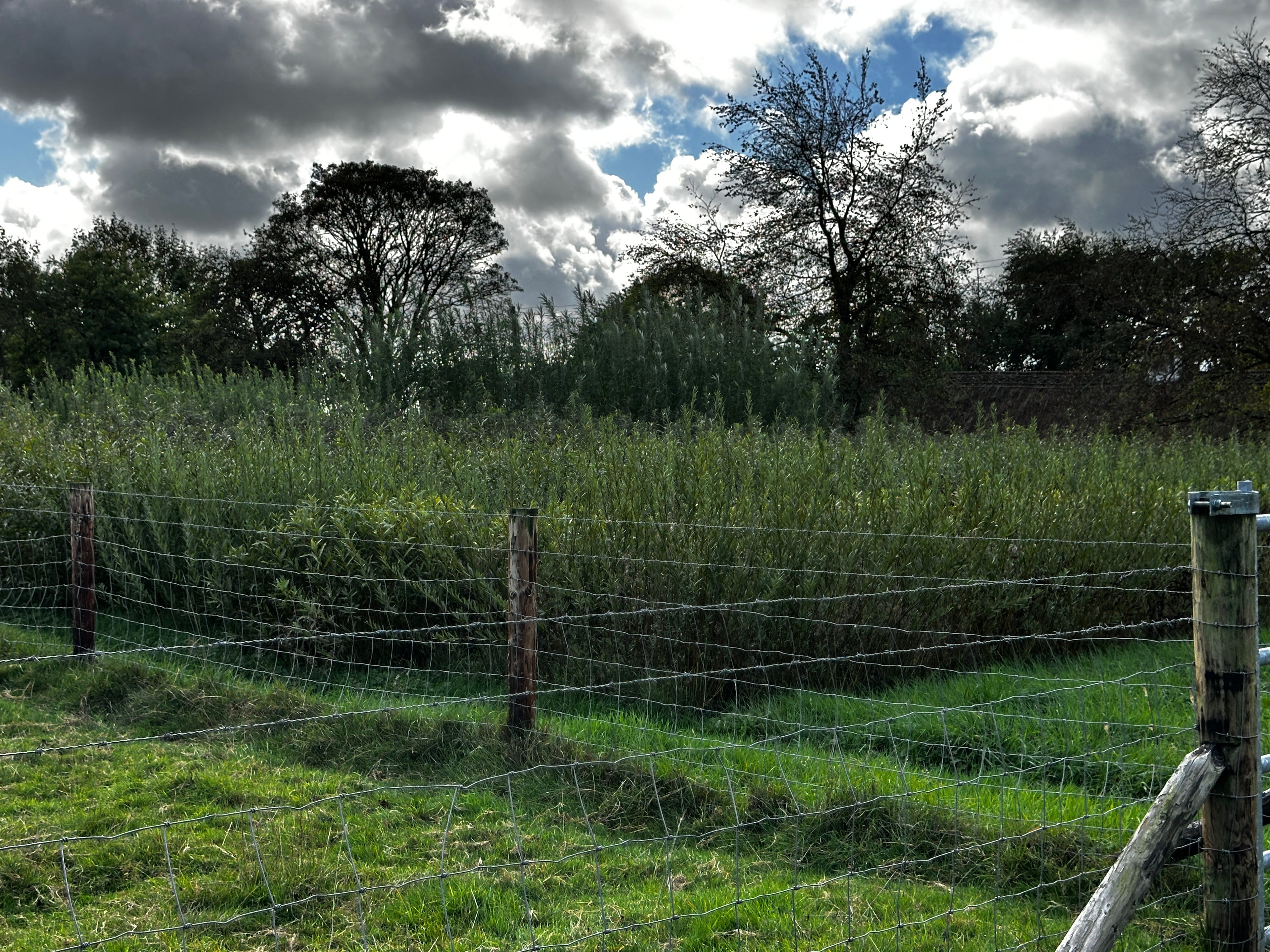
Heike walked me out to see where the willow comes from. She grows almost all of it herself, buying in a little extra only for the classes she teaches. Off to the side of the beds stood an open-fronted shed of corrugated metal with a bright yellow two-seat kayak slung from the rafters on straps, and underneath it, raised on concrete blocks, two long galvanized troughs where the willow soaks before she weaves it. A big caged water tank filled one corner, and an old clawfoot bathtub sat out on the grass by the opening, as though it had wandered off from somewhere and nobody minded. The beds themselves ran farther than I expected, stands of willow well over my head behind a wire fence, several varieties planted side by side and raised as much for their color as anything else. A path of white gravel curved along the front of a second stand I hadn’t seen from the drive, past a crabapple tree so loaded with red fruit its branches hung nearly to the grass.
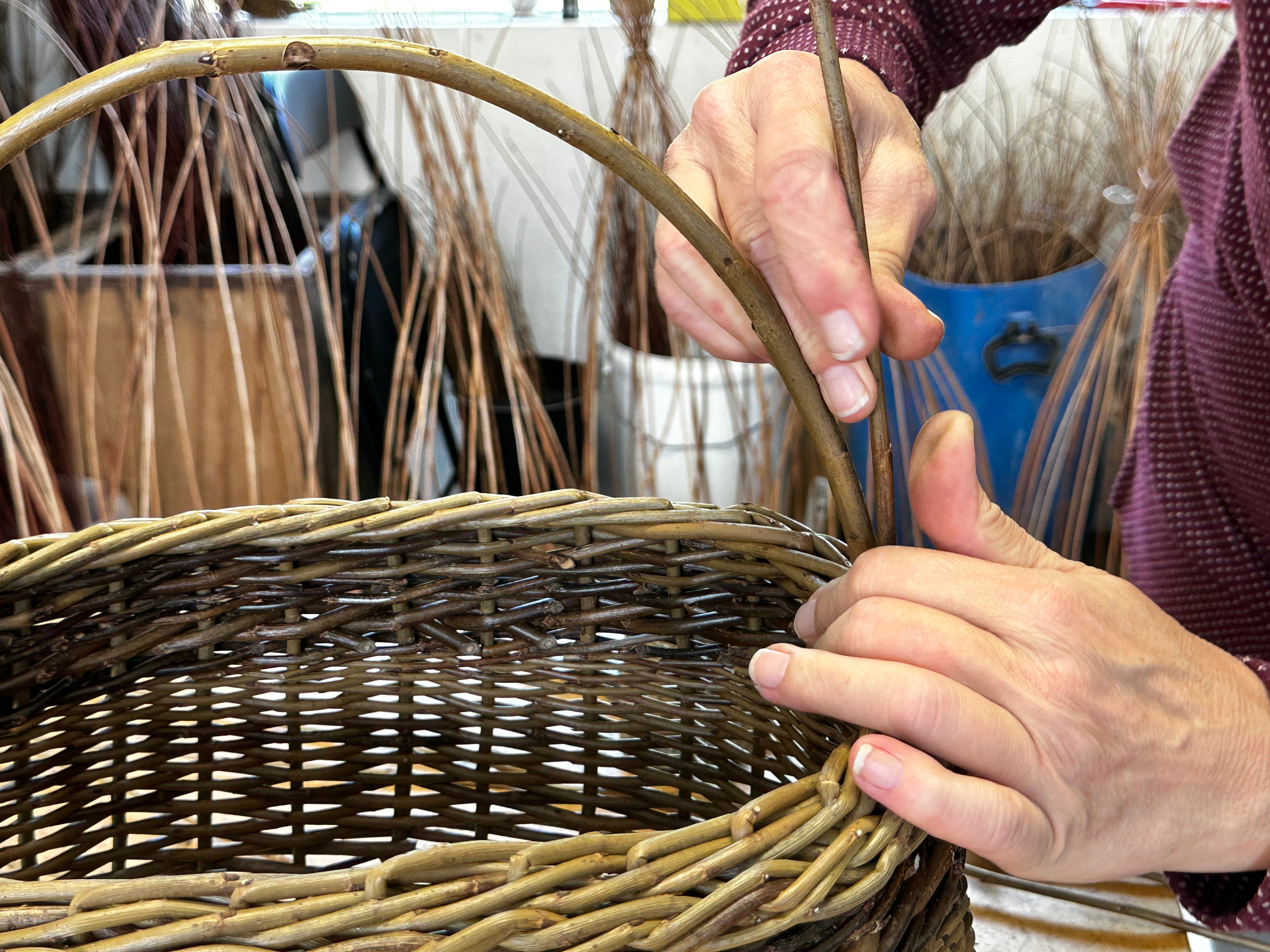
The cycle is the part I keep thinking about. At the end of each season she cuts every plant clear down to a short stub, and the following year new rods come up from that stub, straight and long and ready to cut again. A bed will keep producing like that for around ten years. When she sees the yield start to fall off, a tractor comes in at the end of the season and pulls the old stumps out of the ground, and they replant in the field next door and let the old one rest. Once cut, the rods go into a drying shed for several weeks, and then into those long steel troughs to soak before she can work them. In the drying shed the bundles stand on end against wooden rails, each one cinched at the waist, dull browns down one side and on the other a stand of willow so red-orange it nearly glowed in the dim. I ran my hand down one of the brown bundles, the rods hard and light and rattling against each other, and tried to imagine them ever bending. Back in the shop, Heike showed me how they do. She picked up a basket she had going on the table and worked a handle onto it, threading a long thin rod along the thick bow of the handle and wrapping it around and around, her thumb pressing each turn snug against the last, while her pruning shears, a tape measure, and a few old iron tools worn dark and smooth with use lay scattered across the table beside her.
Klaus’s process lives in its own shed. He bisque fires in an electric kiln, which is easy and predictable for the low first firing, and then does his glaze firings in a wood-fired kiln he built himself, a good-sized thing sitting out on its own in an open board shed away from everything else. It stands taller than I do, boxy and square-shouldered, built of pale firebrick patched here and there with yellow, bound in a frame of rusted steel, its arched door bricked shut and the seams around it blackened with soot from firings past. Between the two of them the place runs like a small ecosystem. Sheep graze one field and do the mowing. Solar panels sit in another. The vegetables grow in raised beds because the native soil is poor, and building the beds let them decide what the roots would grow in. Out by the little shop where they keep inventory stood two barrel-roofed wagons on wheels, one painted a green so bright it looked freshly wet and the other grey with a yellow window, crabapples hanging red beside them, little houses that can be used for anyone who wants to sleep somewhere that isn’t a hotel.
None of it happened at once, and that is the thing I can’t stop noticing. Thirty-five years of cutting willow to the stub and waiting. Back home, willow grows wild along the Platte, and I have walked past it my whole life without once thinking of it as something you could plant, cut down to nothing, and harvest again for a decade. I am starting to suspect that this whole trip is going to be one long lesson in looking at what grows along my own riverbanks.
On the Table
I wanted a basket badly. I stood in Heike’s shop for longer than was polite with one in my hands, feeling how little it weighed and imagining it on the bench in my studio, and then did the arithmetic on shipping and set it back on the shelf. Getting it home would have cost as much as the basket. Klaus and Heike had mentioned they would be at the market on the Parade in Kilkenny on Thursday, so I promised myself I would find them there and try again with something that would fit in my rucksack.
The market was quieter than usual, Klaus said, fewer vendors than a normal Thursday, which worked out in my favor because I got another fifteen minutes with him. Thirty-five years ago, before any of this, he had been a mechanical engineer and Heike had been a biologist. Sometime around 1991 they left Germany for Ireland. For the first couple of years they worked as volunteers for an organization that paid them nothing but gave them a place to live, food on the table, and the use of a car. They took courses the whole time. Eventually they wanted to study those courses more seriously than volunteering allowed, and they left. Klaus went to college for pottery. Then he worked for other potters three days a week for a few years while Heike minded the children, and on the other days she worked on her baskets while he minded them, and back and forth like that, for years, they built the business that is now two studios, a willow field, a wood kiln, and a flock of opinionated geese.
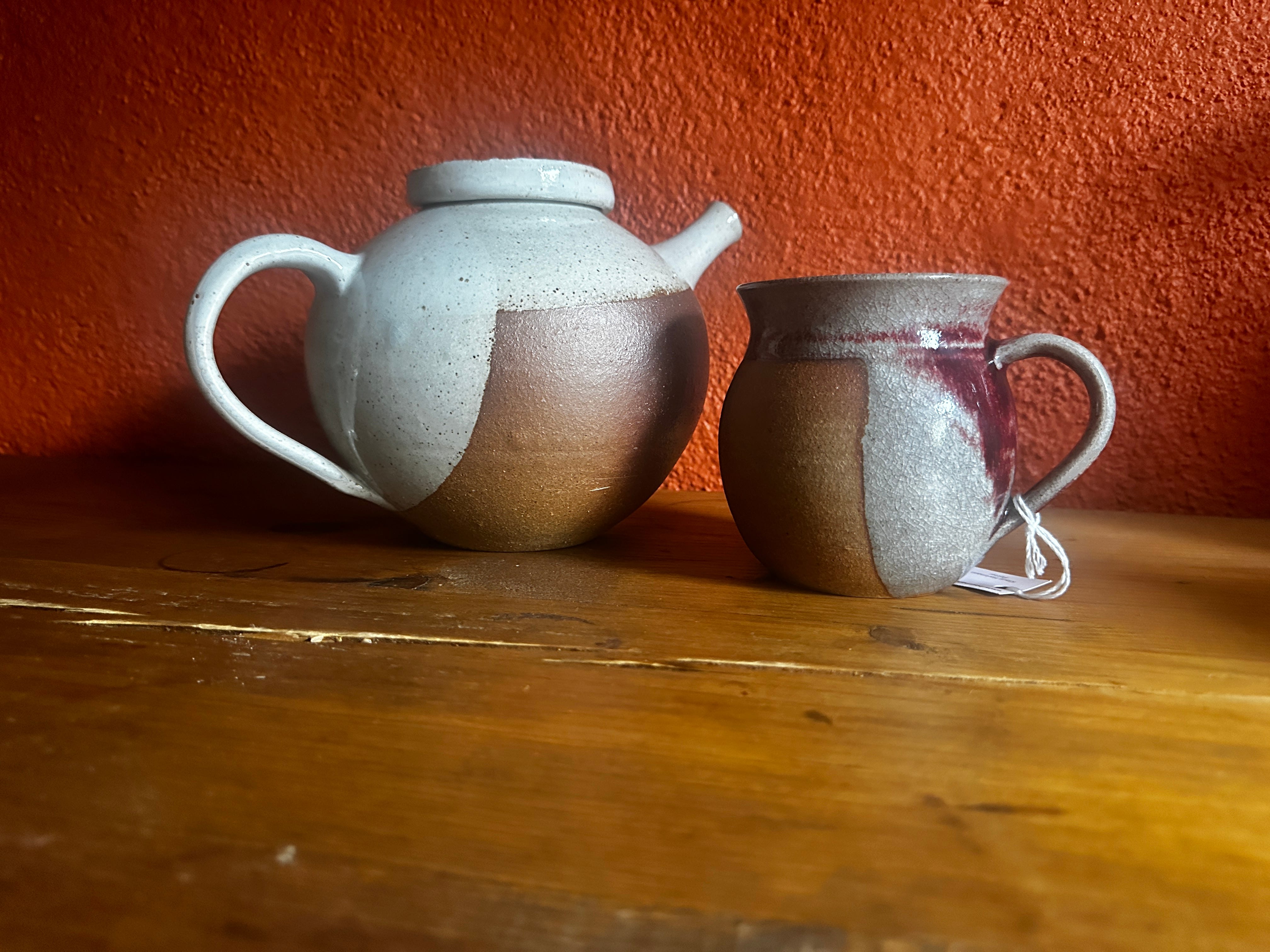
I bought a teapot. I love it, a round, nearly perfect sphere of a pot with a short straight spout and a flat little disc of a lid, its top carved all over in small facets like hammered metal. Klaus had dipped the top half in a pale, speckled grey-white glaze and let it stop in a long diagonal sweep, and below that line the bare clay came out of the wood kiln toasted a warm red-brown, flecked with dark iron where the fire had touched it. I nearly bought the matching mug to go with it, the sensible thing, the set. But there was another mug on the table I liked better, and after standing there long enough to make Klaus wonder about me, I bought that one instead. It is smaller and rounder in the belly, with a rim that flares out to meet your lip. The same pale glaze runs down one side of it in a wide stripe, but on the mug it crazed as it cooled into a fine web of cracks like old porcelain or dry river mud, and a streak of deep red runs through it near the handle, pooling inside the rim and filling the whole inside of the cup the color of a ripe rosehip. The bare clay on its other side fired more honey than brown.
When I got back, I made tea in the cottage with both of them. I lifted the faceted lid, filled the teapot, let it steep, and poured into the mug that doesn’t match, and wrapped both hands around that round red-hearted belly while the window fogged up. Set side by side on the old wooden table against the cottage’s orange wall, they are plainly family, the same clay, the same pale glaze, the same bare toasted bottoms from the same fire. But one came out calm and the other came out crackled and running with red, and they sit together like they have been doing it for years. Two different things that don’t match and work anyway. I think I bought a portrait of the peoples mediums who made them.
In Good Company
Watch: WOVEN, a short documentary by Tristan Hutchinson about the Irish basket maker Joe Hogan and the Galway landscape his work grows out of. Free to watch on YouTube. Hogan has been weaving in the west of Ireland for decades, and the film is as much about the bog and the light and the slow seasons as it is about baskets, which is exactly why I like it.
Read: The Unknown Craftsman by Soetsu Yanagi, adapted by Bernard Leach. Yanagi spent his life defending the beauty of ordinary, useful things made by people whose names nobody wrote down, the teapot, the rice bowl, the basket by the door. I thought about it the whole time I stood at Klaus’s table trying to choose a mug.
Listen: The Lonesome Touch by Martin Hayes and Dennis Cahill. A fiddler from County Clare and a guitarist from Chicago, playing traditional Irish tunes slower and quieter than almost anyone dares to play them. Two instruments that shouldn’t need each other, and listen to what happens when they decide they do.
A Quiet Note
If you are ever within a few hours of Kilkeny, call or email Baurnafea Studio to check out the awsome work of Klaus and Heike. OR you could just stop and see them at the craft market on Parade near Kilkeny Castle on Thursdays. Some of what I’m gathering in Ireland is too slow for an inbox. A story from a willow field, a print, a recipe card, a postcard, the kind of thing meant to sit on a counter for a while before it gets put away. That’s what Unhurried Letters is for, real mail that arrives in your real mailbox. If that pace sounds like something you want more of, you can find it at unhurriedletters.com.
Leave the Light On
Before any of that, before the teapot and the mug, I walked into Kilkenny Thursday morning through the Butter Slip. It is a narrow stone passage with steps running up beneath two old houses, connecting St. Kieran’s Street below with High Street above, and it has been there since 1616, back when butter sellers lined it on market days. The light goes dim as soon as you step in, the rough grey plaster curves in overhead, the paving stones are worn smooth underfoot, and the whole thing feels more like walking through a cave than a shortcut, with the bright street showing at the far end like the mouth of it.
Partway in I heard what I was sure was chamber music, a small string ensemble somewhere up ahead, rich and layered and filling every inch of the stone. I slowed down to listen, and a few steps on, where the passage widened a little, I found one man with one violin. He stood against the wall in a black knit cap and a green hoodie under a black puffer vest, a purple backpack slumped at his feet, his phone propped on a music stand where the sheet music would be, and his violin case lying open on a little folding stool. That was all of it. The rest was the room. Four hundred years of stone walls were taking every note he played and handing it back to him doubled and tripled, so that a single fiddle sounded like a quartet. I asked if I could take his picture, and he nodded, so I took a quick snapshot, nothing like a proper portrait, and recorded a little of what he was playing. Then I emptied every coin in my pocket into his case, which came to about six euro, and kept walking up toward High Street with the music following me out.
(This is a one minute recording of the busker in butter slip)
I think about him alongside that sliding door in Heike and Klaus’s studio, and the stove she never lights, and my hour at the easel. He was not a better violinist because he was standing in the Butter Slip. He was the same violinist he would have been on a street corner in the open air. But he had found the room that made his instrument sound like itself and then some, and he had the sense to stand in it. I don’t know that there is much more to a creative life than that. Find out which climate your hands work in. Build it, or find it, and then stay there long enough for it to become yours. And when somebody offers you the matching set, it is all right to take the mug you love instead.
Keep making, keep growing, be you.
Tio
“Two different things that don’t match and work anyway.”
References
WOVEN, a film by Tristan Hutchinson about basket maker Joe Hogan:
The Unknown Craftsman by Soetsu Yanagi, adapted by Bernard Leach: https://www.penguinrandomhouse.com/books/563597/the-unknown-craftsman-by-soetsu-yanagi-adapted-by-bernard-leach/
The Lonesome Touch by Martin Hayes and Dennis Cahill, Compass Records: https://store.compassrecords.com/collections/world/products/the-lonesome-touch
The Butter Slip, Kilkenny, Discover Ireland: https://www.discoverireland.ie/kilkenny/the-butter-slip-kilkenny
Deci, E. L., and Ryan, R. M., Self-Determination Theory: https://selfdeterminationtheory.org/theory/
Unhurried Letters: https://unhurriedletters.com
Klaus and Heike’s studio https://www.baurnafeastudio.ie/
One-Click Check-In
If you want to read this later or find other issues, you can find them here or hit subscribe.