
Living by Making | Issue 33
A week into slow living in the Irish countryside and I am content. Rested. Peaceful. Full. I have accomplished more at a slow restful pace in the last week than the whole of the previous month. And, more importantly, with intent and purpose, fully present at each stage of this experience. I hope you enjoy reading it as much as I enjoy living it.
At the Workbench
The fog was down on Wednesday morning, a dense sheet of it cloaking the mountain and spilling all the way into the front field, the kind of cool Irish morning where a sweater under a jacket is exactly right. I pulled on my muck boots and drove the five kilometers into Borris a little giddy, if I’m honest, which for a morning of lace is slightly embarrassing to admit. I am an artist, but I don’t sew well, I don’t crochet, and I don’t embroider. What I do have is a deep appreciation for anything made slowly by hand, and I had been looking forward to this morning since the phone call that made it possible.
That call came from my friend Nicola, whose place I’m watching while she teaches in Australia. When I mentioned the lace, she rang one of her many friends and asked whether I might join them for a morning. Mary said absolutely. They meet on Wednesdays from ten until half twelve at the local library, which turned out to sit right beside the church, and that small fact pleased me more than it probably should have. Things move differently here. America is about two hundred and fifty years old, and I was driving past buildings older than my whole country toward a craft that has been worked in this village for the better part of two centuries.
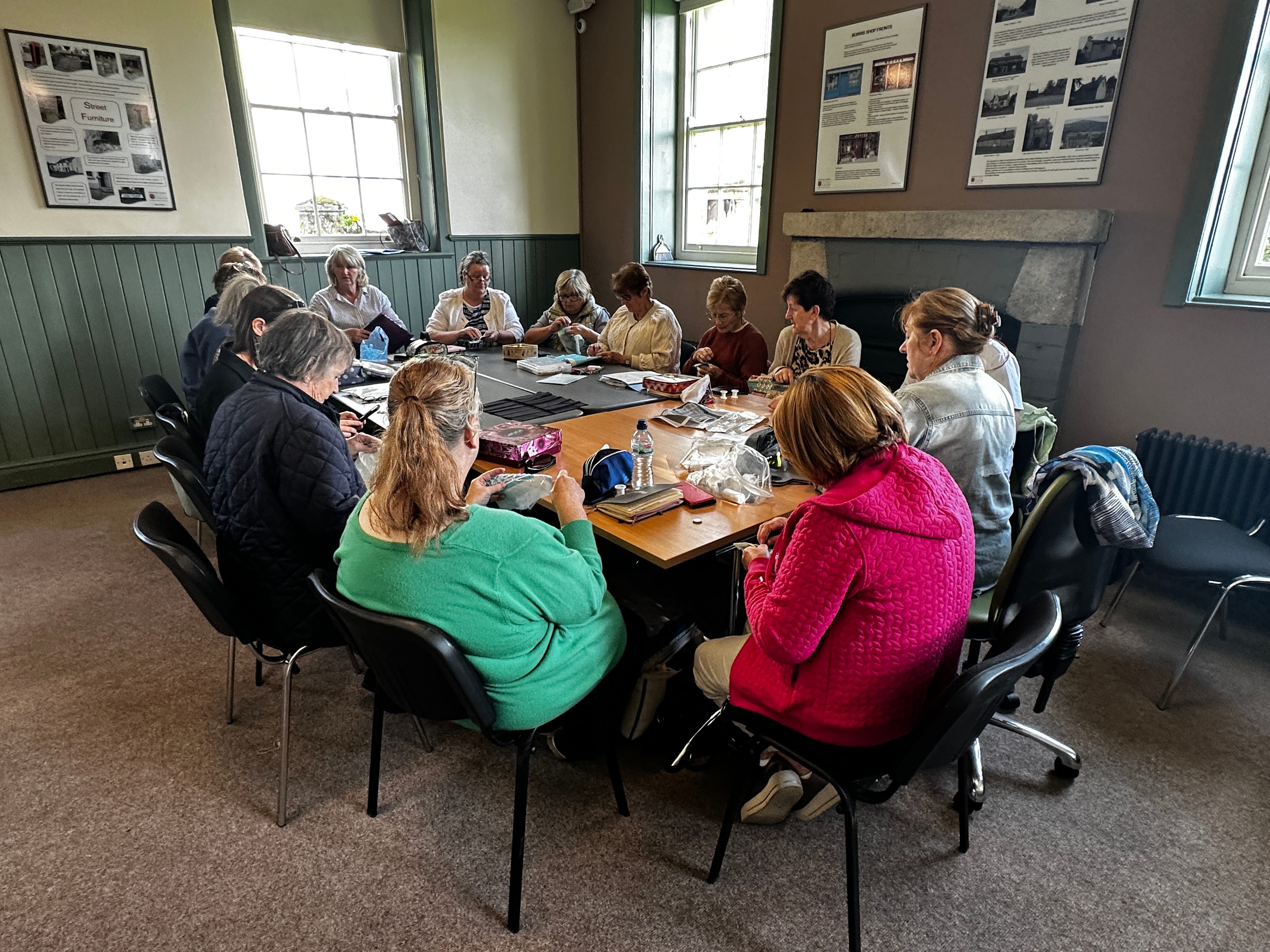
Only one woman was there when I arrived. I introduced myself and she told me to have a seat, so I did, at a long run of tables pushed together under tall sash windows, a stone fireplace at one end of the room and framed photographs of old Borris shop fronts and estate buildings on the walls. Then the others began to trickle in, each with a bag or a tin or a zippered case, and by ten minutes past the hour the room was full, with a few more women arriving over the next two hours. Out came the work, spools of white thread, small scissors, a shortbread tin repurposed for supplies, a red binder with I ♥ LACE across the cover, and a mug with Santa Claus on it, in September, which told me something about this group before anyone said a word. One woman drew a length of thread out to arm’s length, and another was working a seam ripper through a scatter of pale stitches on a piece of dark green cotton, picking them loose one at a time.
I was introduced around the table as a friend of Nicola, which in Borris appears to be all the credential a person needs. I asked whether anyone would rather not be photographed, and then mostly I listened. Every woman there had a piece in some state of completion. A few were beginners and many had been at it for decades, most came from Borris and the villages around it, and the talk moved without a seam between what was happening with somebody’s family and how a particular stitch ought to go. Nobody stopped working to talk, and nobody stopped talking to work.
Under the Surface
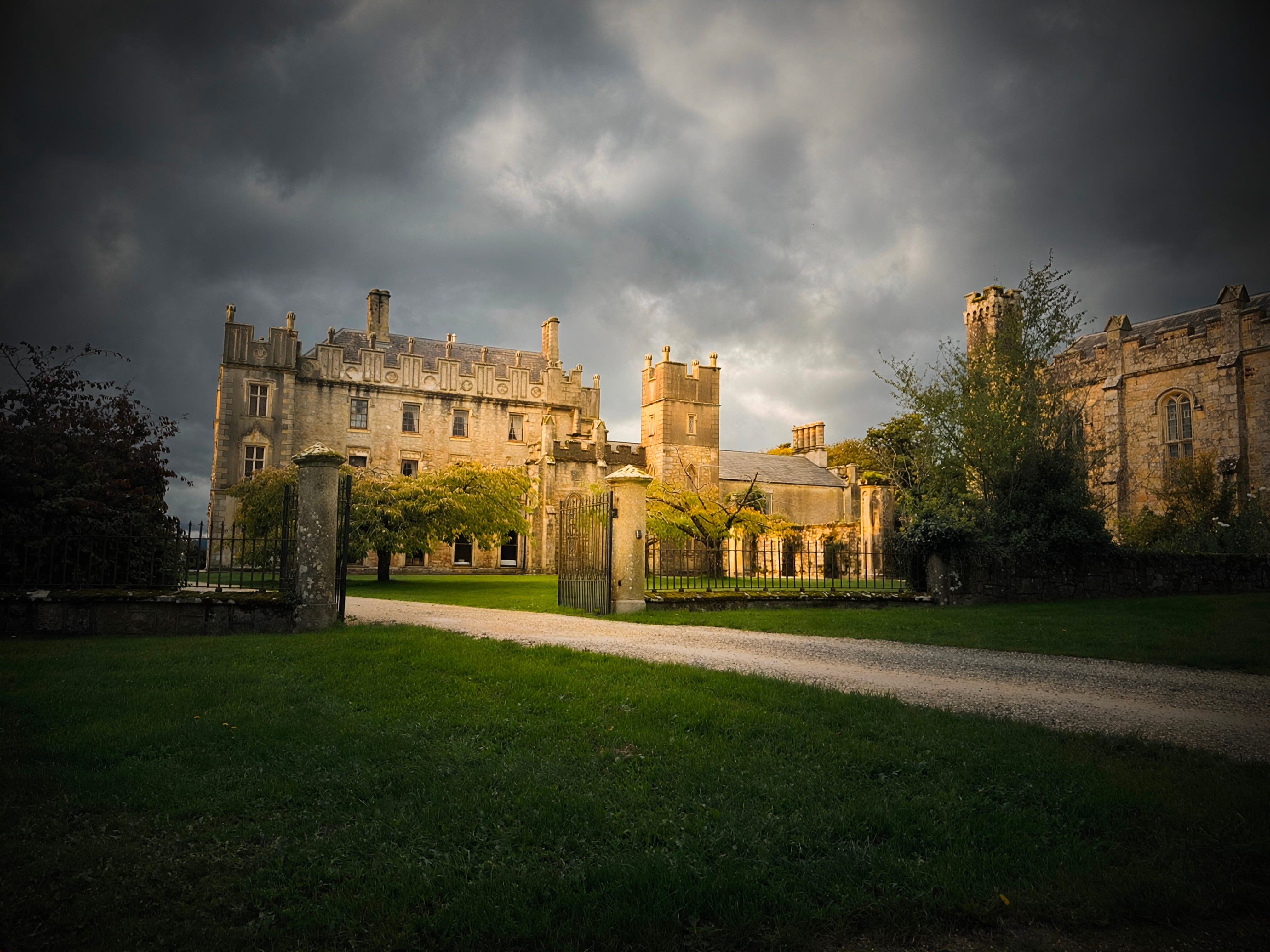
The story of Borris lace begins in the worst years this country has known. When the potato failed in the 1840s and the Great Famine took hold, Lady Harriet Kavanagh was mistress of Borris House, a widow raising four children on the estate, among them a son named Arthur who had been born without fully formed arms or legs and whom she taught to paint and write with a brush held in his mouth. Harriet was a traveler and an artist herself, a woman who drew and painted and kept journals, and on her trips abroad she gathered pieces of old lace from Italy and from Corfu. She came home convinced that the women of the estate, already known as good hands at plain sewing, could learn to make something like it, and that it could be sold. Local accounts date the beginning to 1846, the first terrible year, while other histories put the real start in the 1850s, after her visits to Corfu. The dates depend a little on who you ask, but the reason doesn’t.
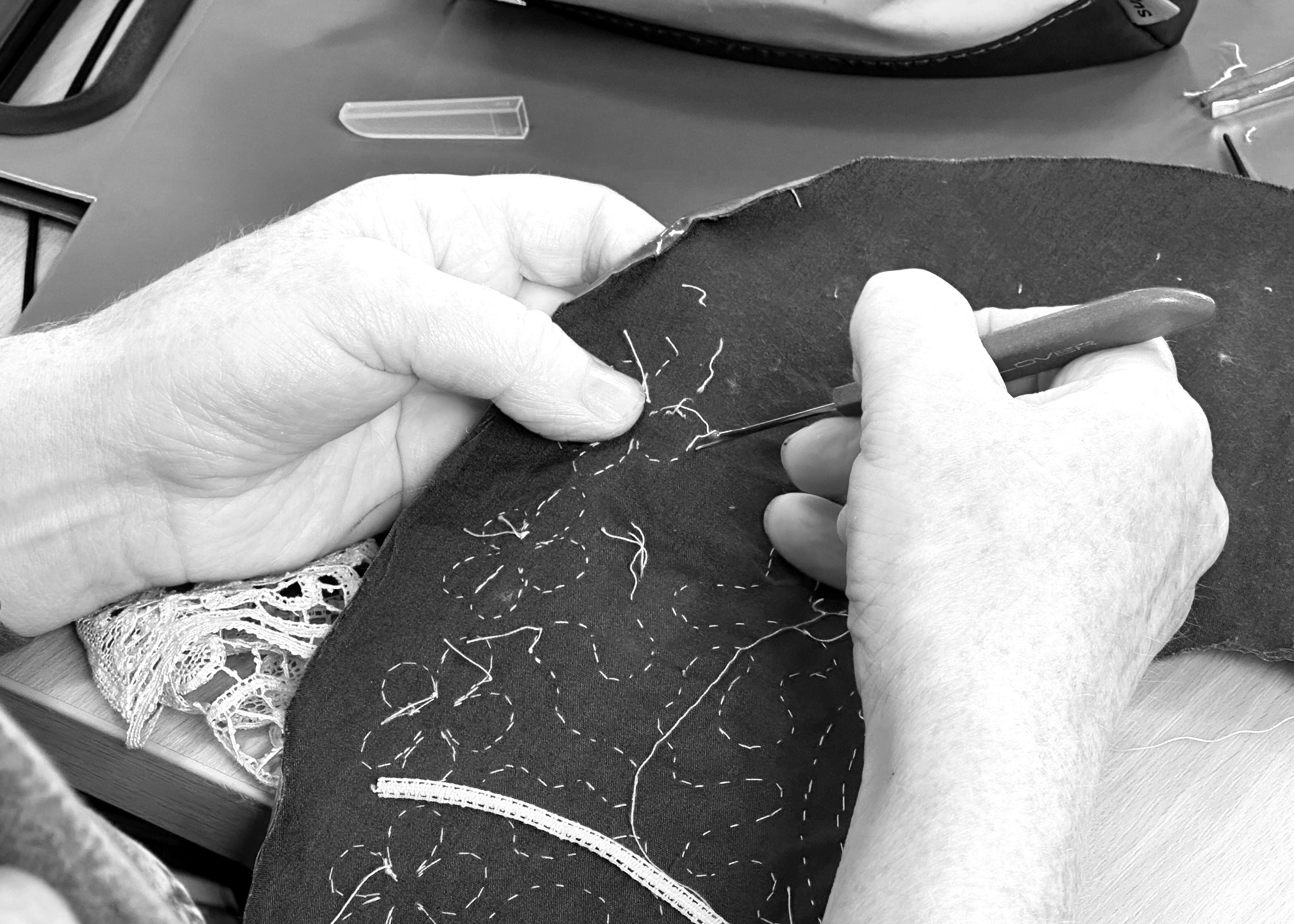
The method she settled on is still the one I watched on Wednesday, and a framed display on the library wall lays it out in four panels. A pattern is drawn on paper and layered with cotton fabric underneath and a clear adhesive film on top. A narrow machine-made tape (which is getting harder and harder to source) is laid along the lines of the design and fastened down with small tacking stitches worked right through the layers. The lace itself, the fillings and bars that fill the open spaces between the tape, is stitched by needle on top of all of it. Then, at the very end, the maker flips the whole assembly, snips the tacking stitches from the back and unpicks them, and the lace comes away free, holding its own shape for the first time. That was what the woman with the seam ripper had been doing. She was letting a piece go.
Lady Harriet drew many of the early patterns herself, and after Arthur married in 1855, his wife Frances took the enterprise further, running weekly classes, handing out materials, and designing patterns of her own. The lace was sold through the Irish Linen Stores on New Bond Street in London, a sample was presented to Queen Victoria, and orders came from England and the Continent and, more and more, from America, collars and pillow covers and trims going out from a village in south Carlow to people who would never see it. The Times of London described it in 1909 as a modern reproduction of Point de Milan, copied from beautiful old Italian models. The First World War began the long decline, with materials costing more, fewer hands to do the work, and machine-made lace undercutting everything, and by 1960 only a handful of women were still making it. After revival attempts that never quite took, an Australian lacemaker named Marie Laurie, who had spent years documenting the lace collection at Borris House, offered workshops in 2016, and the group I sat among grew out of those. Borris lace is now the only known surviving Irish tape lace.
I had come in thinking of it as a story about income, and it was, in years when any income at all could matter enormously. I had also been thinking of it as dignity, skilled and beautiful work rather than charity handed down from the big house. But at that table I began to think Lady Harriet made something else as well, whether she meant to or not. She made a reason for women to gather. There is good research on this, a 2010 review by Julianne Holt-Lunstad and her colleagues that pulled together nearly a hundred and fifty studies and found that people with strong social relationships were about fifty percent more likely to survive over the periods studied than people without them, an effect comparable to quitting smoking. I didn’t need the numbers on Wednesday. You could see it in the room, in the way a question about a stitch opened onto a question about someone’s daughter, and in the way one woman would lean across to look at another’s work without being asked
.
Studio Notes
I stood in front of that framed display for a long time, longer than a person who doesn’t sew has any reason to, reading it the way I used to read a good lesson plan. Four panels, four captions, the whole process visible at a glance: The Assembly, Laying the Tape, Stitching the Lace, The Finished Lace. Years in a classroom will do that to you, and I kept admiring how cleanly it teaches, how a stranger can stand there and understand in two minutes what takes years to do well.
My grandmother made lace. I have doilies and handkerchiefs she made, and standing there I realized I don’t know how she made them, whether it was anything like this or something worked with a tiny hook or a set of needles so fine I can’t picture her hands around them. I found myself rubbing my thumb across my fingertips, the way you do when you’re trying to remember the feel of something. It’s a strange thing to own the finished work of someone you loved and not know the first thing about how it came to exist, and I suspect a lot of us have a drawer somewhere with exactly that in it.
In the studio I have my own version of tacking stitches, though I never thought of them that way until Wednesday. The painter’s tape that holds a collage in place while the medium sets, the clamps on a panel, the masking I peel from the edge of an encaustic piece once the wax has cooled. None of it shows in the finished work, and most people who look at the finished work never think about it. I peel it away, and the piece either stands on its own or it doesn’t.
The conversation turned to education by way of the room itself. A few of the women told me that the part of the library we were sitting in used to be their school, and that some of their husbands had gone there too, and I looked around again at the tall windows and the stone fireplace and tried to picture rows of small desks where the tables stood. We talked for a while about the one-room school and everything that went with it when those schools closed, the older children helping the younger ones, a teacher who knew every family, a building that belonged to the whole community rather than to a district office miles away. Nebraska once had nearly seven thousand one-room schoolhouses, and as late as 1986 it still had more than any other state. Now, I am not sure how many, if any, are left. The schools remaining consolidated into larger districts, and the kids ride a bus past the buildings their grandparents learned in.
From there the talk drifted to what else has been lost, and it turned out the women of Borris and an artist and retired teacher from Nebraska had the same complaint. Nobody teaches the basics anymore. How to make a pot roast, darn a sock, sew a button back on, bake bread, scones or a cake, change the oil in a car or change a tire. The small, necessary skills of caring for yourself and a home used to be a rite of passage, taught by mom and dad and reinforced at school, and now they are nearly gone except in the most diligent rural households, and rarer still in town. One of the women kept stitching the whole time she talked about it, and I remember thinking the lace itself was an answer to the complaint, a skill that nearly vanished and came back because a room full of people decided to learn it together.
On the Table
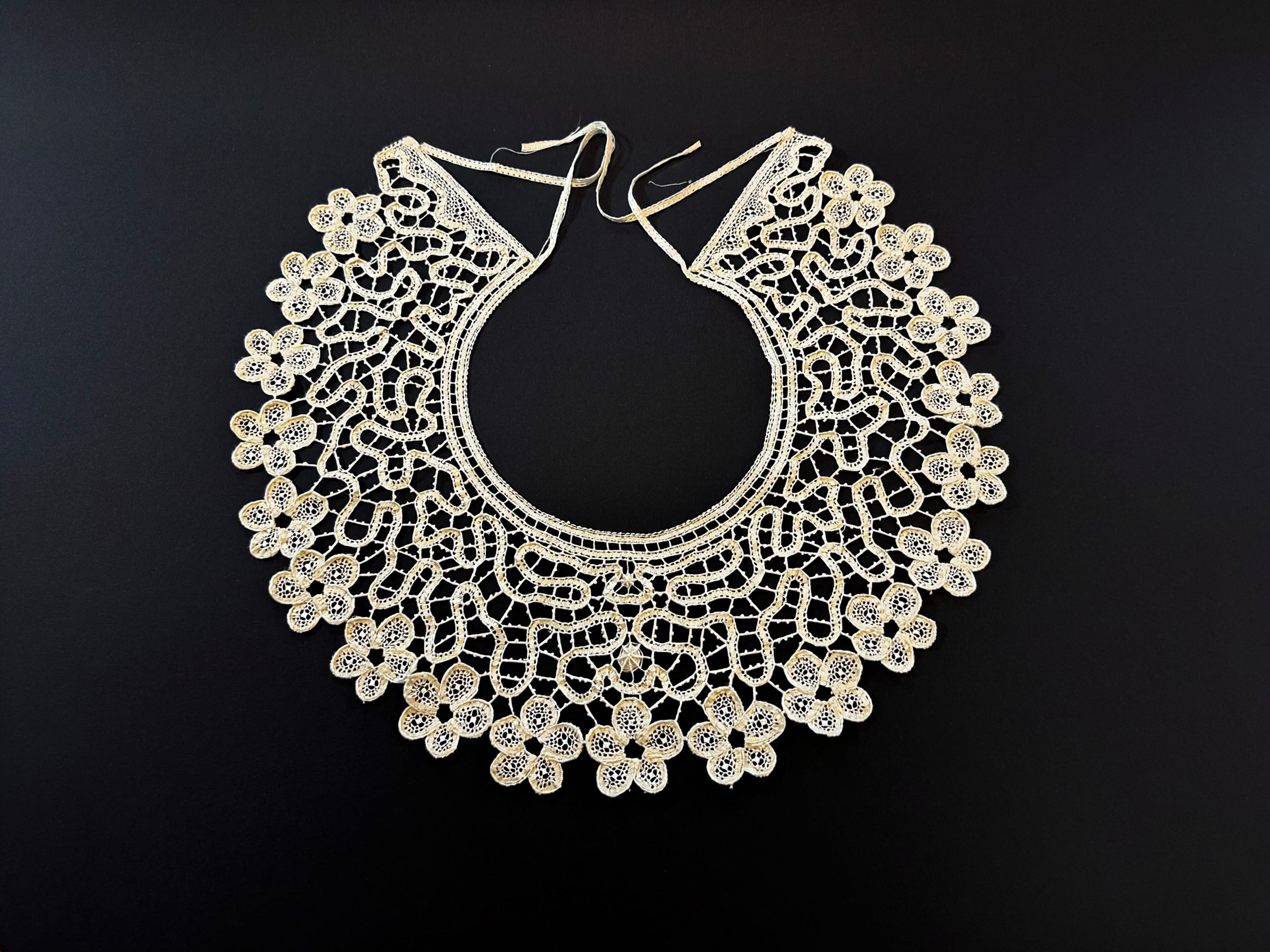
One piece was finished just as my time there came to an end, a collar, though I’m not certain that’s the proper term. It was laid out on a length of black cloth so the white would show, a wide half circle of looping tape and open fillings with a border of small flowers all the way around the outer edge, the thin ties still trailing loose from the neckline. More than sixty hours of attention went into that piece, sixty hours of evenings and Wednesdays, a stitch at a time. Earlier in the morning I had watched two of the women hold a length of lace up between them, one pinching each end, while a third stood behind them talking with her hands, and I understood that nothing made at that table is ever finished by one person alone, even when only one person’s hands did the stitching.
I asked what happens to most of the pieces made there. Gifts, mostly, was the answer. There’s no way to put a price on the time it takes, and nobody seemed troubled by that. Somewhere there is surely still a market for work like this, the way there was when the lace went out to London and America, but the women I met aren’t making it to sell. They’re making it for the people they love and for the pleasure of the making, and I thought of my grandmother’s handkerchiefs again, and how they were probably gifts too, handed across a table somewhere a long time ago.
In Good Company
Watch: The Quiet Girl (An Cailín Ciúin), Colm Bairéad’s 2022 Irish-language film adapted from Claire Keegan’s novella Foster. A quiet girl is sent to spend a summer with relatives on a farm, where she is taught, without fuss, the small everyday tasks of a household and what it feels like to be cared for. Nominated for the Academy Award for Best International Feature.
Read: Bowling Alone by Robert D. Putnam. The classic study of how Americans stopped joining things, the leagues and clubs and circles that used to gather people around a shared purpose once a week, and what we lost when we stopped. I thought about it more than once at that table in Borris.
Listen: The Borris Broadcasts, the podcast of the Festival of Writing and Ideas, which gathers writers and thinkers each year on the grounds of Borris House, the same estate where the lace began. I so wish that the Festival of Writing was here at the same time I was. Maybe next year.
A Quiet Note
During the lockdowns of 2021, Borris lace went out by post, monthly packs of materials, instructions, and a little history mailed to older people at home and in a local nursing home, so that nobody had to stop making just because they couldn’t gather. I loved learning that. It’s the same instinct behind Unhurried Letters, something slow and handmade arriving in the mailbox instead of the inbox, meant to sit on the counter for a while. You can find it at unhurriedletters.com.
Leave the Light On
Near the end of the morning the talk turned to Christmas. The venue for the annual party was booking up and a decision needed making, and delight settled over that table as the subject came up, eyes brightening, voices lifting, the way a room changes when everyone in it is looking forward to the same thing. I have no doubt it will be the event of the season. I tucked my phone away, thanked them, and walked back out past the church to the car. The whole morning had felt like a warm blanket on a cold day, and cozy is the only word I have for it.
On the drive home I kept thinking about those tacking stitches, how they hold the tape to the pattern while everything else is built on top, and how at the end they’re snipped from the back and pulled out, so that nobody who wears the collar or folds the handkerchief ever knows they were there. Lady Harriet drawing patterns from lace she found in Corfu. Frances running her weekly classes. An Australian woman documenting a collection and deciding to teach. Nicola picking up the phone, and Mary saying absolutely. None of it shows in the finished piece. All of it is why there is one.
I need to come up with something to give the group, something that says thank you properly, and I’ve been thinking about it with my hands since I got back to the house, which is usually how I know something matters to me. Whatever it is, it will have to be made slowly. Anything else would feel wrong in that room.
Keep making, keep growing, be you.
Tio
“None of it shows in the finished piece. All of it is why there is one.”
References
How the story of Irish lace is adding a new chapter in Borris, RTÉ Brainstorm: https://www.rte.ie/brainstorm/2023/0328/1366731-irish-lace-borris-lacemakers-history-tradition-craft/
Borris Lace, The Guild of Irish Lacemakers: https://irishlaceguild.com/laces/borris-lace/
Borris Lace, BorrisCarlow.ie: https://www.borriscarlow.ie/borris-lace
Borris Lace, Laces of Ireland: https://lacesofireland.ie/types-of-lace/borris-lace/
Harriet Kavanagh, Wikipedia: https://en.wikipedia.org/wiki/Harriet_Kavanagh
The Borris Lace by Post Project, Age Friendly Ireland: https://agefriendlyireland.ie/initiative/the-borris-lace-by-post-project/
Holt-Lunstad, Smith & Layton (2010), Social Relationships and Mortality Risk: A Meta-analytic Review, PLoS Medicine: https://journals.plos.org/plosmedicine/article?id=10.1371/journal.pmed.1000316
The Quiet Girl (2022), dir. Colm Bairéad: https://en.wikipedia.org/wiki/The_Quiet_Girl
Bowling Alone by Robert D. Putnam:
http://bowlingalone.com/
The Borris Broadcasts, Festival of Writing and Ideas:
Nebraska’s One-Room Schoolhouses, Nebraska Life: https://www.nebraskalife.com/blog/post/nebraskas-one-room-schoolhouses
WBUR Here & Now: One-room schoolhouses are still a lifeline for rural communities
Unhurried Letters: https://unhurriedletters.com
One-Click Check-In
If you want to read this later or find other issues, you can find them here or hit subscribe.