
Living by Making | Issue 36
This has been a glorous week in the Ancient East of Ireland. The locals tell me they don’t refer to this area as that, only a marketing phrase drummed up by someone somewhere. I like it though and really from my short 5 week observation and field study, it seems to fit. Anyway, many adventures and experiences this week, here is one of my favorite.
At the Workbench
The gate was iron, closed and locked, and there was a black Mercedes parked behind it. The GPS said I had arrived. I sat there in the rain with the engine running and the wipers going, looking at a nice house behind a nice fence, with no idea how to get from where I was to where I was supposed to be, and did the only thing I could think of. I opened my laptop on the steering wheel and wrote an email that said, more or less, I’m here, or at least the map says I’m here, where do I come in?
It had taken most of the afternoon to get that far. At three o’clock an email came from Tammi, who had been trying to reach me on WhatsApp and sent her number again, and I tried it every way a man from Nebraska can think to try an Irish phone number. I dropped the zero in front of the country code. I put it back. I dropped the zero in front of the region and kept the other one, and nothing would connect, not a call and not a chat. So I wrote back by email, and the answer came almost at once. She had talked to her husband, and it was fine for me to come by the forge. I said I could leave in fifteen minutes. I walked Pip around the yard, found my coat, typed the Eircode into the GPS and rolled down the lane, and the drive itself was the easiest part of the day, narrow roads winding between hedges gone heavy and dark with rain.
A few minutes after my email, her husband came out to the gate and pointed me around the corner to a second entrance I would never have found on my own. I pulled in between the house and a low block building and parked, and when I looked up Patrick was standing in the doorway of the shop. He is every bit of what you picture when somebody says the word smith. Broad through the neck and shoulders and arms, the kind of strength that only comes from years of lifting heavy things and putting them down carefully, a bald head, and a smile that took up most of his face.
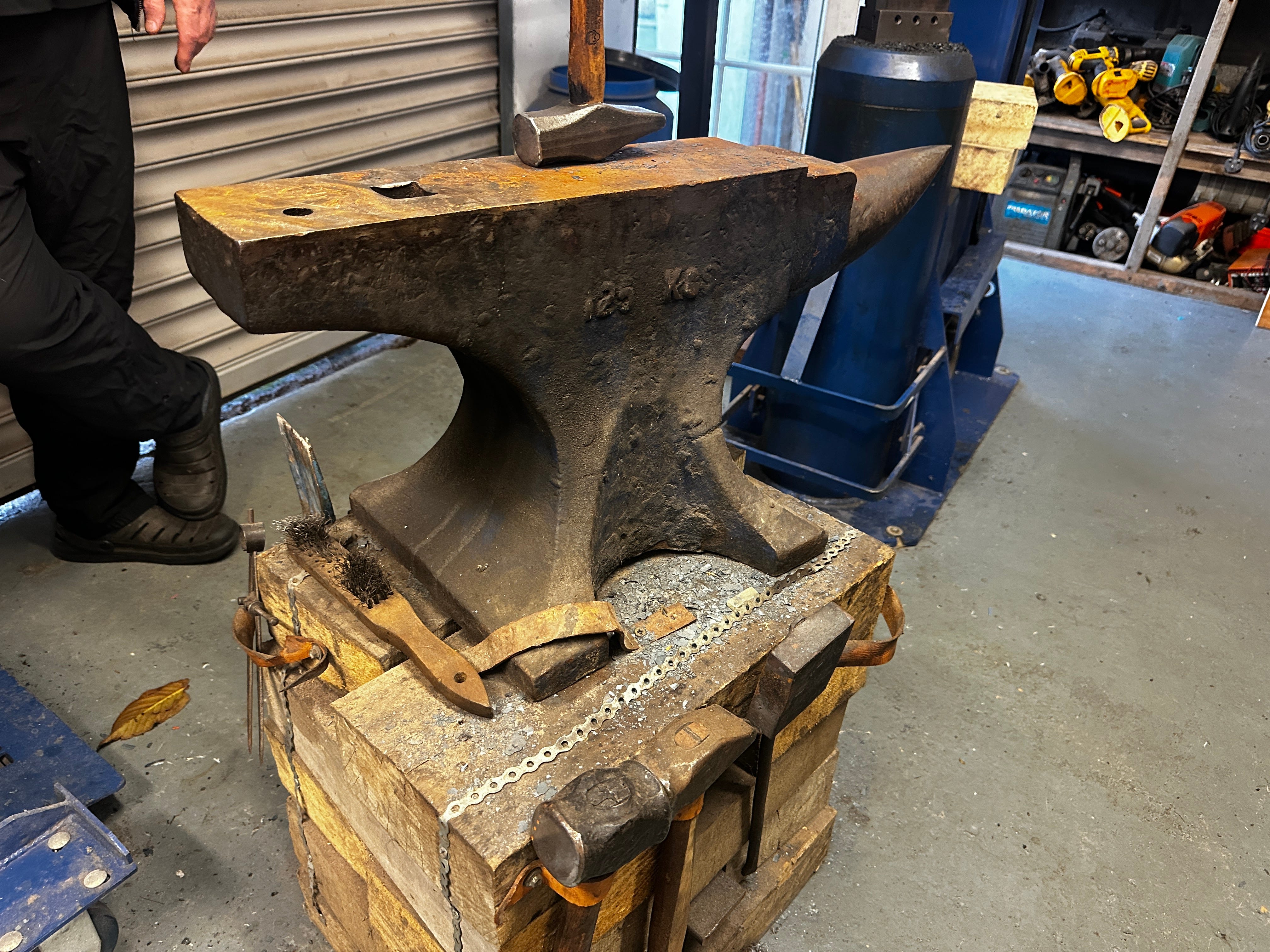
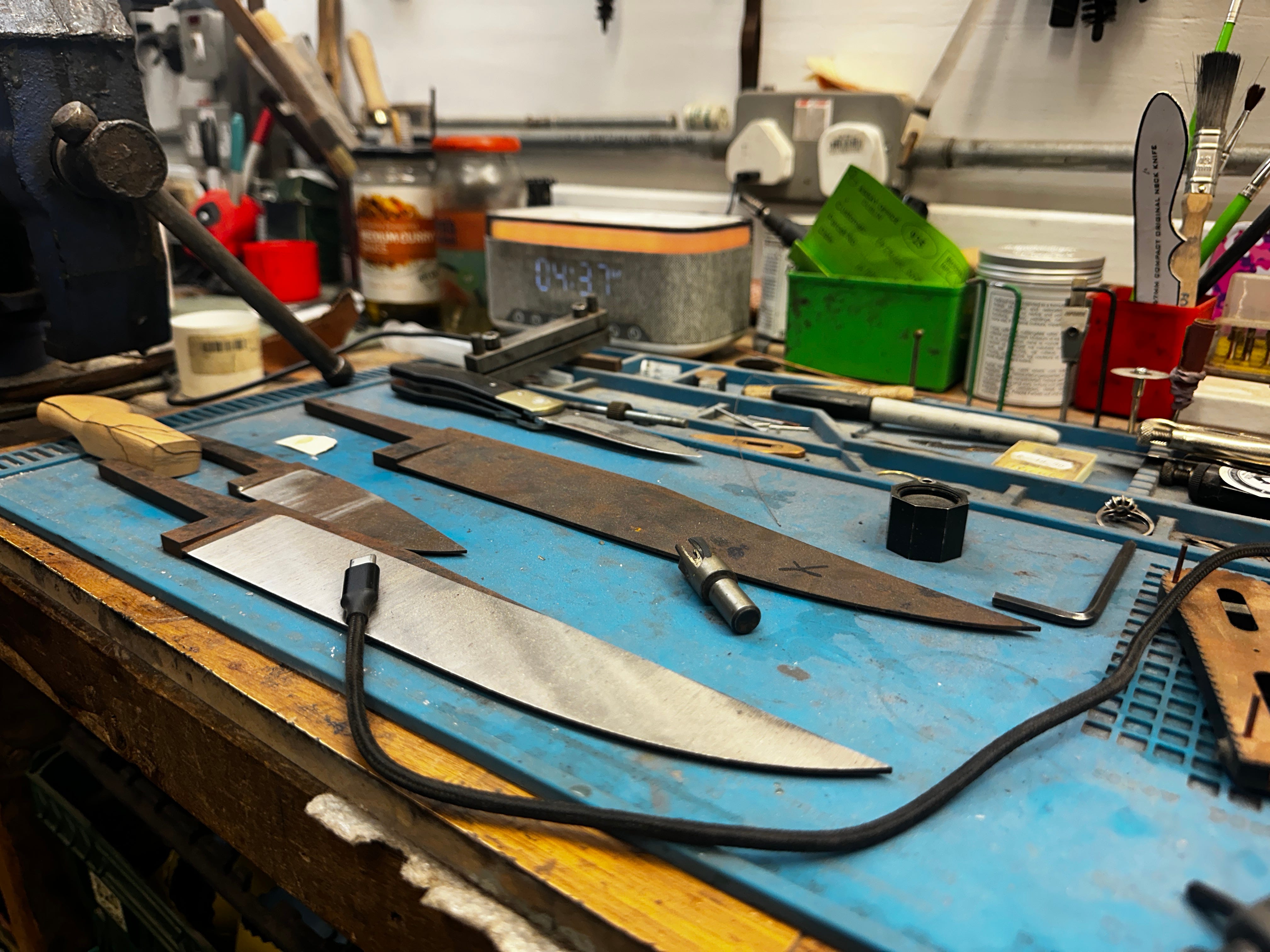
The shop might have been twenty feet by twenty, though I’m only guessing, and every inch of it was spoken for. Tools hung on every wall, hammers and files and pliers and things I had no names for, and in the middle of the floor sat an anvil on a stack of strapped timbers, its face worn the color of rust from use, with a hammer laid across it as though someone had set it down mid-thought. On the workbench, among half-finished blades and a little clock radio that read 4:37, sat a jar of medium curry sauce. I liked him before he said a word.
Under the Surface
He told me his story with a block of wood in his hands, turning it slowly while he talked. He had been a gas engineer in England. One day he was sitting still on his motorcycle when a car hit him from the side at sixty miles an hour, and the impact threw him into the air and he came down on his head. He had on a good helmet, and he will tell you plainly that it is the reason he is alive. The papers that have written about him since say he broke his back in five places. He also had a traumatic brain injury, and it took his words. He had to learn to talk again, what words meant and how to shape them, and after that he had to learn to walk. For two years he was in a wheelchair while Tammi went out to work, and he stayed home with the kids, and they made things together at the table, crafts and art projects, whatever kids make. That was when his hands began to come back, he said, and his brain came back with them. Leather was the first thing that stuck.
I told him about our oldest son, who broke his neck when he was sixteen. I don’t tell that story often, and I didn’t plan to tell it in a knife shop in the Irish countryside, but it came out of me the way things do when you recognize someone. Patrick stopped turning the wood. For a while we weren’t a maker and a visitor anymore, just two men who had both seen how much a body can lose in one second, and how long it takes to get any of it back. We talked about what it takes for a human being to come back from something like that, the stubbornness, the patience, the people around you who refuse to quit before you do. And we talked about the hard part, which is that not everybody does come back. Some people never find their way through it, and nobody can say for sure why one person does and another doesn’t.
I wish I could give you his words from that part of the afternoon, and I can’t. I was listening too hard to remember them. What I remember is the way he talked about learning, as something you commit to and keep on committing to long after it stops being interesting, and about making, as the thing that pulled him forward when nothing else would. As he tells it, he tried to teach himself to make a knife from books and videos at first and got nowhere, so in 2016 he went to Kentucky and spent six months at the bench of the bladesmith Gil Hibben, and in 2021 he finished a degree in jewelry and goldsmithing. The man who once had to relearn the meaning of words now builds blades for people all over the world. I have watched athletes come back from injuries for most of my coaching life, and I have watched my own son, and I know there is no straight line through it. I am not sure I have ever stood so close to someone who made it through and then decided to spend the rest of his life making beautiful things with the hands that came back.
Studio Notes
I kept thinking about those crafts at the kitchen table long after I left. The neuroscientist Kelly Lambert has spent years studying what she calls the effort-driven rewards circuit, a network that runs through the parts of the brain handling movement, emotion and thinking, and her work suggests it comes alive when we use our hands to make something we can see and touch, a scarf on the needles, a garden coming up in rows, a thing finished and set on the table. Using the hands lights up more of the brain’s cortex than moving the legs or the back, and when the hands are busy with real work, the parts of us that concentrate and feel pleasure come along with them. That is a scientist’s way of saying what Patrick told me with a block of wood turning in his fingers. His hands came back first, and the rest of him followed.
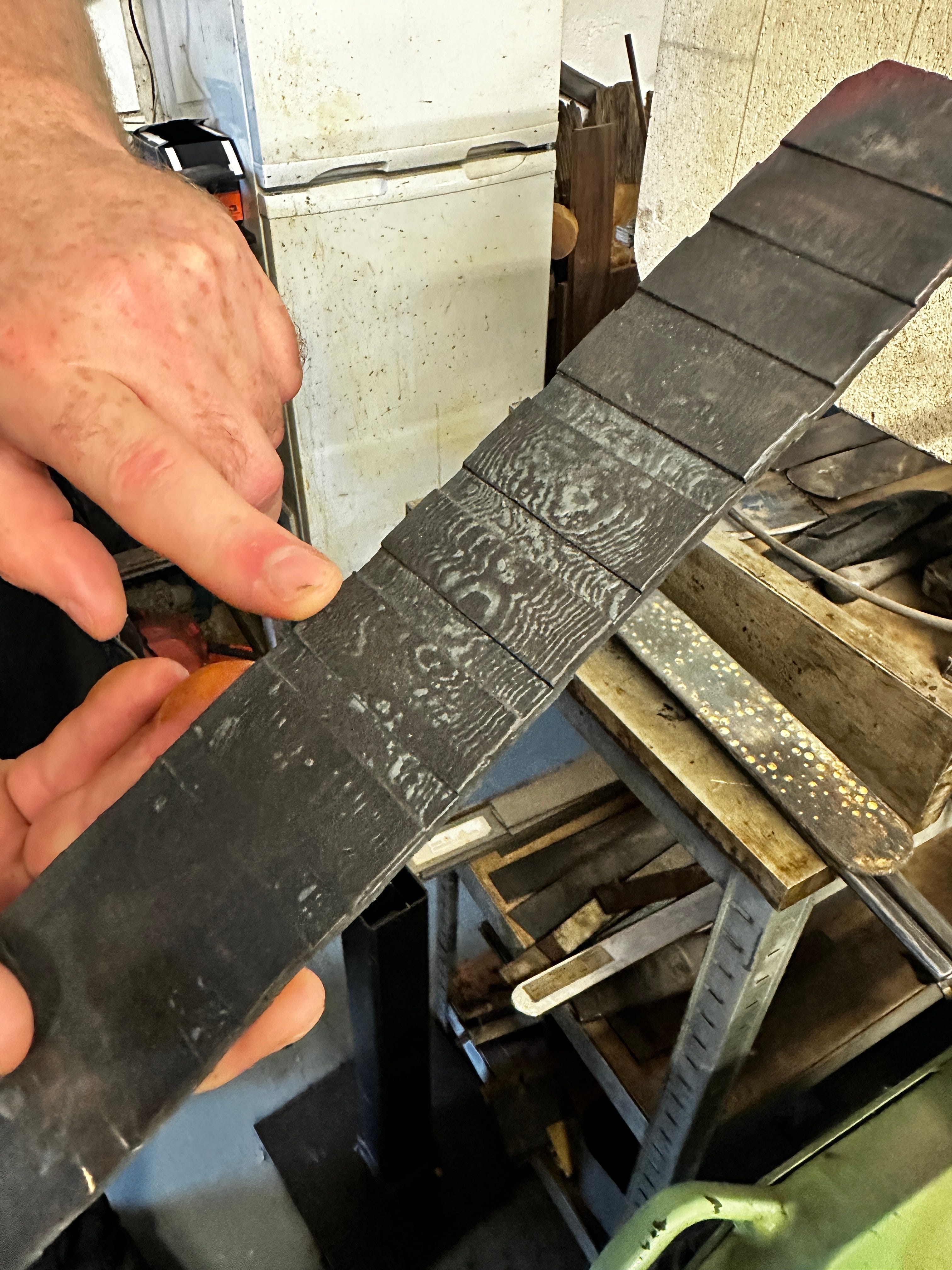
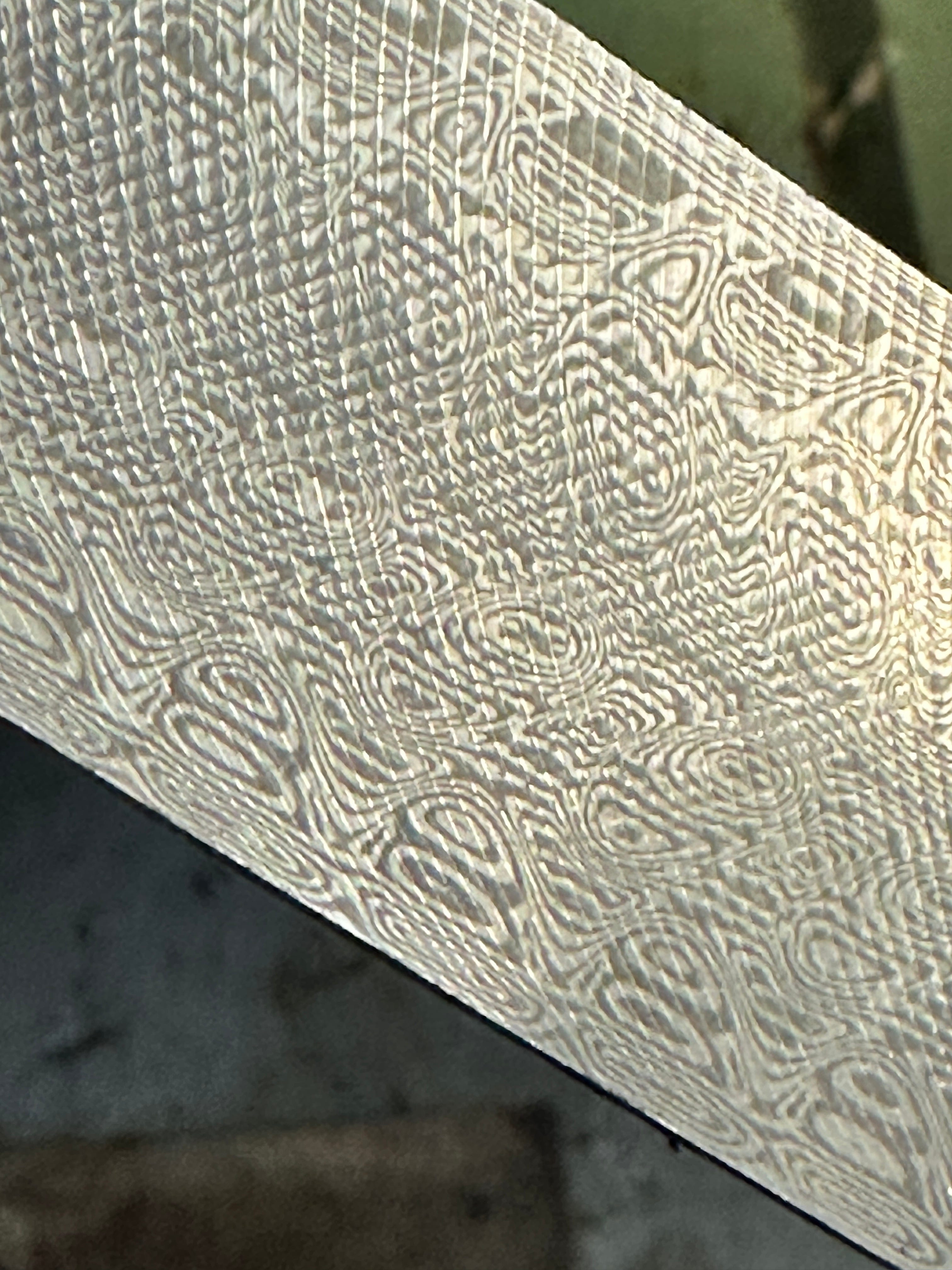
He told me how Damascus starts. He only does his forge work in the winter, so the forge sat cold that afternoon, but he walked me through it standing beside the anvil. The steel goes into the forge until it glows, comes out onto the anvil, gets folded over on itself and hammered back together, then goes back into the fire to be folded and hammered again, the layers doubling each time. He held out a long billet so I could see it, dark grey and stepped into sections like a ladder, and in a few of the sections a pattern was just beginning to rise out of the grey in rippled silver lines. Then he handed me a finished piece. It looked like rings spreading on still water, or the end grain of an old tree, with fine straight lines combed through one corner. The pattern was in the steel all along. The folding put it there, and the etch only brings it up where you can see it.
That same morning I had unwrapped two sweaters from my dye pot, both rolled around a heavy iron pipe, and they came out dark and murky, the leaves showing through like ghosts. Iron does that in a dye pot. Dyers call it saddening, which is exactly the right word. Standing in Patrick’s shop that afternoon I was looking at iron that had been heated and folded and struck a few hundred times over, and it was the most beautiful surface in the room. Same metal. It all depends on what you ask of it, and how many times you are willing to put it back in the fire.
While he showed me the billets, he said something I keep coming back to. These old, slow skills have to be passed on to the younger ones, he said, or they will simply be lost. Not hidden or forgotten for a while, lost. He teaches courses for exactly that reason, and on another bench sat the stacks that prove people are listening, knife handle blanks in exotic woods and in wood and resin poured together, a cream and orange burl swirled through clear resin, another in deep cobalt, another in oxblood red. He told me a good pair sells for sixty dollars or more at knife shows in America. I have been pouring resin into wood for years, and I stood there with a blank in my palm about the size of a deck of cards, thinking that I could make these. I think I will.
On the Table
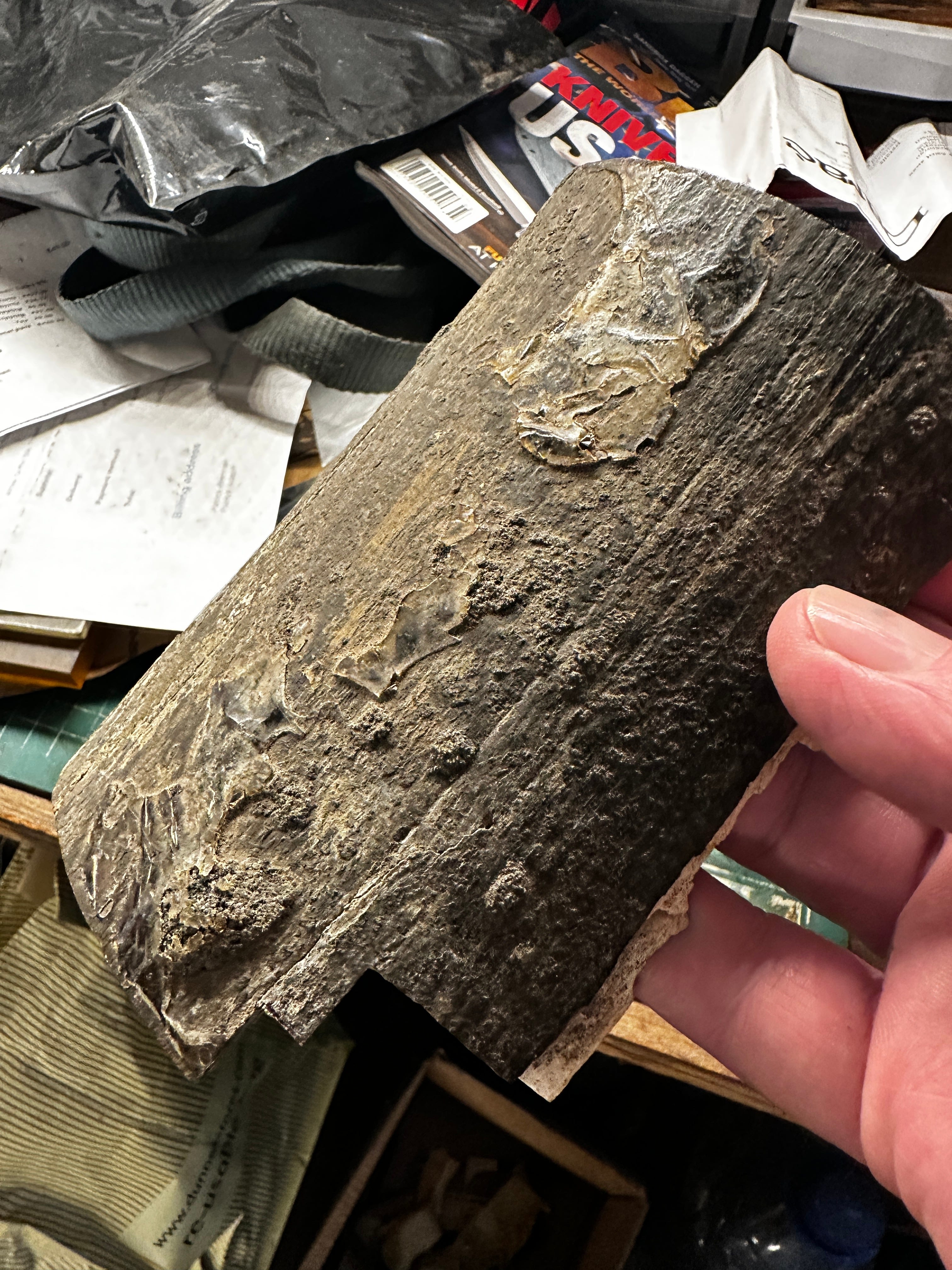
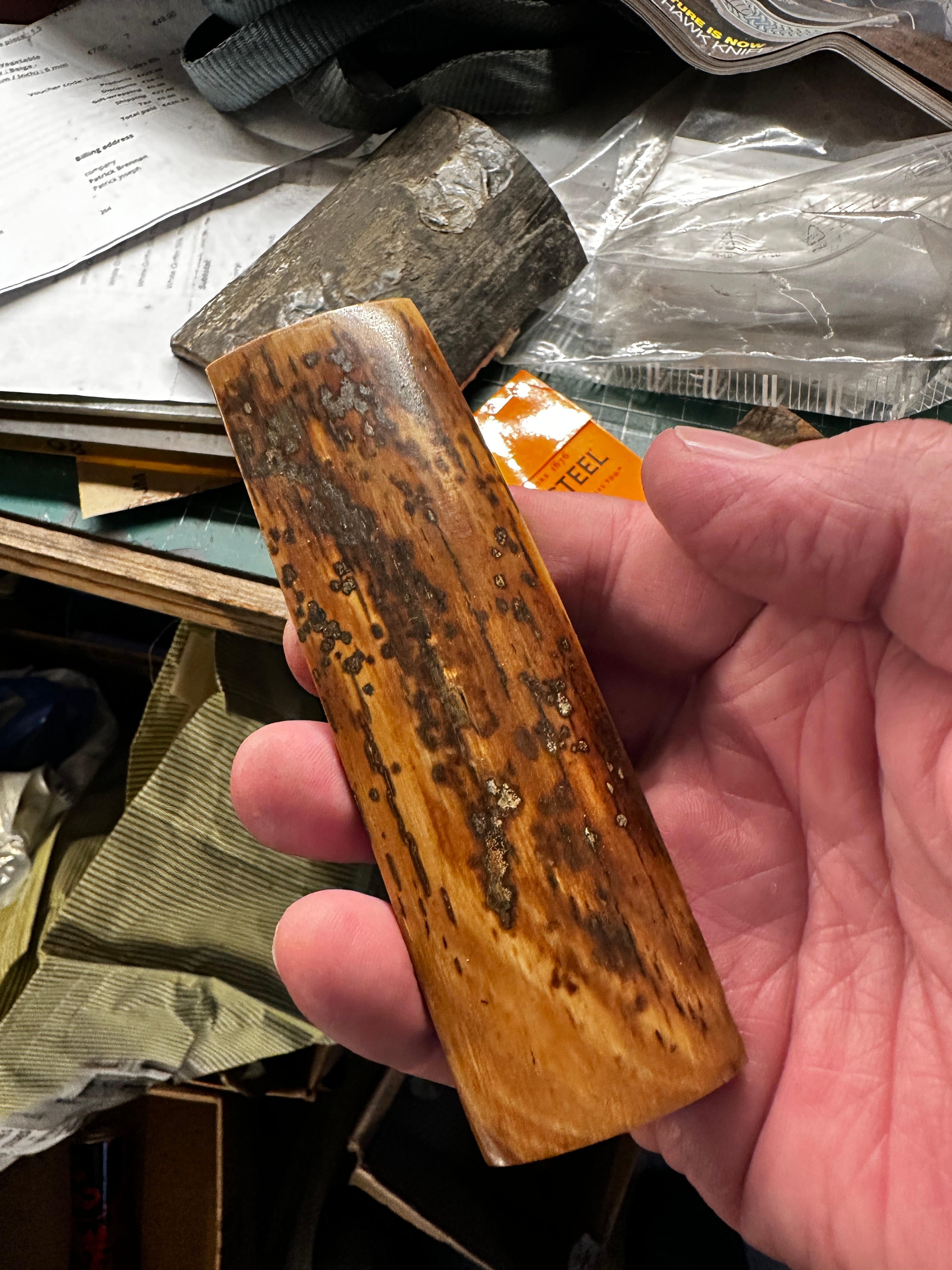
I thought the tour was over. I had seen enough to be impressed for a month, and I was working out how to say thank you and get out of his way, when he started up the stairs, and it was exactly like one of those old Ginsu knife commercials. But wait, there’s more. Upstairs was leatherwork and jewelry and a little woodworking, and a CNC machine he uses to carve handle blanks. He set a ring in my palm, gold knotwork over a band of white metal, and it was heavy the way only precious metal is heavy. He said there was something like ten thousand dollars of platinum and gold in it. He showed me a piece of mammoth ivory, rough and weathered grey on the outside with glassy patches like old ice, and then a polished slab of it, glowing the color of honey and freckled all over with dark spots. A lot of the knives he makes, he said, go out as corporate gifts, closer to men’s jewelry than to kitchen tools, and plenty of them end up in a safe and hardly ever get used. Mostly that’s the daily carry knives, he said, not the kitchen knives he makes for chefs around the world.
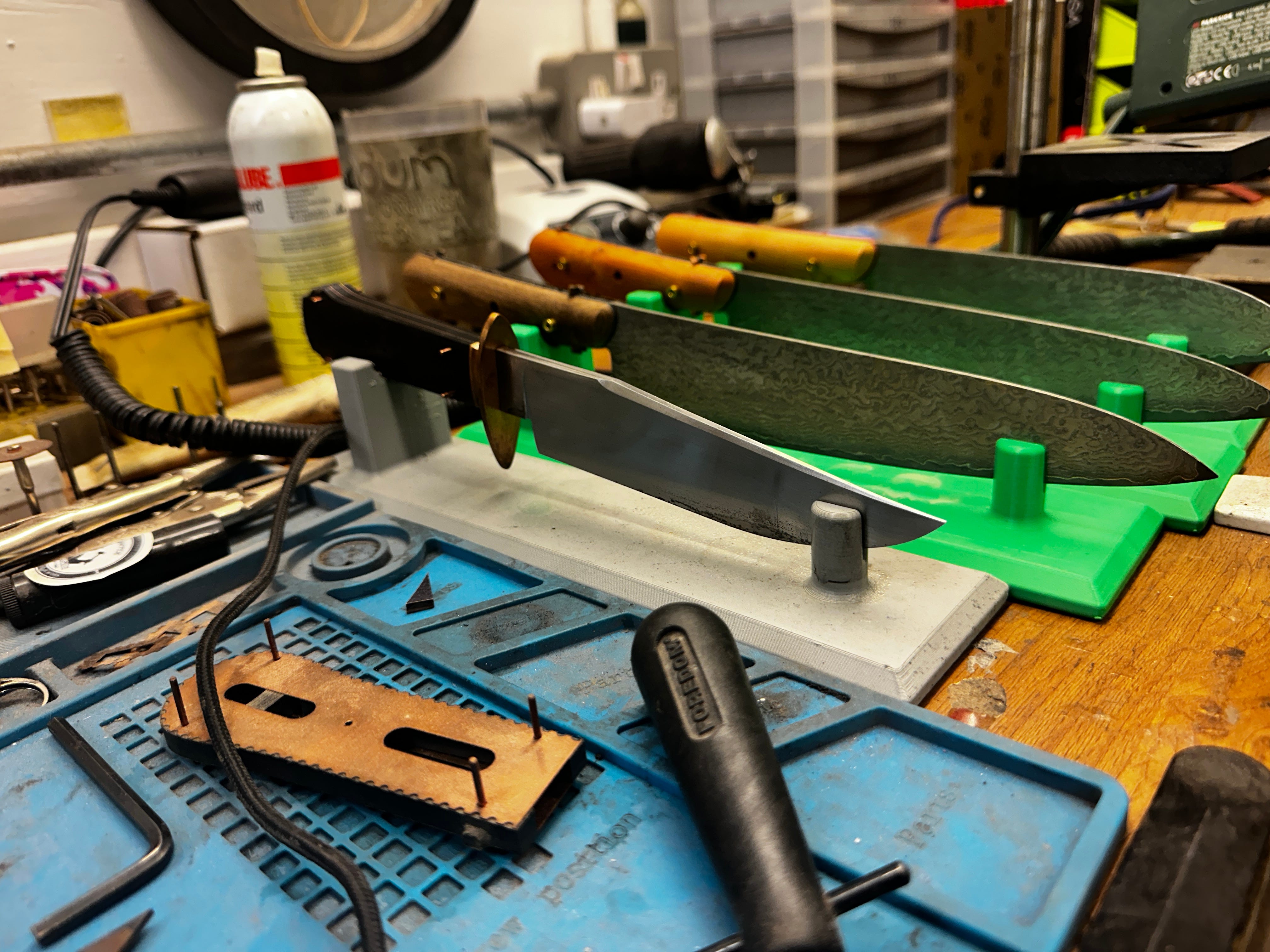
On the bench downstairs sat a row of his chef’s knives on little stands, Damascus blades with wooden handles and brass pins, and I will admit I looked at them longer than was polite. One of those knives runs around twenty-five hundred dollars. He also teaches a longer course where you make your own chef’s knife at his bench, start to finish, and that costs about the same. That is the one I want. I don’t want a knife for a safe. I want one with my own mistakes ground out of it and his corrections in it, one I will reach for every night and run down a stone for the next twenty years. I have one week left in Ireland, and part of me is sad about that and part of me can’t wait to get home to everything waiting for me there. If I get to come back next year, I know where I’ll be spending some of it.
The most useful thing he gave me didn’t cost a thing. It was the name of a stone, a King whetstone, 1000 grit on one side and 6000 on the other, about fifty dollars, and he said it will last you the rest of your life.
So here is something small for your own table this week. Find twenty minutes for something with your hands that ends in a thing you can see, a loaf of bread, a darned sock, a sketch, a row of seedlings, a dull knife brought back to an edge, and do it slowly, with nothing playing in your ear. It doesn’t have to be good. Nobody at Patrick’s kitchen table was making a masterpiece, and that was never the point.
In Good Company
Watch: Handcrafted: A Story of Fire and Steel, a short documentary from Icon Paradigm Productions about four German makers, the knifesmiths Jörg Heckel, Matthias Zach and Jozef Ros and the knifemaker Stefan Steigerwald, who still forge their Damascus by hand when a factory could do it faster. The filmmakers sum them up in one line I liked very much: for them the process is the reason. It is the closest thing I could find to standing in Patrick’s shop with the forge running.
Read: The Hand: How Its Use Shapes the Brain, Language, and Human Culture by Frank R. Wilson. Wilson was a neurologist who spent years with musicians, jugglers, surgeons and craftspeople, and his argument is that the hand and the brain grew up together and keep shaping each other for as long as we live. I thought about this book the whole drive home.
Listen: Artist Talk: Weaving and Natural Dyes with Catharine Ellis, from Slow Fiber Radio, the free podcast of Slow Fiber Studios. Ellis is a weaver and natural dyer who has spent decades learning how plant color and cloth behave together, including the mordants that change everything, and she talks about it the way a good teacher does, patiently and from the hands out. Put it on while your own pot simmers, or while you work that knife on the stone.
A Quiet Note
Some stories from out here are too small for a newsletter and too good to lose, so they go into the mail instead. Unhurried Letters is a handwritten travel story, a fine art print, a regional recipe card and a postcard, sent once a month and made from real trips and real photographs. If a slower kind of mail sounds good to you, you can find it at unhurriedletters.com.
Leave the Light On
As I was leaving, Patrick handed me a Sharpie and asked me to sign the wall. The walls by the door are covered floor to ceiling in handwriting, notes from people who have taken his courses or just come to visit, “I’ll never look at knives the same way again” and “Thanks a mil Patrick” and “Sensei Patrick” and “My eyes have been opened,” dated 2022 and 2024 and 2025, all of it crowded around a red fire blanket hanging in the middle. Sign it anywhere, he said. I found a spot about waist high, to the left of the door, and wrote “Great being here. Thank you!” and my name. A little later he mentioned that the names up above the door, gathered around a framed painting of an eagle, belonged to world champion knife and sword smiths, several of them winners of Forged in Fire who had come to study with him or were simply his friends. I’m glad I signed down low.
It was a quarter past seven and pitch dark when I pulled out, rain coming steady, forty minutes to home. Somewhere along the way the arrival time crept from eighteen minutes to twenty-two, and I started to wonder. Then I came to a stretch I knew, a little knot of houses built right up against both sides of the road, their walls and gates only a few feet off the pavement, and I realized I had already driven through it once on the way home. Then a white gate I had definitely passed before. It put me back in the military, on the night flights I rode along on, when there is nothing outside to tell you where you are, only the dark and the instruments and whatever you can make out directly below. This time I was the pilot, though. I slowed way down and watched. The GPS told me to turn left, and right on schedule a left turn appeared, and I was sure, as sure as I have been of anything, that I had already taken it three times. Every time I took it, the map started me over.
This time I went straight. Just over a small rise, maybe a hundred yards on, there was a four-way with a left turn of its own, and when I took that one the map didn’t reset. I had driven the same loop at least three times and lost forty minutes doing it. When I finally walked into the cottage, the chili I had made that afternoon was waiting on the stove, and then I got to talk with Allison, who listened to the whole day, the gate and the shop and the stairs and the white gate in the dark, and made it feel like a good story instead of a long one.
(Below is the song Fire and Steel. I wrote the lyrics, Suno produced the song. Real music? Maybe not but still fun to put my poems to music.)
Somewhere in the countryside outside Kilkenny, near Thomastown, there is a wall covered in the names of people who came to learn something old and slow from a man who once had to learn his own words over again. Mine is down low, to the left of the door. It is a good place to be.
Keep making, keep growing, be you.
Tio
“The folding put it there, and the etch only brings it up where you can see it.”
References
Patrick Joseph knives:
https://www.patrickjoseph.ie
“Forged by fire, sealed with skill,” Irish Farmers Journal: https://www.farmersjournal.ie/forged-by-fire-sealed-with-skill-859685
“Meet the Makers: Patrick Brennan, founder of Patrick Joseph knives,” IMAGE: https://image.ie/agenda/meet-the-makers-patrick-brennan-founder-of-patrick-joseph-knives-799129
Handcrafted: A Story of Fire and Steel, Icon Paradigm Productions, Vimeo:
Artist Talk: Weaving and Natural Dyes, Catharine Ellis, Slow Fiber Radio: https://slowfiberstudios.com/podcasts/
The Hand by Frank R. Wilson, Penguin Random House: https://penguinrandomhouse.ca/books/191866/the-hand-by-frank-r-wilson/9780679740476
Kelly Lambert, Lifting Depression: A Neuroscientist’s Hands-On Approach to Activating Your Brain’s Healing Power (Basic Books, 2008)
“Drawing on the Effort-Driven Rewards Circuit,” Psychology Today: https://www.psychologytoday.com/us/blog/arts-and-health/200808/drawing-on-the-effort-driven-rewards-circuit
Unhurried Letters: https://unhurriedletters.com
One-Click Check-In
If you want to read this later or find other issues, you can find them here or hit subscribe.