
Living by Making | Issue 34
What a great way to spend a few hours. if you love history and the feeling of solace you get from old spaces you will love the Mill at Cushendale. Thank-you to the family and friends that allowed me the visit their.
At the Workbench
Another crusty morning out here near Borris, the daylight coming up subdued and gray behind a wind that has hardly let up. My first ten days in Ireland were bright and sunny, the kind of weather that had the locals shaking their heads and telling me, almost apologetically, that it was not normal, that I should expect it cool and wet and windy. They were right. This is the Ireland they promised me, and it is windy, though somehow it is a different wind than the one that comes across the Nebraska plains, less of a shove and more of a steady press against the house, and the sound of it through the old walls made me want a fire in the wood stove. Not because I was cold, or even chilly really, just a fire for the comfort of it.
I stood there with the stove door open and the matches in my hand for longer than I would like to admit before I decided that was too indulgent at eight in the morning, closed the door, and made breakfast instead, eggs and toast and a pork chop (sorry, veggies). Then I wrote. Even though I miss playing in my studio and the smell of molten beeswax and oil paint, I love being able to write any hour I want here, and my mind seems clearer than it is at home, though I cannot tell you whether it is the seclusion settling my neurodivergent brain, the real, whole food, or just that there is less to do, less standing in the doorway waving its arms for attention.
Under the Surface
It is not that there is nothing to do. The things here are simply quieter about it. I have yet to walk more than five miles of the trails along the river, and I have spent only a few hours on foot in several of the villages around Borris rather than a full day in them. The rosehips for the jelly, or jam, or tincture, I have not decided which, are still out on the hedges. A friend gifted me some felt, and it sits folded on the chair by the window waiting for the eco dye pot. I want to take proper care of the glorious, established dirty pot Nicola keeps here, which sounds like a funny thing to say out loud, but any dyer will know exactly what I mean. Every one of those things I would file under the same heading, slow living, and none of them requires me to act like one of the productivity bros. I did that long enough.
About a year before I retired, I realized, the way a dog eventually figures out he has been chasing a stick and not a bone, that productivity was never the thing I was hungry for. Sixty-six years it took me to figure that out, and I mean, come on. Slow living as a way of life fits me the way minimalism never quite did, maybe because it is more attainable, maybe because it asks you to add attention rather than subtract things. So, with my fork in one hand and the last of the toast in the other, I started thinking about Tuesday, today as I write this, and the two o’clock visit I had booked at Cushendale. The form on their website would not work for me, so I called, and Trevor told me that was the usual way anyway, by phone or email, and just like that I was on the calendar.
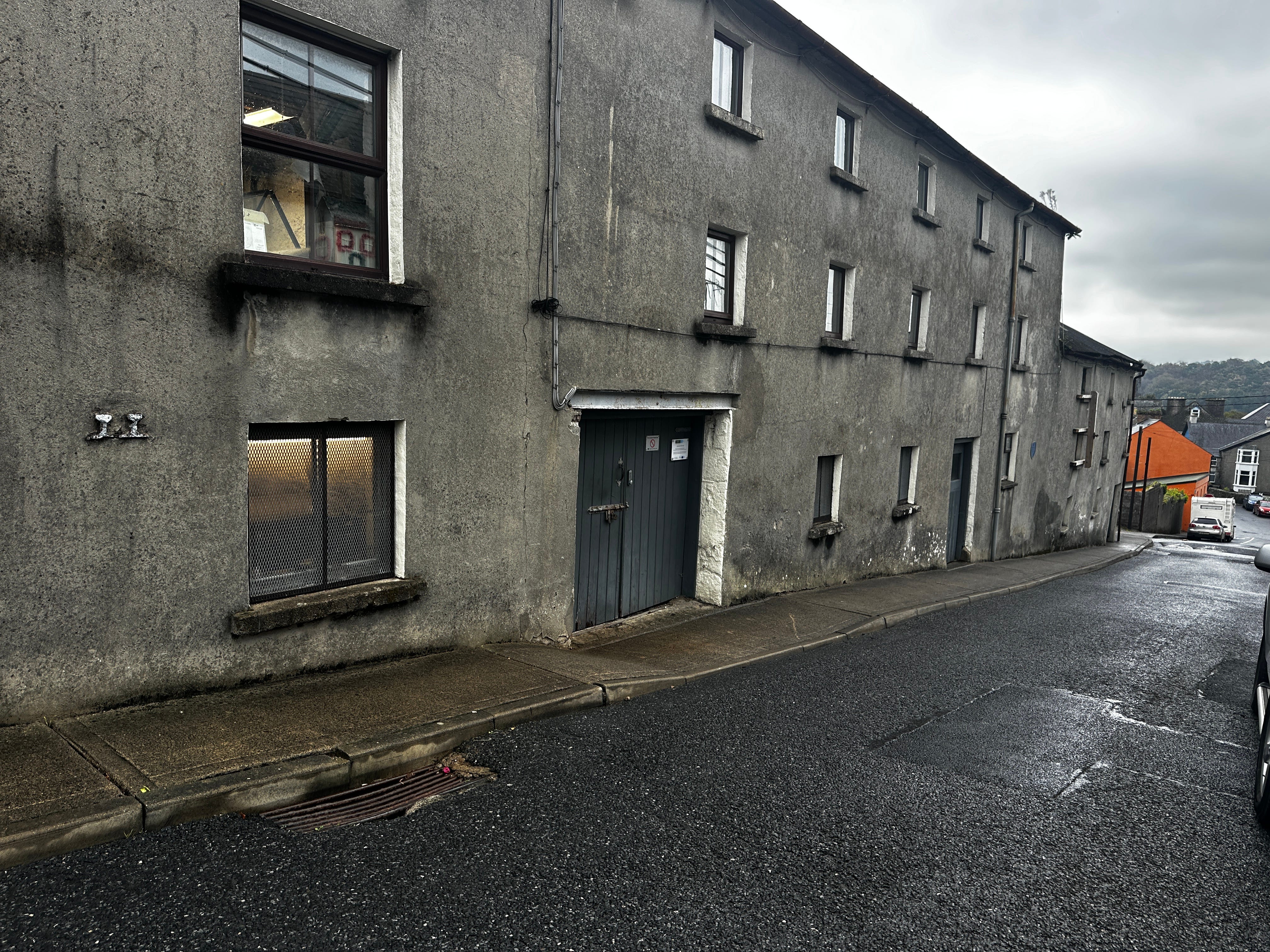
Lyrics created from journal notes and substack story. Suno produced the song.
Studio Notes
I had been waiting for this one because it is special in a way that is hard to explain back home. Walking in the Sandhills we know intuitively that people stood where we are standing long before us, but the history we can actually trace runs about two hundred and fifty years, usually less, seldom more. At Cushendale there has been a woollen mill on the same ground since 1204, when Cistercian monks and the Norman knight William Marshal founded the abbey in what became Graiguenamanagh, the village of the monks. That is provenance, a heritage you can put your hand on, and it lights up my imagination.
I left the house about an hour early thinking I would grab a quick sandwich in town, which I did, though it took longer than I planned, and right about the time I set off on foot the rain started again. I went the wrong direction first and ended up down by the Barrow, so I just walked a big loop around the old abbey grounds and found my way back up the hill, pushing through the door at one minute past two with rain still on my jacket. Trevor met me there. I only had an hour with him, but he is the kind of man I would happily sit down with for a whole afternoon, deeply knowledgeable about weaving and the wool trade and about running a business. It was refreshing to talk with someone who has his hand on the pulse of an artisan business working at their scale.
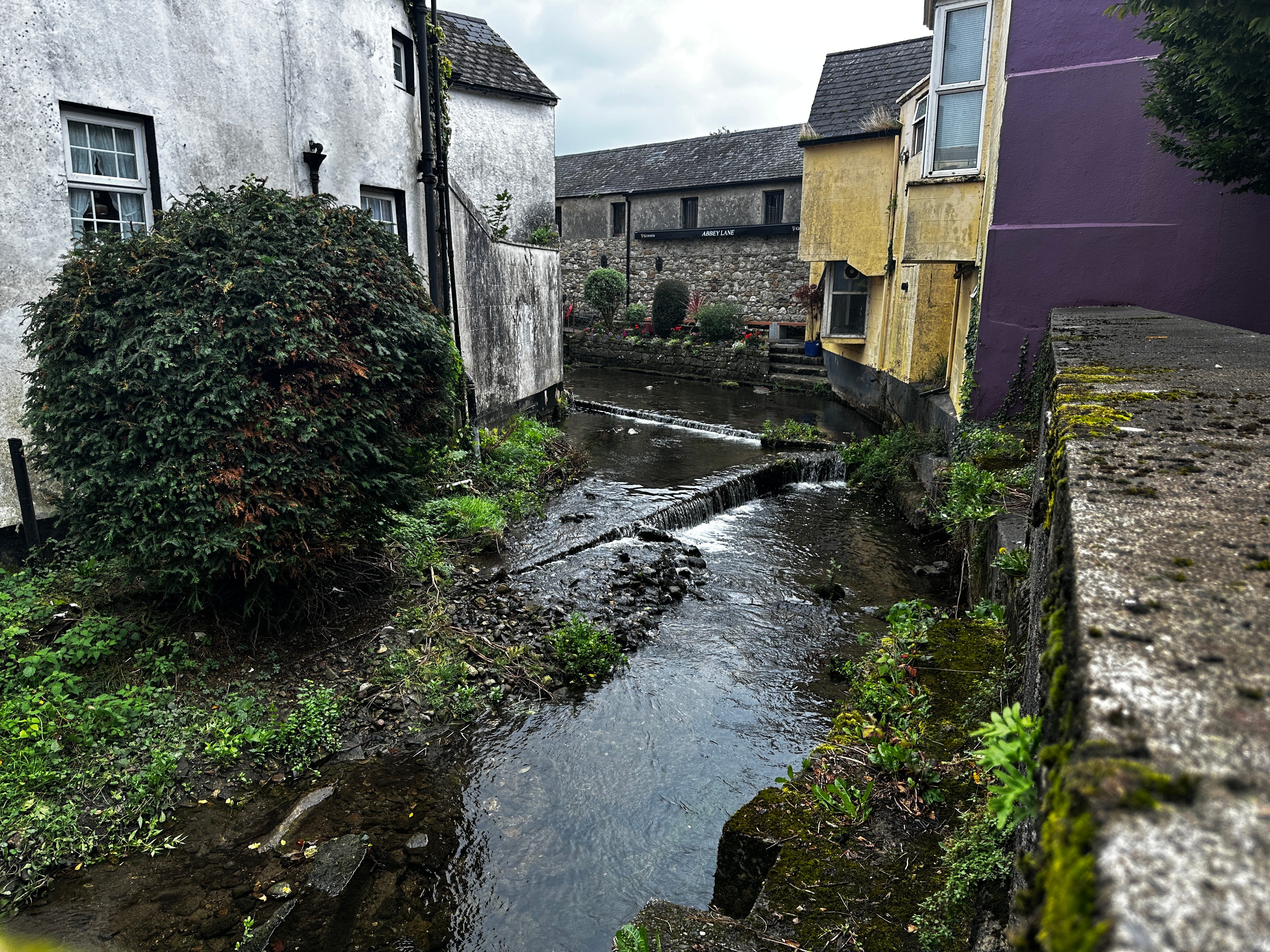
The thing I had been most excited about was the water. The monks cut a channel, the mill race, to bring water down from the Duiske, a small river that comes off Brandon Hill above the town, Trevor thinks close to a mile of it, and I kept picturing them working it by hand with what would have been fairly primitive tools, through heavily forested ground full of stone and bramble. It still runs right outside the mill. You can see it out one of the windows, and I leaned my camera against the glass and took more pictures of it than I needed, because they use that water and only that water for their wet work, and it turns out the water is a good part of why their color looks the way it does.
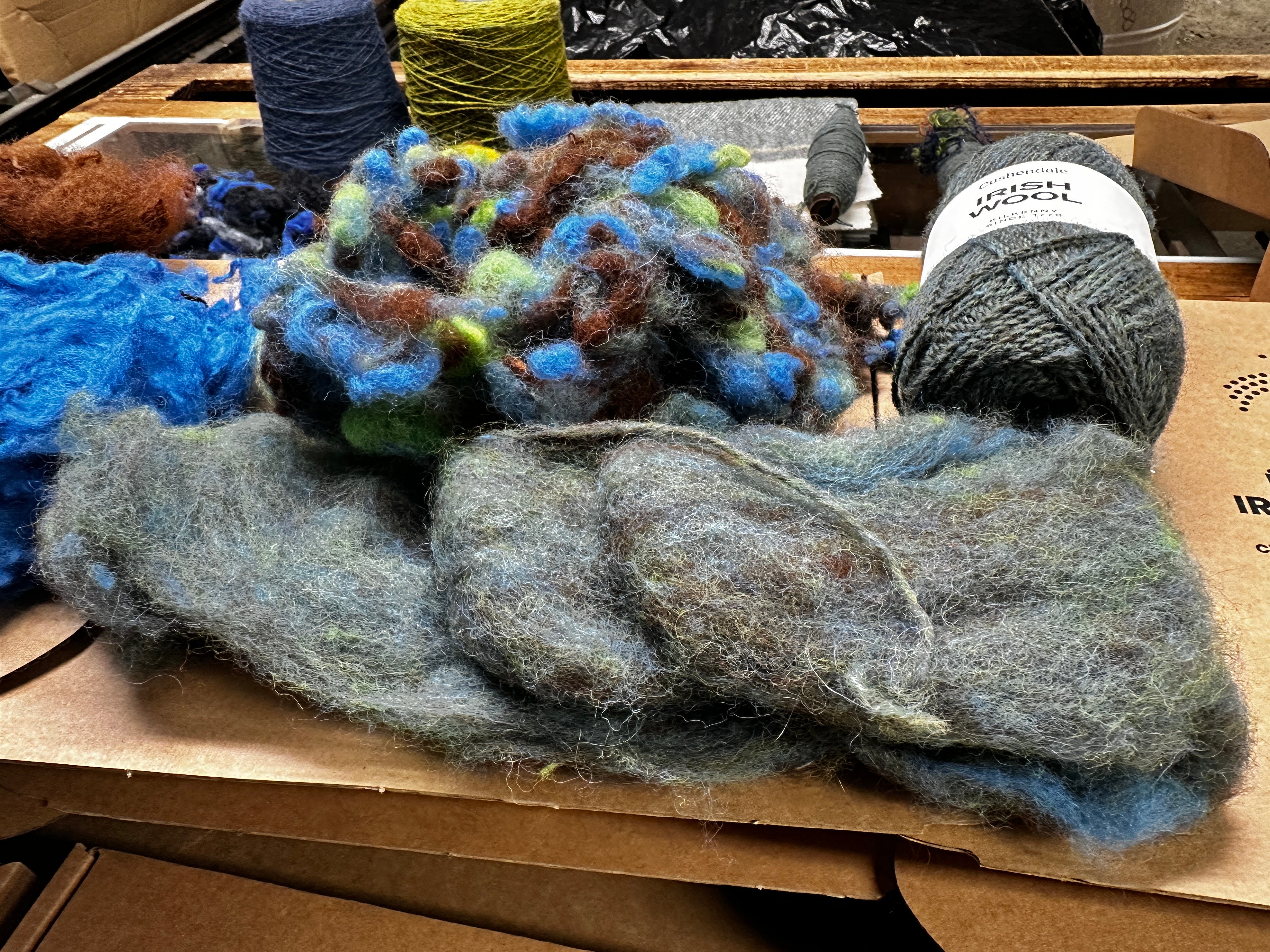
All of the dyeing happens right there in the mill, in batches, and Trevor explained something about it that I have not been able to stop thinking about since. The wool is dyed into a small set of strong, pure colors, and when they want a new shade of yarn they do not mix those colors the way I would mix paint on a palette. They blend the dyed fibers together, and every one of the original colors is still there in the finished yarn, a red fiber lying next to a green one lying next to a yellow, and it is your eye that does the mixing. Up really close it is still a crowd of colors. From a few feet away it is heather, or moss, or whatever that particular blend was meant to become. From there the fibers go through carding and then onto the spinning mule, and the mule is its own history lesson.
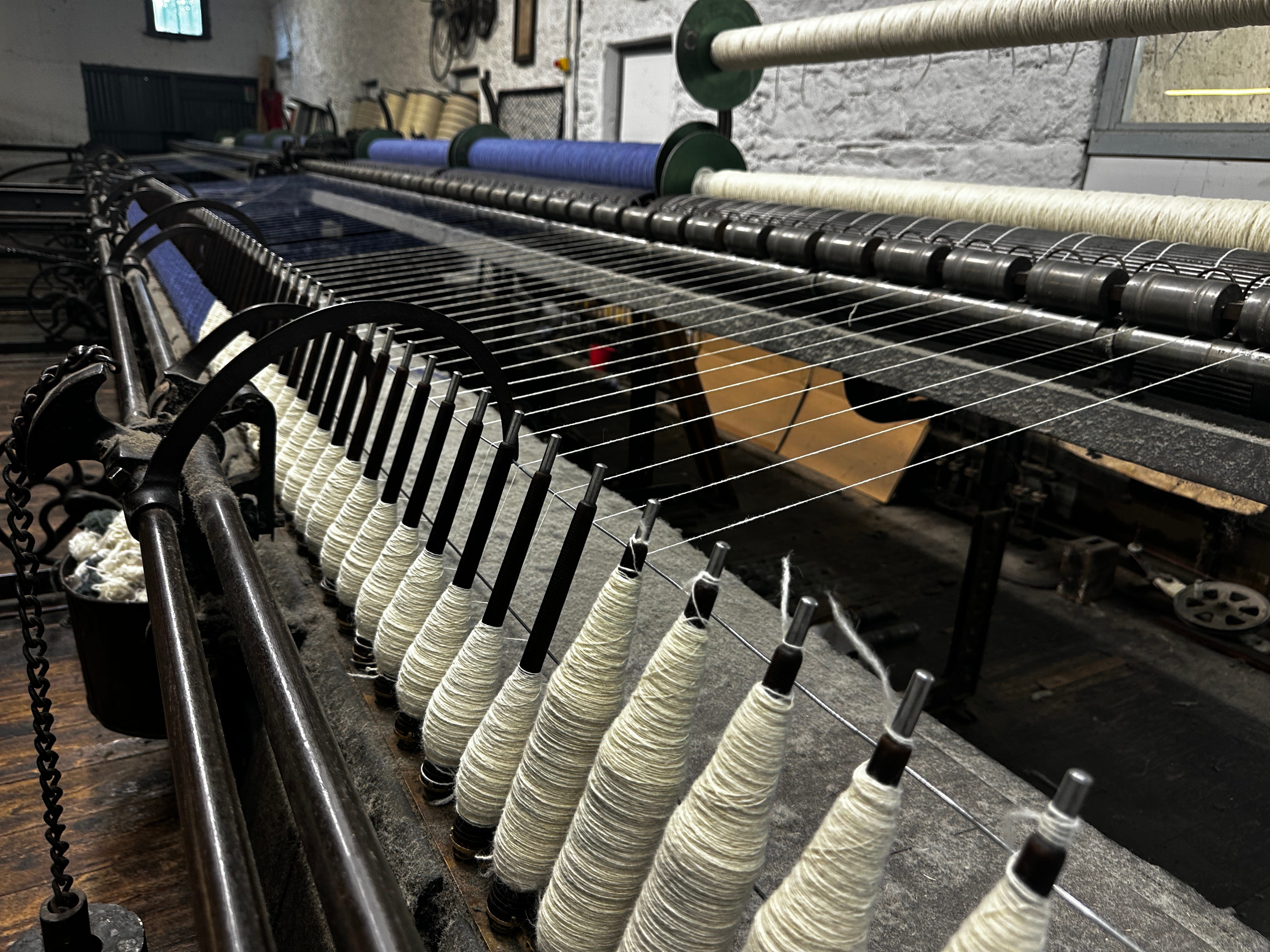
Samuel Crompton worked the mule out in Lancashire in the late 1770s by combining two earlier spinning machines into one, a hybrid, which is where the name comes from, and Philip Cushen has called it less an evolution than a revolution. Theirs was built in 1890, bought by the family from a mill that was closing down, and it is still spinning, one of the last of its kind still working in Ireland. I asked Trevor why a mill that owns two of the newest, largest looms around still runs a machine that old, and his answer was simple enough that I wished I had thought of it myself. At every stage, and there are more than twenty of them between a fleece and a finished blanket, they ask whether a newer machine would make that step any better, and by better they mean one thing, would it improve the quality. Trevor told me Philip has stayed the course for decades by keeping three things in the same order, quality first, then design, then price, and the machines simply fall in line behind that.
For the weaving the answer was that the new looms do the job just as well, so the new looms came in. For the spinning the answer was no, nothing newer matches what the old mule gives them, so the old mule stays, and Philip or one of the other workers still stands beside it watching for the small problems before they turn into big ones. Trevor told me stories, too, one about the more than four thousand scarves they have been making for the Irish government to give as gifts to European dignitaries while Ireland holds the presidency of the EU Council this year, and another about how Cushendale survived when synthetics took over in the late eighties and nineties and the wool market all but disappeared, not just in Ireland but across the UK. I could not keep hold of all of that second story, and I would go back just to hear it again. I did not get the photographs I had hoped for, but I got a few I like, and I walked back down the hill to the car feeling a little like I had been wrapped up in one of their mohair throws.
On the Table
That trick of the eye has a history, and it runs straight through a dye house. In the 1820s the French chemist Michel Eugène Chevreul was put in charge of the dyes at the Gobelins tapestry works in Paris, and the weavers kept complaining that some of his colors, the blacks especially, looked weak and dull in the finished tapestries. Chevreul tested the dyes and found nothing wrong with them. What he found instead was that a color changes depending on what sits beside it, and in 1839 he published a thick book on what he called the simultaneous contrast of colors. Forty-some years later Georges Seurat and Paul Signac read Chevreul and built a whole way of painting out of it, laying down small separate dots and strokes of pure color and trusting the viewer’s eye to blend them at a distance, which is how we got A Sunday on La Grande Jatte and the movement people call pointillism. If you want to geek out the way I did, the whole of Chevreul’s book in its 1861 English translation, all 340 pages of it, is free to download, and I have put the PDF link down in the References.
I have taught that painting and stood in front of reproductions of it more times than I can count, and I never once thought about the fact that the idea began with a man staring at dyed wool. At Cushendale the idea has simply come home, and Jim, who has been their dyer for more than thirty-five years, lifts a blend to the window and knows by looking whether those separate colors will read as the shade he wanted. The philosopher Michael Polanyi wrote that “we can know more than we can tell,” and I suspect Jim could explain a good deal of what he does, but not all of it, and the part he could not explain is the part that took thirty-five years.
In Good Company
Watch: A Cushendale blanket from fleece to finish, a short film with Philip and Miriam Cushen that follows a blanket from Galway sheep through dyeing, the 1890 spinning mule, warping, weaving and finishing. It runs about five minutes, and if you cannot get to Graiguenamanagh anytime soon, it is the nearest thing to standing inside the building.
Read: Chevreul himself, and you can read him for free. The Met holds an original 1839 edition of De la loi du contraste simultané des couleurs, with its colored lithograph plates, as a public domain object you can look through online, and the 1861 English translation, The Laws of Contrast of Colour, is on Project Gutenberg or as a downloadable PDF from the Internet Archive. Look at the subtitle, which lists painting, mosaic work, tapestry and carpet weaving, dress, and flower gardening, and tell me that man was not a maker at heart. For the people side of the story, read Mundy Walsh’s interview with Miriam Cushen, the sixth generation of the family, on growing up in the mill, leaving for a corporate career and coming home, and her grandmother’s rule of doing the right thing because it is the right thing.
Listen: The Lonely Palette, Episode 47: Georges Seurat’s A Sunday on La Grande Jatte. Tamar Avishai’s podcast takes one painting at a time, and this is the painting that took Chevreul’s dye-house discovery and turned it into a million dots. If you would rather stay with the sheep, the History and Heritage Podcast has a short episode, Native Breed Series: The Galway Sheep, on the breed whose fleece goes into Cushendale’s Irish wool, and how close it came to disappearing.
A Quiet Note
If you are ever within a few hours of Graiguenamanagh, call or email Cushendale and go. If you love history, slow making, and the art of handmade things, or if your world runs toward the boutique, the bespoke, or anything made one at a time, it is for you. The photographs I did like from that rainy Tuesday and the painting, along with another version of this visit, are going into Unhurried Letters, which is where the stories that need a slower telling go to live. If that sounds like something you would want in your own mailbox, or in someone else’s, it lives at unhurriedletters.com.
Leave the Light On
I keep thinking about that channel of water sliding past the window while two brand new looms ran a few feet away, and only a few feet from those, a mule well over a century old doing exactly what it was built to do. Nobody at Cushendale is trying to go back to 1204, and nobody is trying to outrun it either. They ask of every step whether the new way would improve the quality or cost them some of it, no matter how much time it might save, and they keep the old way wherever the answer is no, cleaning it, oiling it, standing beside it. The water does not seem to mind at all. That is about as good a picture of slow living as I have found, not a refusal of the new, just a refusal to let go of what still runs.
Keep making, keep growing, be you.
Tio
“Nobody is trying to go back to 1204, and nobody is trying to outrun it either.”
References
Chevreul, M. E. (1839). De la loi du contraste simultané des couleurs. Paris: Pitois-Levrault. Metropolitan Museum of Art, Thomas J. Watson Library. https://www.metmuseum.org/art/collection/search/900717
Chevreul, M. E. (1861). The Laws of Contrast of Colour (J. Spanton, Trans.). London: Routledge, Warne and Routledge. Project Gutenberg. https://www.gutenberg.org/ebooks/76939
Chevreul, M. E. (1861). The Laws of Contrast of Colour [PDF scan, Getty Research Institute]. Internet Archive. https://archive.org/details/lawsofcontrastof00chev Direct PDF download: https://archive.org/download/lawsofcontrastof00chev/lawsofcontrastof00chev.pdf
Polanyi, M. (1966). The Tacit Dimension. University of Chicago Press.
Cushendale Woollen Mills. Medieval History. https://cushendale.ie/pages/medieval-history
Cushendale Woollen Mills. Our Team. https://cushendale.ie/pages/about-cushendale
Cushendale Woollen Mills. Made Slower. https://cushendale.ie/pages/made-slower
Cushendale Woollen Mills. Sustainability. https://cushendale.ie/pages/sustainability
Cushendale Woollen Mills. Fleece to finish film with Philip and Miriam Cushen. YouTube.
Design Ireland. Cushendale Woollen Mills. https://designireland.ie/designers/cushendale-woollen-mills
Walsh, M. Weaver and Textile Designer Miriam Cushen [Interview].

Echo Live (2026, March 11). Government to spend €135k on wool scarves to give as gifts during EU presidency. https://www.echolive.ie/nationalnews/arid-41808254.html
Wikipedia. Spinning mule. https://en.wikipedia.org/wiki/Spinning_mule
Avishai, T. (2020, April 13). Episode 47: Georges Seurat, A Sunday on La Grande Jatte. The Lonely Palette. http://www.thelonelypalette.com/episodes/2020/4/13/episode-47-george-seurats-a-sunday-on-la-grande-jatte-1884
Blake, L. (2025, July 22). Native Breed Series: The Galway Sheep. The History and Heritage Podcast. https://historyandheritagepod.podbean.com/e/native-breed-series-the-galway-sheep/
Unhurried Letters.
https://unhurriedletters.com/
Nebraska’s One-Room Schoolhouses, Nebraska Life: https://www.nebraskalife.com/blog/post/nebraskas-one-room-schoolhouses
WBUR Here & Now: One-room schoolhouses are still a lifeline for rural communities
Unhurried Letters: https://unhurriedletters.com
One-Click Check-In
If you want to read this later or find other issues, you can find them here or hit subscribe.