
Living by Making | Issue 18
At the Workbench
The robin starts before the sun shows. By the time the sky begins to lighten he has already been at it a while, and the cardinal joins him, and then the mourning doves, and then from the field just down the path comes the meadowlark, that particular flute-like sound that does not belong to any other bird. I have been out here most mornings now, mug in both hands, watching all of this etch itself into the day, the way I had no time to do before. It is my favorite fifteen minutes.
Then the meadowlark stopped.
Not the others, just him. A small quiet gap in the ensemble, and then the rest continued without him. I did not look at the sky. I already knew. When the meadowlark leaves the morning, rain is coming or is already here.
My first feeling was disappointment. I had a list that Tuesday, the good kind, every item something I had been genuinely waiting for a gap in the schedule to finally reach. The woodshop had a full morning in it: sorting through the wood stores stacked on the floor and along the walls, deciding what goes on the rack, what gets set aside for building garden beds, what gets burned or given away. The grapes were overdue for cutting back. There was a stretch of garden bed I had been looking forward to getting my hands into, elderberry to thin, a few hours of that work that feels less like labor and more like a conversation with something that has been patient with you. The rain closed all of it before the first drop fell.
Then came the guilt, which might seem like a strange sequence. We are in a drought. The garden needs this, the yard needs this, the whole ag community around us needs this. Whatever I wanted from the day, the land wanted something else, and the land was right. I reframed, the way you do, told myself the office had things that needed doing, found some equanimity about it. But the thistle was still at the edge of the bed, and the seed heads were still forming, and the clock on that particular problem does not pause for rain.
Field thistle blooms purple. Not the washed-out purple of something ordinary but a deep, architectural color, precise and almost formal, the kind of thing that stops you when you come around a corner and find it unexpectedly. There is an argument for letting it go a few more days. The garden has been hard and unglamorous work for weeks, and something that looks like that feels like a small reward for the effort. I have made that argument to myself before. But I know what comes after. Once those heads mature and the first real sun hits them after a wet spell, the seeds go everywhere. What was one manageable bed becomes a three-year conversation with thistle across the whole yard. The window between beautiful and compounding is genuinely short, and it does not announce itself.
It just closes.
The rain stopped late in the afternoon. I went out with a sharp hoe and cut every thistle at the ground, left everything where it fell except the ones with heads already forming, those I carted off since a cut thistle head can still open and seed if it has come far enough along. The roots stayed in the soil. Then cardboard over the whole bed, weighted at the edges, wet well, and four to six inches of woodchips on top. A few hours of work. By late summer that ground will be ready to plant into. By next spring it should be among the most productive beds I have.
The thistle made it that way. The plant I spent the afternoon cutting down is the reason the soil will be worth planting into.
None of that happens if I wait for a better day.

Under the Surface
In permaculture, thistle is not a weed. It is a reading of the soil. Field thistle grows specifically in compacted, disturbed ground, places where something happened and the soil has not had time to recover. The taproot drives straight down through hardpan clay, and when the plant dies, that root decomposes in place and leaves behind a channel for water and air to travel deeper than they could reach before. It builds the infrastructure that more complex plants will need later. It shows up for the hard early work, does what only it can do, and is said to disappear on its own once the job is done.
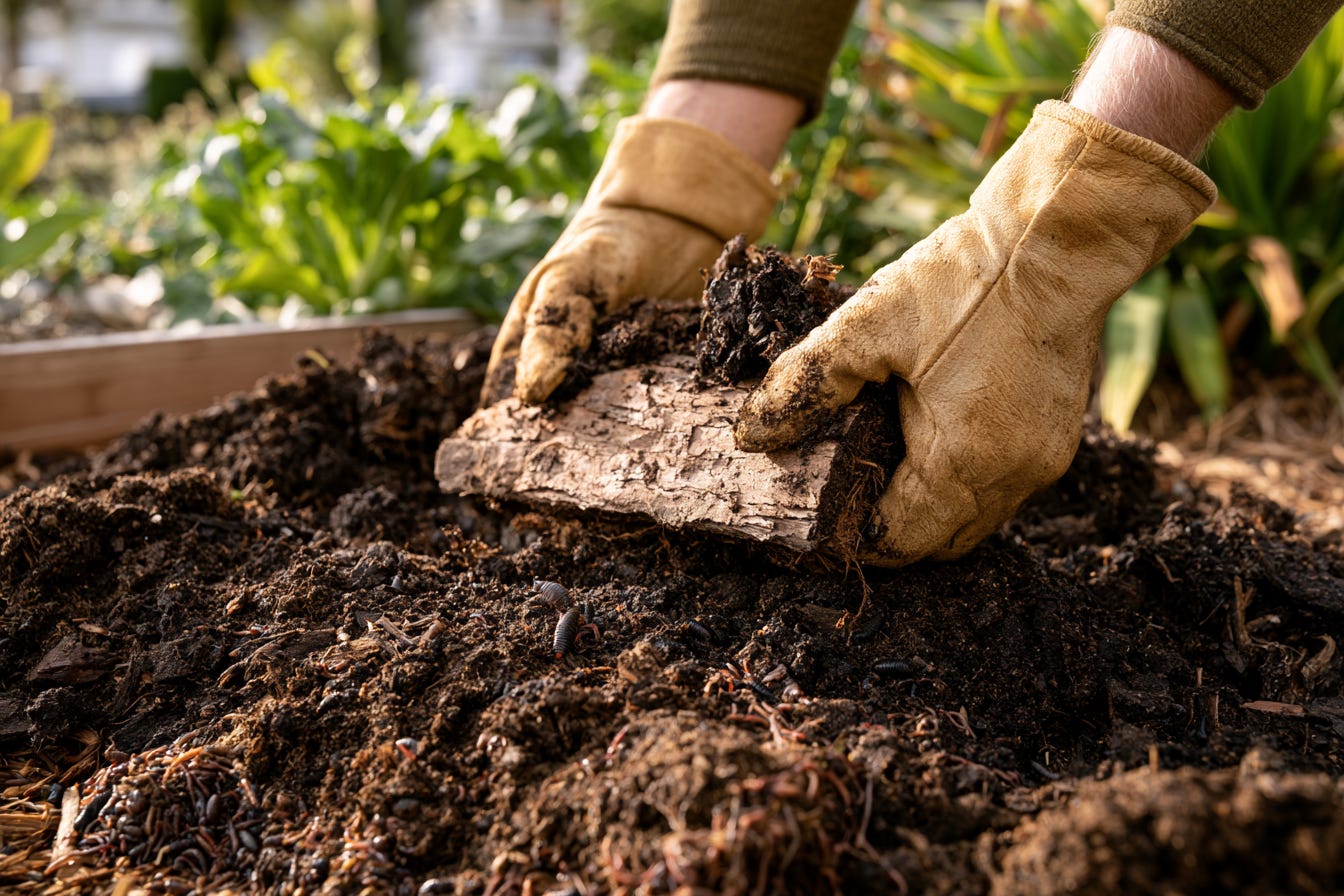
I got a look at what that work actually produces when I moved a few small logs left in one corner of that same bed last fall, remnants of a diseased almond tree I cut down. Three or four logs, maybe three or four inches across, tucked into a two-foot patch while the thistle grew up all around them. When I lifted them out, the soil underneath was black. Not just dark, but that deep, living black that means something has been happening there in the quiet, roly-polys scattering, centipedes moving fast toward the edges, worms, small spiders, all of it suddenly exposed and going about its work in every direction. That small corner, untouched and left alone, had already become something. The rest of the bed was still compacted. That patch was ready.
Ecologists call the larger process succession. Pioneer plants are the first stage, not the destination. They are the work that makes everything else possible, and they do it whether or not anyone is watching.
Every space I work in right now is in pioneer conditions. The woodshop, the metal shop, the studio, the yard, all of the beds. None of them where I want them yet. What is strange about standing in the middle of all this is that I have done most of it before, decades of it, studios built and gardens kept and workspaces made functional. The pioneer conditions have nothing to do with inexperience. They have to do with disturbance, with what happens when something in the shape of a life shifts significantly enough that the ground needs to be read again from the start.
Retirement is a disturbance event. A real one. So is a daughter’s wedding, aging parents that require help, an autistic son going through a rough season. The soil of a life compacts gradually, maintenance deferred a little at a time while the one thing that needs everything gets everything. And then the constraint lifts. The shape of the day opens. What you find underneath is not a blank slate. It is ground that has been through something and is ready, now, to be worked with again. The tangle is not evidence of failure. It is the first stage of the repair.
The thistle does not mean the garden is ruined. It means the garden is ready to come back.
And the flower is real. The beauty of it is not incidental. Something doing hard, unglamorous work in damaged soil produces a bloom worth stopping for. The impulse to stay with it a few more days is not wrong. It just has to be honest about the clock. The cost of waiting is not paid now. It is paid later, quietly, by a future version of you working through a yard full of thistle you could have managed in a single afternoon.
Studio Notes
I went into the studio once this week. Once, in a week that ran closer to forty hours of physical work in the woodshop and the garden. There is a quality to how the studio feels when you have been away from it, not dramatic, just present, the way a room with unfinished work in it registers somewhere at the edge of your awareness even when you are fully absorbed in something else.
The work outside has been genuinely satisfying. There is real reward in sorting through a stack of wood and making decisions about what it becomes, in cutting thistle at the root, in laying cardboard over ground that is finally getting what it needs. That is true. And the studio is still there, still waiting, and those two things are not in competition. They are both part of the same season.
The woodshop is nowhere near finished. Weeks of work left, equipment to move into position, wall sections to complete, the floor still mostly buried under years of accumulated material. But I can see exactly what it will be. The stove going this fall, the floor worn in the way a workspace gets worn when it is actually being used, working on something unhurried while the light comes through windows that open smoothly because I cleaned the weep holes in June. That is not a fantasy waiting at the end of the real work. That is the succession I am in, and the pioneer stage is happening right now.
Sometimes slow living is the slow work of the studio. Sometimes it is the slower work of earning the conditions for the studio to become what it needs to be. And sometimes it means just living, simply, with quiet contentment while life itself is rearranged by the master Creator allowing for the next season that we can’t see.
On the Table
The kombucha took a hit this week. My SCOBY hotel developed mold, which has happened exactly once in twenty-plus years of fermenting tea, and I had to start over from scratch. New starter, fresh tea, back to the beginning. There is something almost funny about it in the context of everything else happening right now. Pioneer conditions, all the way down. The new batch is going and it will be fine. These things always come back.
A Quiet Note
If any of this resonates, the pioneer conditions and the rebuilding and the longer, slower view of what a creative life actually looks like from the inside, that is the territory Unhurried Letters covers. Once a month: a handwritten story, a fine art print, a recipe card, a postcard. Something made and sent through the mail. The physical counterweight to all the noise.
If you have been thinking about it: unhurriedletters.com.
Leave the Light On
Pioneer plants are not confused about their role. They do not wish they were the oak tree. They do the specific work that only they can do in this particular moment, and then they make room for what comes next.
Whatever stage you are in right now, whether you are cutting things back, lifting logs to see what is already alive underneath, waiting out the rain, or finally in the long middle season of tending something that has taken real hold, you are in the right stage. The sequence is doing what sequences do.
Keep making. Keep growing. Be you.
Tio
Pioneer plants are not confused about their role. They do the specific work that only they can do in this particular moment, and then they make room for what comes next.
One-Click Check-In
If you want to read this later or find other issues, you can find them here or hit subscribe.