
Living by Making | Issue 25
At the Workbench
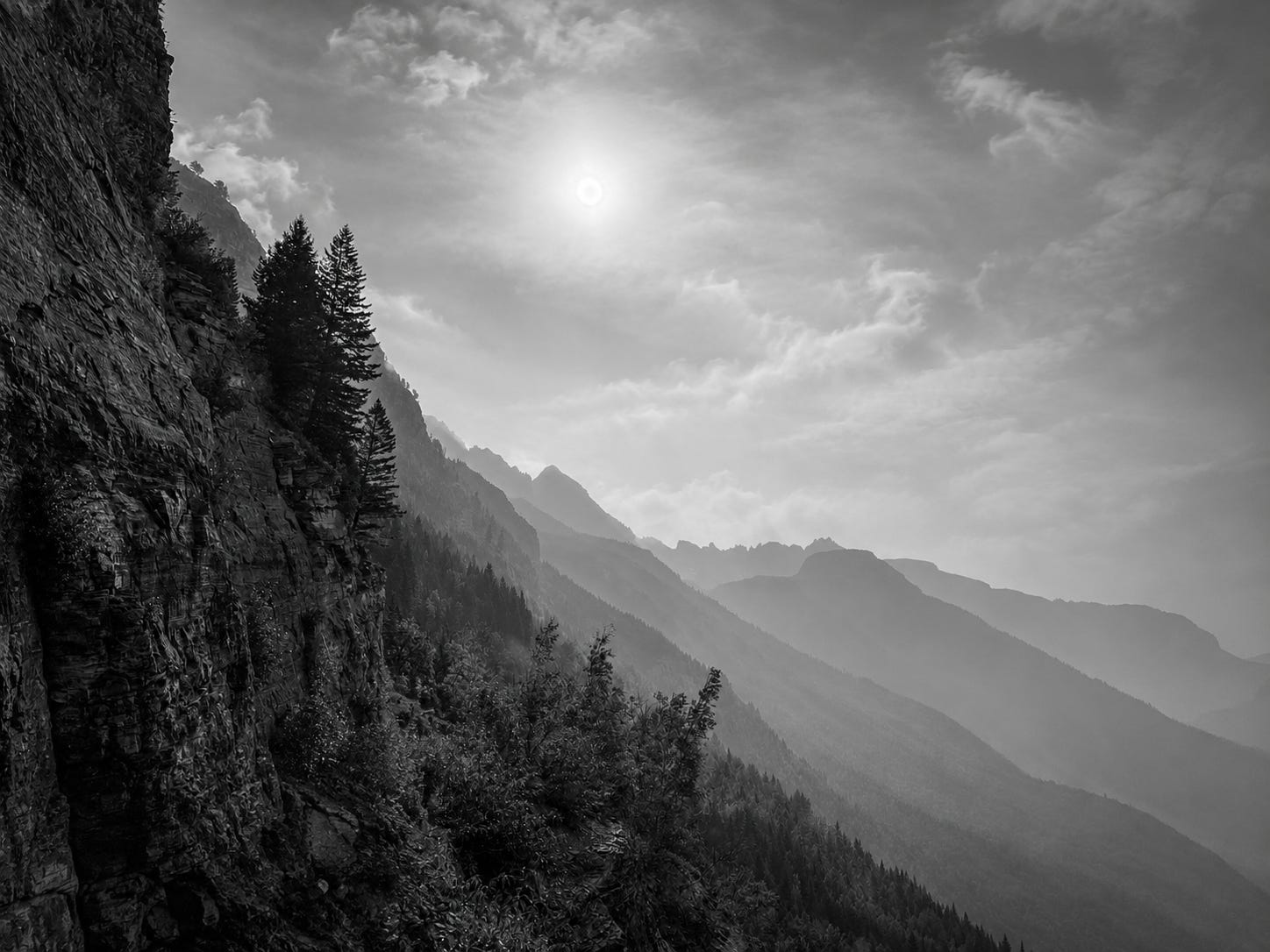
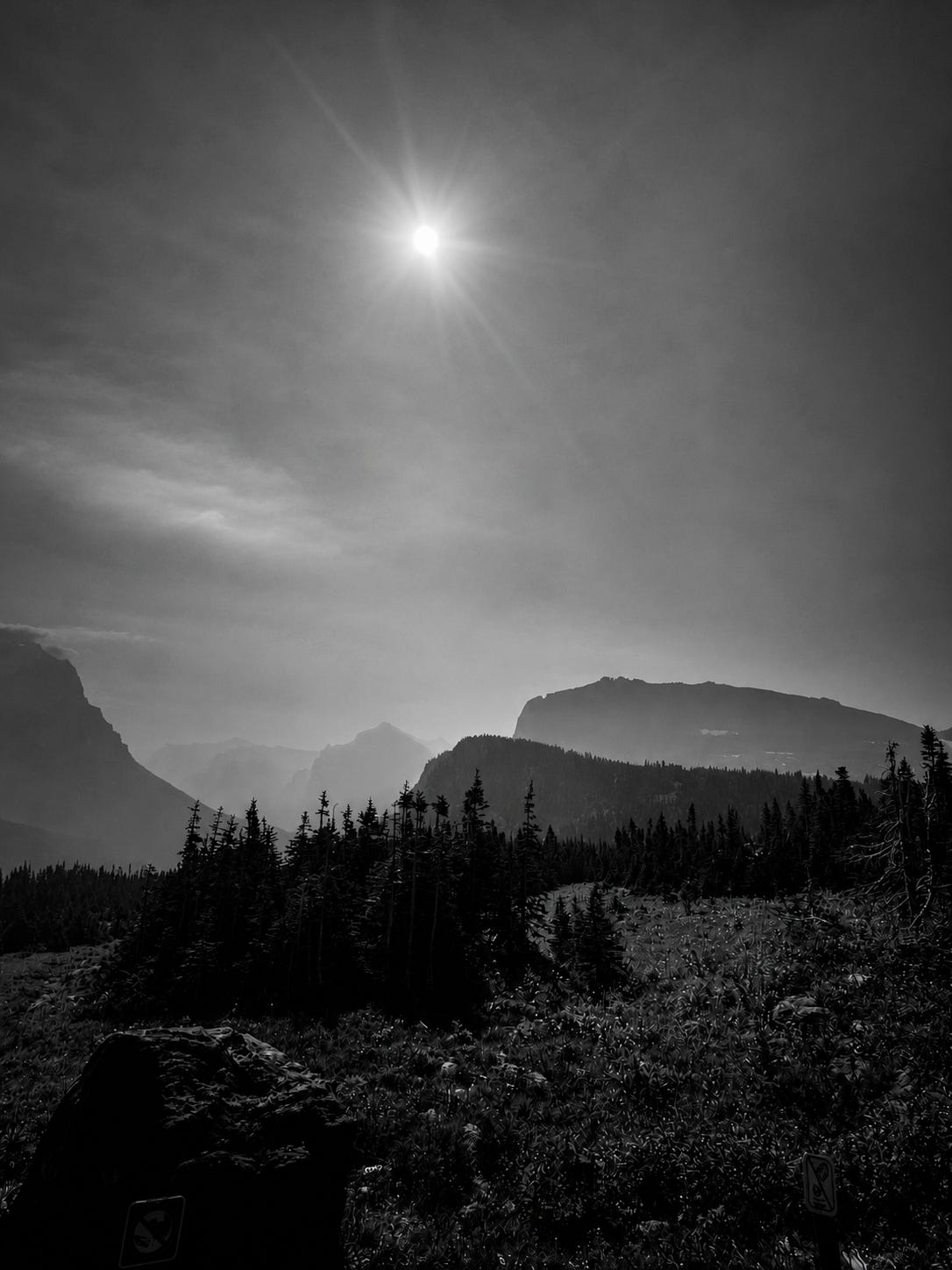
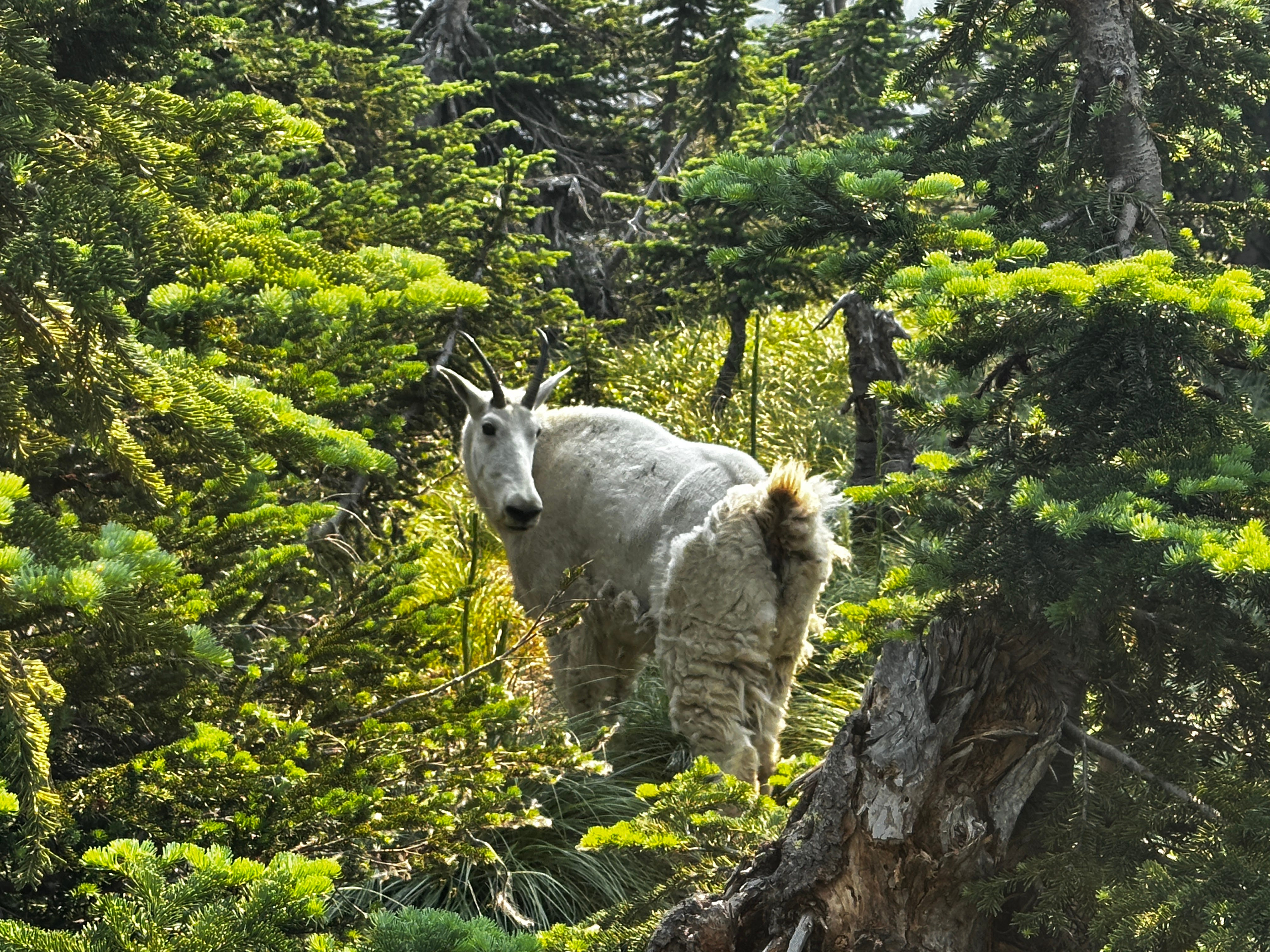
I have never been to Glacier National Park in my whole life, and this week I finally went. Smoke from wildfires burning across the Canadian border hung low over the whole park, softening every peak into something closer to a pencil sketch than a photograph, and it did not matter one bit. We drove by the Weeping Wall and came across Lunch Creek trail. We hiked the short trail up to a waterfall and saw more in half a mile than I expected to see in a full day. A bighorn sheep far off on the mountainside, and separately, much closer, a young mountain goat kid that came close enough to photograph. A hoary marmot sprawled out in the sun like it had nowhere else to be. A young buck still carrying his velvet. A peregrine falcon, a Clark’s nutcracker, a Columbian ground squirrel, a chipmunk small enough to be a rumor. Wildflowers covered the ground the whole way, indian paintbrush and lupine and shrubby penstemon and a dozen others I could not name and did not try to.
We took the Going-to-the-Sun Road east across the park, crossing the Continental Divide at Logan Pass, and came down the other side into the St. Mary Valley for lunch at Two Dog Flats.
Under the Surface
That lunch stop was the first time I actually looked across the valley and realized I was looking at real glacier ice, the thing the whole park is named for. Most of us picture a glacier as some massive, gleaming wall of bright blue ice, the kind you see in documentary footage of Alaska or Antarctica. The ones at Glacier are a bit of a reality check. Sitting high up in mountain bowls, they end up caked in dirt, gravel, and rock dust from grinding against the cliffs around them, so from a couple miles across a valley they look a lot more like a dirty snowpack tucked into a shadow than the postcard version. They shrink down in your vision too, until it is almost hard to believe you are looking at a huge, moving slab of solid ice at all.
What caught me was not just the size of it, once I actually placed it. It was the age. From there my mind kept walking backward on its own, from the ice, to how young the whole colonized world is next to it, to how young America itself is next to that, and finally down to how young I am against all of it. I do not feel my age anymore. Not the way I did driving in, or for that matter, when hiking. I am not in as good of chape as I thought.
I know there is scripture on our own smallness, and philosophers too. Marcus Aurelius wrote something close to this himself, in his own private notebook, centuries before anyone called it a genre. “Asia and Europe”, he said, “are only corners in the universe, every sea a drop in the universe, a whole mountain a clod of earth in the universe, every instant of the present a mere point in eternity”. “Brief is a man’s life”, he wrote, “and small the corner of the earth where he lives, and even the longest fame after death is carried by nothing sturdier than a short chain of people who will not remember much about him either, and who will themselves be gone soon enough”. Out there at Glacier, close enough to touch the wildlife and the wildflowers both, you feel folded into the same living system as everything else rather than just passing through it looking at it.
We kept driving clear to the east side before turning back for Kalispell. Eighty-seven miles out, we stopped for gas at a little roadside stand with a hand painted sign for the Huckleberry Hut.
Studio Notes
Rip, the man running the stand told me it had been a rough year for huckleberries, not many out there this season, and then he told me the fruit itself is something of an anomaly. University botanists have spent years trying to pin down what a huckleberry actually needs to produce on command and still cannot reliably reproduce it outside the specific patch of forest floor it already calls home. Move the plant, change the soil, and it stops producing, almost like it knows the difference between where it belongs and everywhere else. That alone strikes a chord in the slowness of bloom-where-you-are-planted philosophy I like to adopt.
I bought a small container, more out of loyalty than expectation, and told the man I would take them off his hands since nobody else in line seemed to want the last of them. Doc Holliday’s line ran through my head the rest of the drive, I am your huckleberry, and for once it fit two ways at once. I have loved that movie since the first time I saw it, and never expected to actually get to think the line standing at a real huckleberry stand.
I have lived a few days’ drive from Glacier my entire adult life and never once made the trip. Most of those years I was building a business as an artist and entrepreneur, not a teacher. Coaching and teaching only came into the picture the last fourteen years. Either way, a hundred versions of not enough time, and somewhere this beautiful never won the argument against all of it. It took retiring, and a visit to see my daughter that happened to route us through Montana, for me to finally stand in front of it. Nobody rushed me into that, and nobody could have. It arrived exactly when it was ready to arrive, not one trip sooner, the same way a huckleberry only shows up where the ground already knows how to grow it.
On the Table
Carry something small this week, the way a huckleberry insists on its own patch of ground and its own timing, or the way a Roman emperor once used the back pages of a private notebook just to remind himself how small one life actually is. A notecard, a phone note, whatever is already in your pocket. Jot down one thing you notice and cannot fully explain, a plant, a stranger’s habit, a stray thought, and leave it exactly that unfinished. You are not filing it away for later use. You are just proving to yourself that you noticed. It is an easy thing and reminds us of intentional slow living even if only for a moment.
In Good Company
Watch: Goodie to check out this week start with a nod to Betye Saar who died this week at 99. I have loved her spirit and work for a while. Betye Saar: Taking Care of Business, an eight-minute LACMA-produced short filmed inside her Los Angeles studio a few years back. Her gallery announced this week that she died in her sleep at home on July 26, four days shy of her hundredth birthday. She spent seven decades turning found and discarded objects, an old washboard, a broken tool, a cast off photograph, into work that confronted racism and reclaimed her own history one recycled piece at a time.
Read: The dynamic between Stieglitz and O’Keeffe has long been a subject of study and interest for me. Georgia O’Keeffe on why she painted flowers so large. Critics spent decades reading her giant blooms as commentary on women’s sexuality, and she never once agreed with any of it. Most of that seemed to be propagated by Stieglitz, in the beginning for marketing. Her own explanation was simpler. A flower is small, we are always moving too fast to really look at anything, and nobody actually stops long enough to see one honestly. So she painted them the size of a wall, and made whoever stood in front of the canvas slow down and finally give the thing the attention it never got at its actual size. I love the realization of intent through your art. That is cool.
Listen: I love not only huckleberries but just the idea of their slow existence and resilience as well. Huckleberries, Montana’s Little Icons, Retain Their Mysteries, a short Field Notes segment from Montana Public Radio. Nobody is even fully sure which pollinator does the work, the bumblebee is the leading suspect, and every attempt to reproduce that specific wild taste in a cultivated patch has come up short.
Younger Than the Ice-I wrote the lyrics from my journal notes and substack story. Suno produced the song.
A Quiet Note
If the unhurried, own-clock side of things is what you come here for, that is exactly the territory Unhurried Letters lives in. A handwritten story, a fine art print, a recipe card, sent through the actual mail once a month. unhurriedletters.com.
Leave the Light On
Depending on the season you are in right now, some things only arrive once the years are actually right for them. A park you finally reach. A berry that will not be rushed. A life’s work carried in a small notebook clear to the end of it. None of that is late. It is just on time.
Keep making, keep growing, be you.
Tio
“For the entire earth is but a point, and the place of your own habitation but a minute corner in it.” -Marcus Aurelius
References
Marcus Aurelius, Meditations, Book IV, 3, Book VI, 36, and Book III, 10. The closing line and the two ideas worked into Under the Surface, on the smallness of any single life against the size of everything, all come from these three passages.
Georgia O’Keeffe Museum, Access O’Keeffe, the source for the flower passage referenced in Read.
Georgia O’Keeffe Catalogue Raisonne, a second place to find the same material.
Betye Saar: Taking Care of Business, the documentary referenced in Watch.
Huckleberries, Montana’s Little Icons, Retain Their Mysteries, Montana Public Radio, the segment referenced in Listen.
No Taming the Wild Huck, Flathead Beacon, the source for the huckleberry cultivation research mentioned in Studio Notes.
One-Click Check-In
If you want to read this later or find other issues, you can find them here or hit subscribe.